Klipspringer
The klipspringer (Oreotragus oreotragus) is a specialized antelope uniquely adapted for life in the rocky mountains of eastern and southern Africa. Its…
What are the unique physical characteristics of klipspringers?
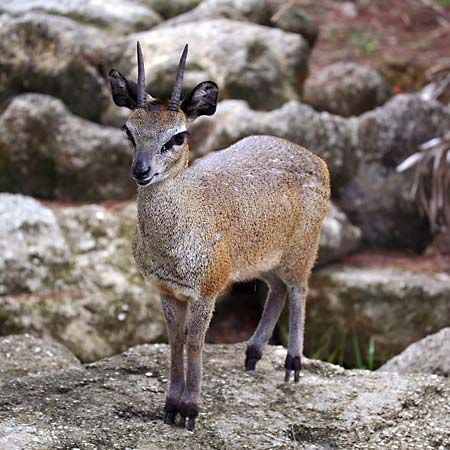
The klipspringer (Oreotragus oreotragus) is a specialized antelope uniquely adapted for life in the rocky mountains of eastern and southern Africa. Its physical characteristics include:
- Hooves: It possesses truncated hooves that allow it to stand on its tiptoes, providing exceptional balance on precipitous slopes and jagged terrain.1
- Coat: The animal has a dense undercoat featuring brittle, air-filled guard hairs, which provide insulation against extreme climates ranging from sea level to 4,500 metres.1
- Build: It has a stocky build with massive hindquarters, a short neck, and a vestigial tail.1
- Coloration: Its grizzled tan, gray, and brown coat serves as camouflage against rocky backgrounds. The only contrasting markings are its large, rounded ears, which are white inside with black margins.1
- Horns: Straight, spike-like horns measuring approximately 10 cm (4 inches) are frequently found on both sexes in Ethiopian and East African populations.1
These adaptations, combined with a bounding gait, enable the klipspringer to navigate difficult landscapes with ease.1
What is the social behavior and mating system of klipspringers?
Klipspringers exhibit a highly specialized social structure and mating system characterized by long-term monogamy and cooperative territorial defense.1
Social Structure and Mating
Klipspringers live in stable, monogamous pairs that maintain a close association throughout the year. This pair bond is reinforced through behaviors such as duetting, where disturbed pairs call to one another, which serves to discourage predators, advertise their presence to others, and strengthen their social connection. Offspring typically remain with the parents until they reach adult size as yearlings, at which point they leave the home territory.1
Territoriality and Defense
Both sexes actively participate in defending their territory, which can range from 8 to 50 hectares depending on local resource availability. They mark their boundaries using:1
- Dung middens: Shared sites used for defecation.1
- Preorbital gland secretions: Both sexes daub tarlike globules of secretion from their facial glands onto twigs at the borders of their territory.1
The male plays a particularly vigilant role in this system. He spends significant time standing sentinel on high promontories, where he can visually advertise the pair’s occupancy and monitor for potential threats. This vigilance provides a critical benefit to the female, as it allows her to spend more time feeding while the male guards the family from predators and rivals. If the male sounds a whistling alarm snort, the female immediately retreats to higher ground for safety.1
What is the scientific classification of the klipspringer?
The scientific classification of the klipspringer is as follows:
- Kingdom: Animalia
- Phylum: Chordata
- Class: Mammalia
- Order: Artiodactyla
- Family: Bovidae
- Tribe: Neotragini
- Genus: Oreotragus
- Species: Oreotragus oreotragus1
The klipspringer is a unique antelope that, while classified within the tribe Neotragini, is considered radically different from other dwarf antelopes. Its genus name, Oreotragus, is derived from New Latin and Greek, meaning “mountain goat,” which reflects its specialized ability to navigate rocky, precipitous terrain.15
How are klipspringers adapted to their rocky habitat?
The klipspringer (Oreotragus oreotragus) is uniquely adapted to thrive in the rugged, mountainous terrain of eastern and southern Africa. Its physical and behavioral traits allow it to navigate precipitous slopes and jagged lava fields with remarkable agility.1
Physical Adaptations
- Hooves: The klipspringer possesses truncated hooves that allow it to stand on its tiptoes, providing exceptional grip on small, rocky surfaces.1
- Body Structure: It has a stocky build with massive hindquarters, a short neck, and a vestigial tail, which contribute to its balance and sure-footedness.1
- Coat: Its dense undercoat features brittle, air-filled guard hairs that provide insulation against extreme temperatures, ranging from sea level to 4,500 meters (14,800 feet). Its grizzled tan, gray, and brown coloration serves as camouflage against rocky backgrounds.1
- Gait: Its specialized bounding gait enables it to outrun predators across difficult, uneven terrain.1
Dietary and Behavioral Adaptations
Klipspringers are highly adaptable feeders, consuming a wide variety of evergreen shrubs, succulents, and herbs. These plants provide all the necessary water, allowing the animals to remain in rocky sanctuaries even in arid conditions.1
Sources
- klipspringer — Encyclopædia Britannica
- klipspringer — Merriam-Webster
- Chemoreception - Territorial behavior — Encyclopædia Britannica
- Animal social behavior - Social interactions involving the costs and benefits of parental care — Encyclopædia Britannica
- Oreotragus — Merriam-Webster
Published on · 3 min read