Royal Antelope
The royal antelope (Neotragus pygmaeus) is the world’s smallest antelope, standing approximately 25 cm (10 inches) tall and weighing between 2.5 and 3 kg…
What is the royal antelope and where is it primarily found?
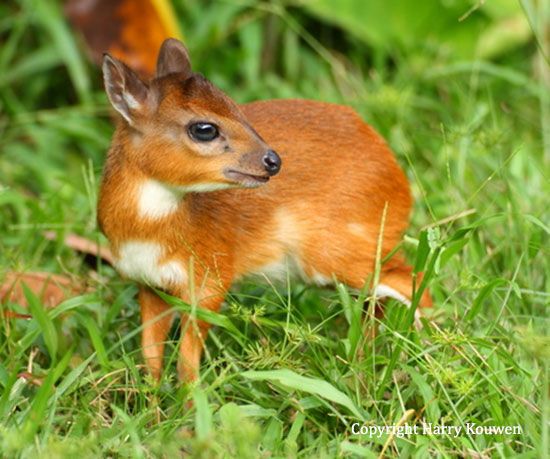
The royal antelope (Neotragus pygmaeus) is the world’s smallest antelope, standing approximately 25 cm (10 inches) tall and weighing between 2.5 and 3 kg (5.5–7 pounds). Often compared to a hare due to its physical build, it features large eyes, a short tail, and overdeveloped hindquarters.1
This species is primarily found in the lowland rainforests and adjacent forest-savanna mosaics of West Africa, specifically in the region stretching from Ghana to Sierra Leone. It prefers dense vegetation where sunlight reaches the forest floor, as well as areas of secondary growth. Despite being locally abundant in some areas, the royal antelope is a secretive, nocturnal animal that is rarely observed by humans.1
What is the diet and feeding behavior of the royal antelope?
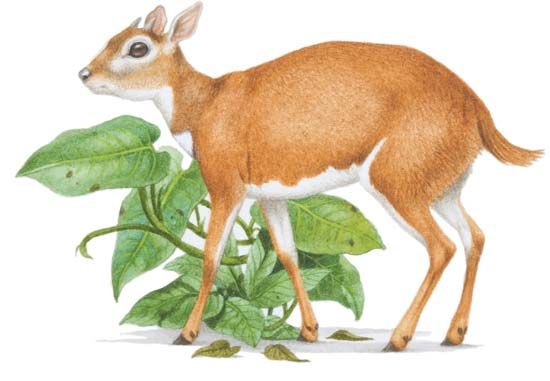
The royal antelope (Neotragus pygmaeus) is a specialized browser, meaning it feeds primarily on the foliage of shrubs and trees rather than grazing on grass. Its physical anatomy is highly adapted for this selective feeding behavior; it possesses a narrow muzzle and a long tongue, which allow it to carefully pick and consume specific plant parts.13
Its diet consists of a variety of vegetation, including:
As a secretive and largely nocturnal animal, the royal antelope inhabits dense vegetation where sunlight reaches the forest floor, as well as areas of secondary growth. While its specific ecological habits are difficult to observe directly due to its elusive nature, it is believed to fill a similar niche to other dwarf antelopes, which are known to be highly selective in their food choices. Like other antelopes adapted to closed habitats, it relies on concealment and quick, dodging movements to navigate through undergrowth while foraging.13
What are the unique physical characteristics of the royal antelope?
The royal antelope (Neotragus pygmaeus) is distinguished by several unique physical characteristics that adapt it to life in dense forest environments:
- Size: It is the world’s smallest antelope, standing approximately 25 cm (10 inches) tall and weighing between 2.5 and 3 kg (5.5–7 pounds).
- Hare-like Build: It shares many physical traits with a hare, including overdeveloped hindquarters and hind legs that are nearly twice as long as its forelimbs. This anatomy supports a bounding, dodging run used to navigate through thick undergrowth.
- Facial Features: The animal possesses large eyes, small but transparent ears, and a narrow muzzle.
- Coat and Markings: Its coloration is red- or golden-brown, complemented by a rufous collar and white underparts, chin, and undertail.
- Horns: While females are slightly larger than males, only the males possess horns. These are short (2.5–3 cm), sharp, and back-slanted spikes.
These features, combined with its small stature, allow the royal antelope to remain elusive and effectively conceal itself within its habitat.1
How does the royal antelope’s size compare to other antelope species?
The royal antelope (Neotragus pygmaeus) holds the distinction of being the world’s smallest antelope, representing the extreme lower end of the size spectrum within the family Bovidae.13
To understand its size relative to other species, consider the following comparisons:
- Weight: The royal antelope typically weighs between 2.5 and 3 kg (5.5–7 pounds). In contrast, the largest antelope species, the giant eland, can weigh over 1,000 kg (2,200 pounds), making it hundreds of times heavier than the royal antelope.132
- Height: Standing approximately 25 cm (10 inches) at the shoulder, the royal antelope is roughly the size of a hare. Larger antelopes, such as the eland, can reach shoulder heights of up to 180 cm (6 feet).13
- Comparison within the Tribe: The royal antelope belongs to the tribe Neotragini, which includes other small species like dik-diks, klipspringers, and oribis. While these are all considered dwarf antelopes, the royal antelope remains the smallest among them, with the dwarf antelope (Neotragus batesi) being only slightly larger.12
This diminutive size is a specialized adaptation for life in dense rainforests, where the animal relies on concealment and agility to navigate through thick undergrowth, rather than the speed and size required by open-habitat species.125
Sources
- royal antelope — Encyclopædia Britannica
- royal antelope — Merriam-Webster
- antelope — Encyclopædia Britannica
- artiodactyl - Food habits — Encyclopædia Britannica
- What is the difference between a pronghorn and an antelope? — Encyclopædia Britannica
- What is the largest antelope? — Encyclopædia Britannica
Published on · 3 min read