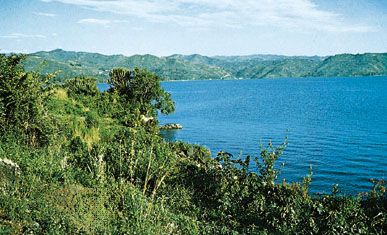
Lake Albert
Lake Albert is located within the Western Rift Valley, a major branch of the East African Rift System. This rift system has been forming for approximately 30…
What is the geological history of Lake Albert and how was it formed?
Lake Albert is located within the Western Rift Valley, a major branch of the East African Rift System. This rift system has been forming for approximately 30 million years as the African and Arabian plates separated.1
The lake itself attained its present form primarily due to earth movements during the Pleistocene Epoch, which occurred roughly 2.6 million to 11,700 years ago. Because the lake rests within this active rift, its formation postdates the surrounding landscape. While many lakes in the rift system are deep and fjordlike, Lake Albert is relatively shallow, with a maximum depth of 190 feet (60 meters). This shallowness is attributed to the accumulation of thick layers of sediment on the lake floor. Throughout the Pleistocene, fluctuating climate conditions caused the lake’s water levels to rise and fall, as evidenced by the presence of raised beaches.231
How does Lake Albert contribute to the Nile River system?
Lake Albert serves as a vital reservoir and transit point within the Nile River system. Its contribution to the river’s flow is defined by the following processes:
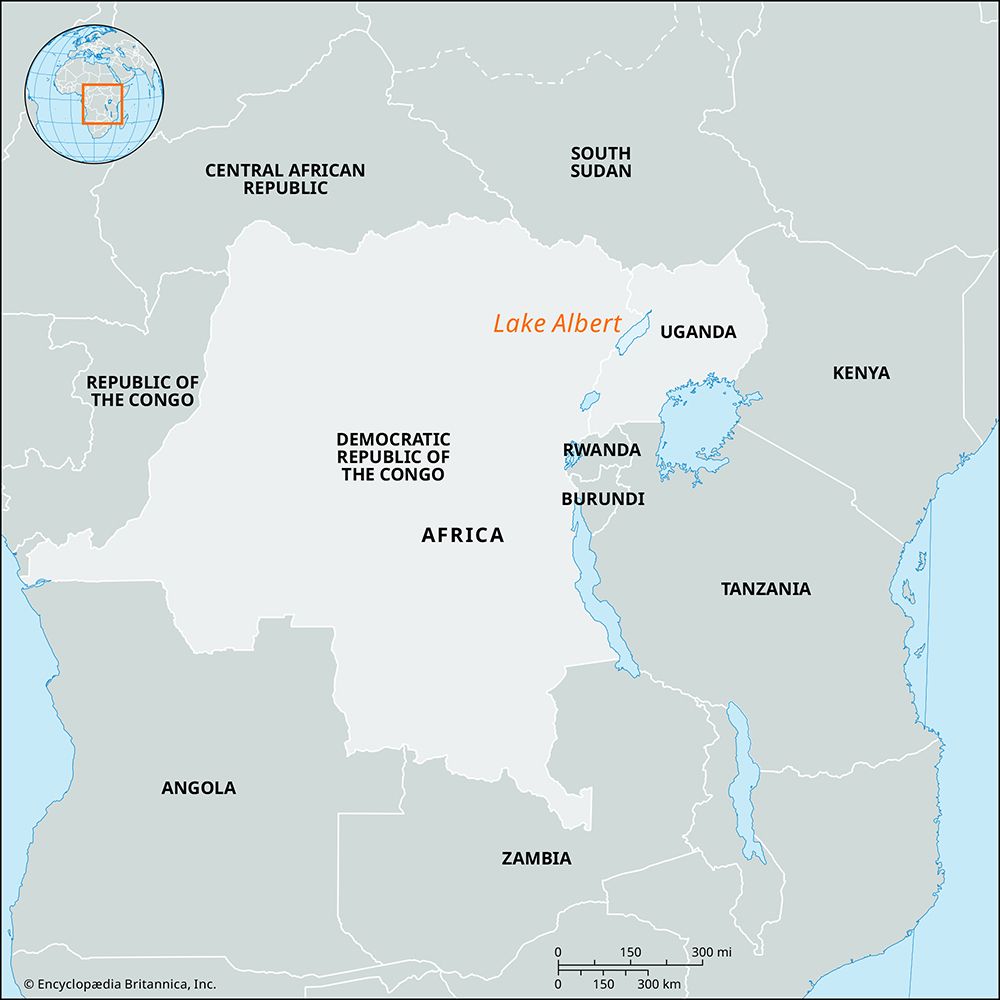
- Inflow: The lake receives significant water from the Victoria Nile, which enters the northern end of the lake after descending from Murchison Falls. Additionally, the Semliki River flows into the lake from the southwest, bringing water from Lake Edward and the Ruwenzori Range.516
- Outflow: The waters of the Victoria Nile and the Semliki River unite within Lake Albert before exiting at the northern end as the Albert Nile. This section of the river then continues northward to supply the White Nile.51
- Hydrological Balance: While Lake Albert experiences high rates of evaporation due to the hot climate of the Western Rift Valley, these losses are balanced by rainfall and the inflow from its tributaries. Consequently, the lake maintains a consistent annual outflow of approximately 918 billion cubic feet into the Nile system.57
What kinds of wildlife and fish species can be found in and around Lake Albert?
Lake Albert supports a diverse array of wildlife and fish species, benefiting from its connection to the Nile River system.
Fish Species
The lake’s fish population is closely related to that of the Nile, featuring several prominent species:
- Nile perch: A major predator found in the lake.91
- Tiger fish: Including the genus Alestes, which accounts for a significant portion of the total commercial catch on the Ugandan shores.91
- Bichir (Polypterus): A primitive, ray-finned fish found in the lake’s waters.9
While the lake supports a productive fishery, it is believed that current catches remain below the maximum sustainable yield.1
Terrestrial and Aquatic Wildlife
The areas surrounding Lake Albert, particularly the Semliki Plains and the northern shores near Murchison Falls, are home to abundant game, including:
- Large Mammals: Elephant, buffalo, and various species of antelope are frequently seen in the region.910
- Aquatic Wildlife: The hippopotamus is ubiquitous along the lakeshores, and the crocodile is also widespread in the area.910
The lake’s ecology is further enriched by a variety of resident and migrant birds, including fish-eating species such as cormorants, darters, and kingfishers.9
What role did Lake Albert play in early European exploration of Africa?
Lake Albert played a pivotal role in the 19th-century European quest to identify the sources of the Nile River. Its discovery was a critical milestone in filling the gaps left by earlier expeditions that had identified Lake Victoria as a primary source.
- Initial Discovery: In 1864, the English explorer Sir Samuel White Baker, accompanied by his wife Florence von Sass, became the first Europeans to reach the lake. Acting on information provided by John Hanning Speke and James A. Grant, the Bakers approached from the north and named the lake in honor of Queen Victoria’s consort.11112
- Mapping and Exploration: Following its discovery, the lake became a focal point for further geographical mapping. Romolo Gessi circumnavigated it in 1876, and later expeditions, including those led by Henry Morton Stanley, helped clarify the region’s complex hydrology, including the connection to the Semliki River and Lake Edward.111312
- Strategic Significance: Beyond exploration, the lake served as a base for colonial administration and military efforts. Both Stanley and Mehmed Emin Pasha established forts on its shores, and the lake region became a site for efforts to suppress the slave trade and manage regional political instability.11131
Sources
- Lake Albert — Encyclopædia Britannica
- East African lakes - Geology, climate, and hydrology — Encyclopædia Britannica
- East African Rift System — Encyclopædia Britannica
- Albert, Lake — Merriam-Webster
- Semliki River — Encyclopædia Britannica
- Nile River - Physiography of Nile River — Encyclopædia Britannica
- Nile River - Climate and hydrology — Encyclopædia Britannica
- East African lakes - Physiography — Encyclopædia Britannica
- East African lakes - Plant and animal life — Encyclopædia Britannica
- East African lakes - Resource exploitation — Encyclopædia Britannica
- Nile River - Study and exploration — Encyclopædia Britannica
- Sir Samuel White Baker — Encyclopædia Britannica
- East African lakes - Study and exploration — Encyclopædia Britannica
Published on · 3 min read