Lake Mai-Ndombe
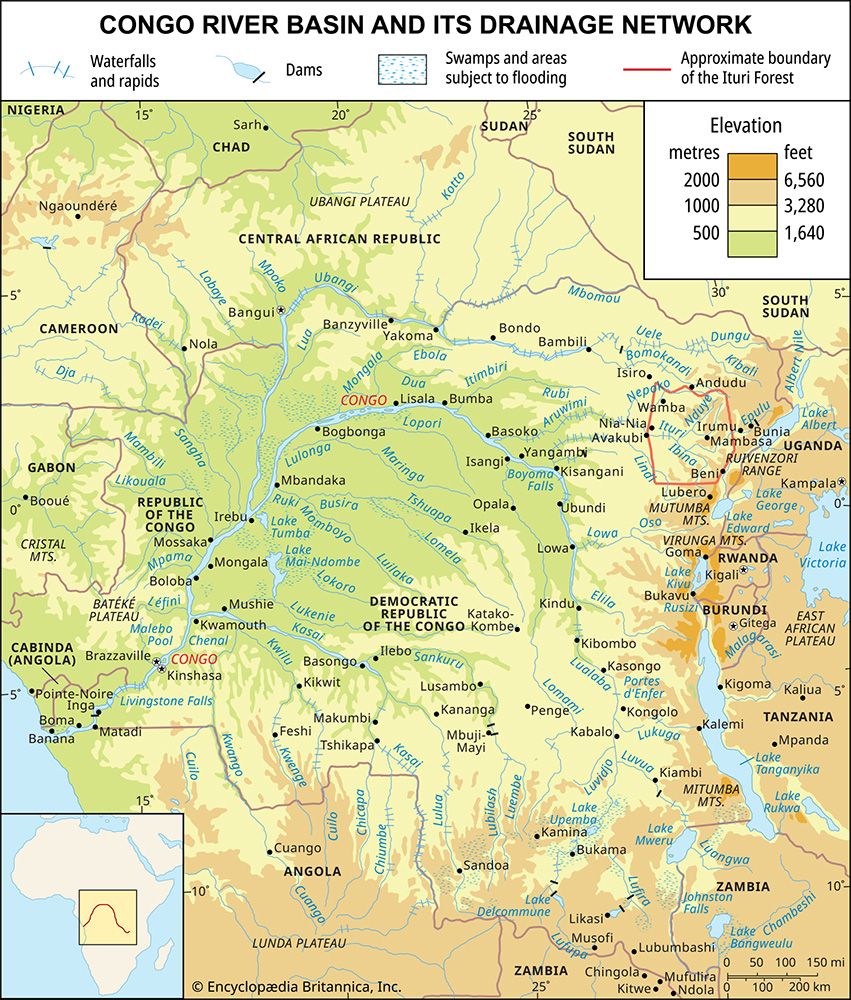
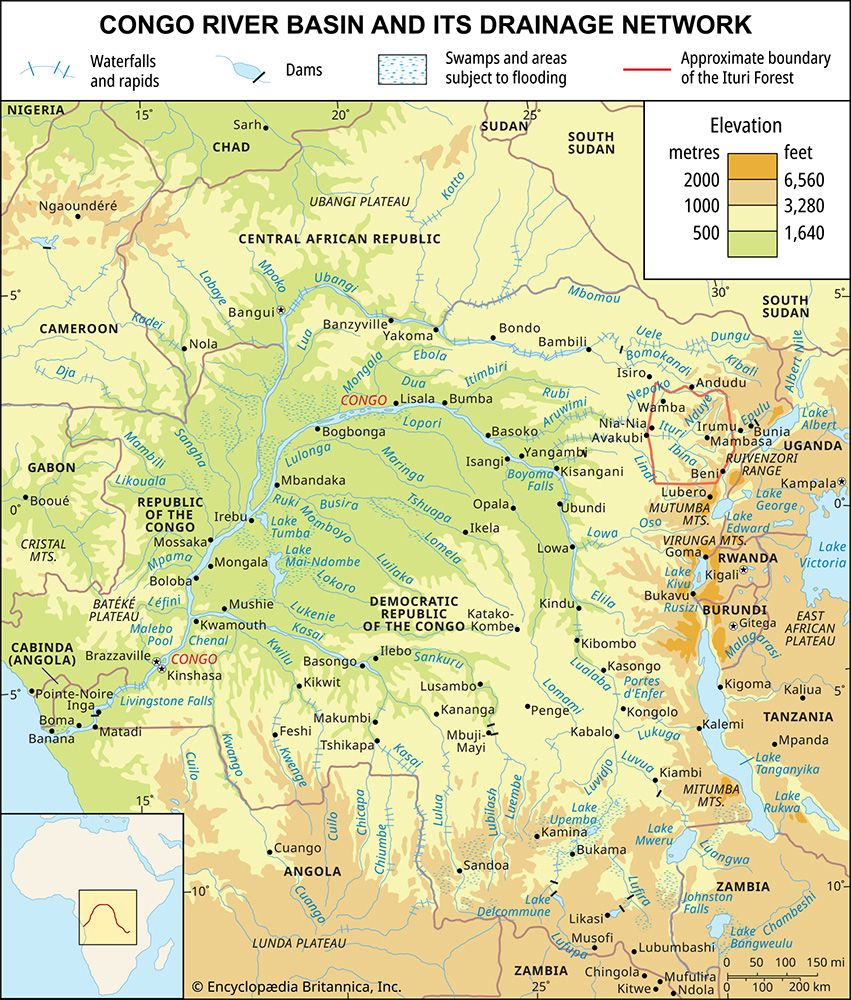
Lake Mai-Ndombe is a large, shallow lake located in the western region of the Democratic Republic of the Congo. Situated east of the Congo River and south of…
What is Lake Mai-Ndombe?
Lake Mai-Ndombe is a large, shallow lake located in the western region of the Democratic Republic of the Congo. Situated east of the Congo River and south of Lake Tumba, it is characterized by its irregular shape and low, forested shores.1
While it typically covers about 890 square miles (2,300 square km), its size is highly variable, often doubling or tripling during the rainy seasons. The lake drains southward via the Fimi River into the Kasai River, and its primary port is the town of Inongo on the eastern shore. Formerly known as Lake Leopold II, the lake was first reached by a European in 1882 when the explorer Henry Morton Stanley arrived at its shores.12
How does the Congo River influence the surrounding ecosystem?
The Congo River acts as the primary drainage system for the Congo basin, a vast region that supports the world’s second-largest rainforest. Its influence on the surrounding ecosystem is profound and multifaceted:
- Hydrological Regulation: The river’s regular flow, fed by year-round equatorial rains, sustains a dense network of tributaries and swamps. This constant water supply maintains the humidity and high temperatures necessary for the equatorial forest, while river valleys provide rich, fertile alluvial soils that contrast with the more erosion-prone soils of the surrounding savanna regions.3456
- Distinct Ecological Milieu: The Congo and its tributaries form a unique aquatic environment. The riverine system supports a diverse array of life, including over 230 species of fish in the Malebo Pool alone, as well as reptiles like crocodiles and semiaquatic tortoises.7
- Habitat Diversity: The river creates specialized niches, such as wooded marshlands and riverine swamps. These areas host unique adaptations, such as lungfish that survive dry periods in mucus cocoons and black catfish that have evolved to match the dark, tea-colored water of the marshes.7
- Wildlife Support: The basin serves as a critical corridor for birdlife, including indigenous forest species and migratory birds from Europe. Aquatic mammals, such as the hippopotamus and manatee, also rely on these waterways.7
What makes Lake Tumba similar to Lake Mai-Ndombe?
Lake Tumba and Lake Mai-Ndombe share several key geographical characteristics as part of the Congo River basin:
- Physical Features: Both lakes are characterized by their shallow depths and low, forested shores.91
- Location: They are both situated in the western region of the Democratic Republic of the Congo, relatively close to one another in the central basin.91
- Hydrology: Both lakes are integral parts of the Congo River’s vast drainage system, with their water levels and surface areas influenced by the region’s tropical climate and seasonal rainfall.91
- Navigation: Both bodies of water are navigable by river steamer, reflecting their role as accessible features within the broader river network.91
Why do tropical lakes change size during rainy seasons?
Tropical lakes change size primarily due to the hydrologic balance between water inputs and outputs, which are driven by meteorological factors.4
- Precipitation and Evaporation: Lake levels typically rise following seasons of high precipitation and fall during seasons of high evaporation. In tropical regions, these seasonal patterns are often pronounced, leading to significant fluctuations in water volume and surface area.411
- Drainage Basin Dynamics: For lakes connected to river systems, the timing of rainfall across the entire drainage basin is critical. The full effect of heavy rains may not be immediate, as it takes time for water to travel through tributaries and reach the lake. In some cases, such as the Congo River system, the rise and fall of water levels are influenced by the complex interaction of multiple tributaries, which may arrive at different times and modify the lake’s level.4512
- Environmental Factors: Other factors, such as the blocking of outlets by floating vegetation or changes in atmospheric pressure, can also contribute to variations in water levels. Additionally, lakes in drier regions are generally more sensitive to these seasonal shifts than those in consistently wet environments.511
Sources
- Lake Mai-Ndombe — Encyclopædia Britannica
- Mai-Ndombe, Lac — Merriam-Webster
- Congo basin — Encyclopædia Britannica
- Congo River - Hydrology of the Congo River — Encyclopædia Britannica
- Democratic Republic of the Congo - Drainage and soils — Encyclopædia Britannica
- Congo River - Animal life — Encyclopædia Britannica
- Congo River: Top Questions — Encyclopædia Britannica
- Congo River - Climate — Encyclopædia Britannica
- Lake Tumba — Encyclopædia Britannica
- Congo River - Physiography — Encyclopædia Britannica
- lake - Water level fluctuations — Encyclopædia Britannica
- Amazon River - Hydrology of the Amazon River — Encyclopædia Britannica
- Ubangi River — Encyclopædia Britannica
- river - Floodplains — Encyclopædia Britannica
- 6 Lakes That Are Drying Up — Encyclopædia Britannica
Published on · 3 min read