Lake Tumba
Lake Tumba is a shallow lake located in the northwestern region of the Democratic Republic of the Congo. As part of the Congo River basin, it covers…
What is Lake Tumba?
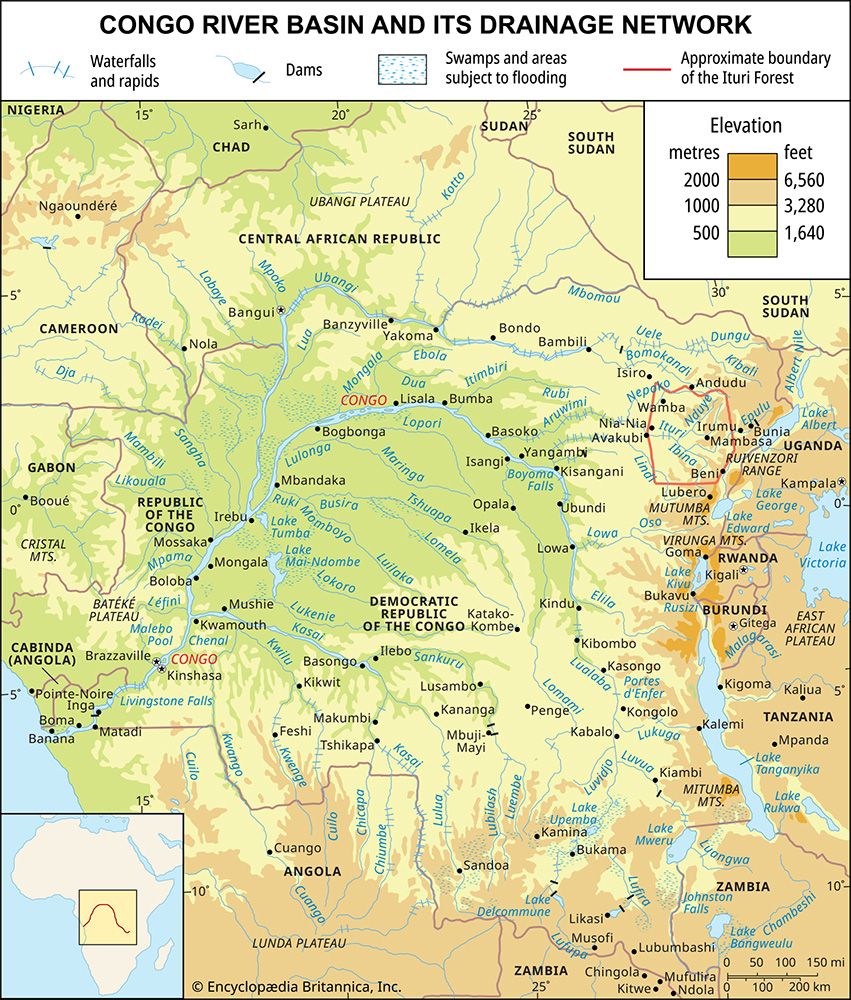
Lake Tumba is a shallow lake located in the northwestern region of the Democratic Republic of the Congo. As part of the Congo River basin, it covers approximately 190 square miles (500 square km) and features a depth ranging from 6 to 20 feet (2 to 6 meters).1
The lake is characterized by its low shores and is navigable by river steamer. It connects to the Congo River via the Irebu channel, situated directly opposite the confluence of the Congo and Ubangi rivers. Additionally, it is located about 75 miles (120 km) northwest of Lake Mai-Ndombe.1
What is the Congo River basin?
The Congo basin is the vast hydrographic region drained by the Congo River in west-central Africa. Spanning more than 1.3 million square miles (3.4 million square km), it is the world’s second-largest river basin, surpassed only by the Amazon basin3.2
Geography and Climate
The basin lies astride the Equator and is defined by a central depression known as the cuvette, or “shallow bowl.” This region is surrounded by concentric slopes and features a dense, fan-shaped network of tributaries. The basin is home to the world’s second-largest rainforest, which thrives in the prevailing equatorial climate and is bordered by belts of savanna.324
Political and Physical Scope
The drainage area encompasses nearly all of the Democratic Republic of the Congo and the Republic of the Congo, as well as parts of the Central African Republic, Angola, Zambia, Cameroon, and Tanzania. Geologically, the basin is characterized by a persistent tendency toward subsidence, resulting in thick accumulations of alluvial deposits and sandstones.32
How does the Ubangi River influence the Congo River?
The Ubangi River serves as the largest right-bank tributary of the Congo River, playing a significant role in the hydrology of the central Congo basin. Its influence on the Congo is characterized by several key factors:6
- Volume Contribution: As a major tributary, the Ubangi contributes to the enormous increase in the Congo’s average rate of flow as it moves through its middle course toward Kinshasa.7
- Hydrological Interaction: The relationship between the two rivers is dynamic. During the period from late April to late June, the waters of the Congo are high enough to push back the waters of the Ubangi.6
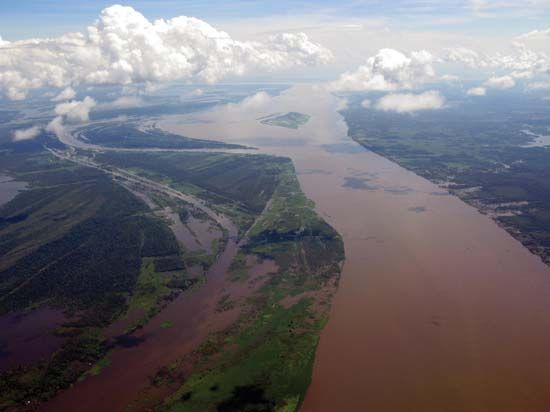
- Confluence: The Ubangi joins the Congo at the village of Irebu, located at the mouth of the Irebu Channel. This channel also serves as the drainage point for the low-lying, swampy Lake Tumba, which flows into the Congo via the Ubangi’s influence.6
- Navigation: The river system provides essential inland navigation; barges of up to 600 tons are able to travel from the Congo River up the Ubangi to reach Bangui.6
What kind of wildlife lives in the Congo Basin?
The Congo Basin supports an incredibly rich and diverse array of wildlife, with species distribution largely dictated by the region’s distinct equatorial forest and savanna habitats.1011
Forest and Savanna Mammals
The equatorial forests are home to iconic primates, including chimpanzees, bonobos—found exclusively in lowland rainforests south of the Congo River—and gorillas, which inhabit the eastern mountains. Other forest dwellers include African forest elephants, okapis, and various monkeys and baboons. In contrast, the surrounding savanna woodlands host predators such as lions, leopards, cheetahs, hyenas, and wild dogs, alongside herbivores like giraffes, buffaloes, and rhinoceroses.103
Aquatic and Reptilian Life
The river systems are teeming with life, including hippopotamuses, crocodiles, and various otters. The waters are well-stocked with fish, such as lungfish, catfish, cichlids, and eels. Reptiles are also common, ranging from pythons and vipers to turtles and chameleons.10113
Birds and Insects
The region boasts a vast birdlife, including parrots, sunbirds, eagles, vultures, and various waterbirds like pelicans and storks. Insects are innumerable, featuring hundreds of butterfly species alongside tsetse flies, mosquitoes, and various ants and termites.10113
Sources
- Lake Tumba — Encyclopædia Britannica
- Congo River: Top Questions — Encyclopædia Britannica
- Congo basin — Encyclopædia Britannica
- Congo River - Physiography — Encyclopædia Britannica
- Congo River - Plant life — Encyclopædia Britannica
- Ubangi River — Encyclopædia Britannica
- Bomu River — Encyclopædia Britannica
- Lualaba River — Encyclopædia Britannica
- Congo River — Encyclopædia Britannica
- Democratic Republic of the Congo - Plant and animal life — Encyclopædia Britannica
- Congo River - Animal life — Encyclopædia Britannica
- Republic of the Congo - Plant and animal life — Encyclopædia Britannica
Published on · 3 min read