Leopard Shark
The term "leopard shark" most commonly refers to Triakis semifasciata, a small, slim shark found in shallow waters along the Pacific coast of the United…
What is leopard shark?
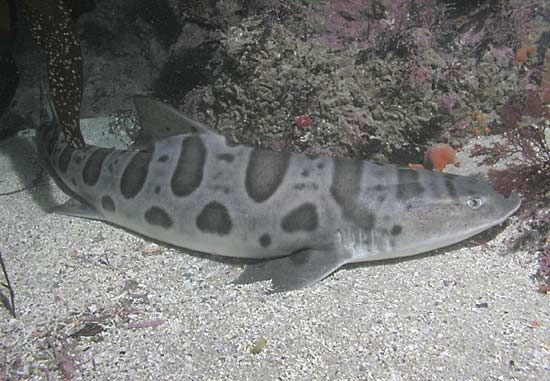
The term “leopard shark” most commonly refers to Triakis semifasciata, a small, slim shark found in shallow waters along the Pacific coast of the United States and Mexico. Growing to about 1.2 to 1.9 meters (3.9 to 6.2 feet), it is characterized by a gray body with black transverse bars and spots. It is generally considered harmless to humans, though it may bite, and it is classified as a species of least concern by the International Union for Conservation of Nature.1
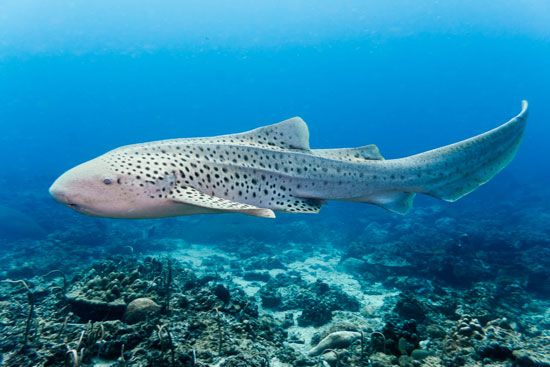
It is important to note that the name “leopard shark” can be misleading, as it is sometimes used to describe other species. For instance, the zebra shark (Stegostoma fasciatum), which inhabits the Indian and western Pacific oceans, is commonly called the “leopard shark” in Australia because its juvenile stripes break into spots as it matures. Unlike the Triakis semifasciata, the zebra shark is classified as an endangered species.23
How does the zebra shark differ from the leopard shark?
The zebra shark (Stegostoma fasciatum) and the leopard shark (Triakis semifasciata) are distinct species often confused due to their common names and spotted patterns. While the zebra shark is frequently called a “leopard shark” in Australia, they differ significantly in biology, habitat, and conservation status.3
Key Differences
Feature
Zebra Shark (
Stegostoma fasciatum
)
Leopard Shark (
Triakis semifasciata
)
Classification
Order Orectolobiformes (carpet shark)
Order Carcharhiniformes (ground shark)
Habitat
Coral reefs in the Indian and western Pacific oceans
Shallow waters along the Pacific coast of North America
Size
Can reach up to 3.7 meters (12 feet)
Typically 1.2 to 1.9 meters (3.9 to 6.2 feet)
Appearance
Cylindrical body with prominent ridges (keels) and an extremely long tail
Slim body with black transverse bars and spots
Conservation
Classified as
endangered
Classified as least concern
The zebra shark is a nocturnal hunter that uses its slender, flexible body to navigate narrow crevices in coral reefs to find mollusks and crustaceans. Unlike the leopard shark, its appearance changes drastically with age: juveniles possess dark brown skin with white stripes, which break into spots as they mature.3
What are some other types of sharks found in the Pacific Ocean?
The Pacific Ocean is home to a vast array of shark species, ranging from harmless plankton-feeders to powerful apex predators. Beyond the leopard shark, several notable species inhabit these waters:
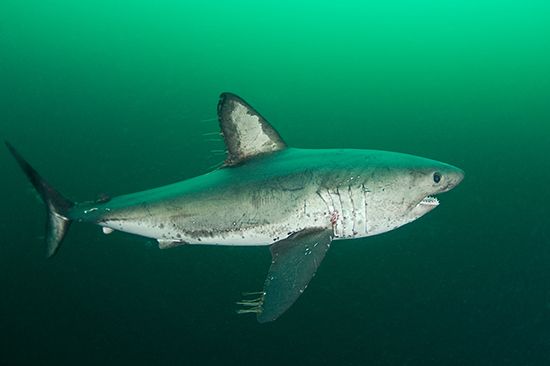
- Salmon shark: Found throughout the North Pacific, this mackerel shark is a partial endotherm, allowing it to hunt efficiently in cooler subarctic and temperate waters. It is known for its speed and diet, which consists largely of Pacific salmon.4
- Whale shark: As the world’s largest fish, this harmless giant can reach lengths of up to 18 meters (59 feet). It subsists by straining plankton from the water through its gills.5
- White shark: A voracious apex predator that can grow to 6 meters (20 feet), it is found in various marine environments where it hunts seals, dolphins, and large fish.5
- Great hammerhead shark: Known for its distinctively shaped head, this species is a large predator whose range and nursery areas have historically overlapped with other major marine carnivores.6
- Bull shark: A member of the Carcharhinus genus, this species is notable for its ability to enter fresh waters.5
Why do some shark species change their color patterns as they grow?
Some shark species undergo significant changes in their coloration as they mature, a process often linked to their growth and development. These transformations are typically morphological, involving the gradual synthesis or destruction of biochromes or chromatophores over time.93
A primary example is the zebra shark, whose appearance shifts dramatically with age. Juveniles are characterized by dark brown skin with yellowish-white vertical stripes and spots, which provide a pattern reminiscent of a zebra. As these sharks grow to approximately 60 to 90 cm (2 to 3 feet) in length, these markings break up into small brown spots on a yellow background. As the shark continues to grow, these spots become less linear and more evenly dispersed across the body, which is why the species is sometimes referred to as a “leopard shark” in certain regions.10
While rapid, short-term color changes in some vertebrates are controlled by the nervous system or hormones to respond to environmental stimuli or excitement, age-related changes are generally more permanent shifts that occur as an individual reaches different life stages.1193
Sources
- leopard shark — Encyclopædia Britannica
- leopard shark — Merriam-Webster
- zebra shark — Encyclopædia Britannica
- shark - Description and habits — Encyclopædia Britannica
- Pacific Ocean - Biological resources — Encyclopædia Britannica
- megalodon - Predators and prey — Encyclopædia Britannica
- salmon shark — Encyclopædia Britannica
- shark — Encyclopædia Britannica
- coloration - Age-related changes — Encyclopædia Britannica
- coloration - Short-term changes — Encyclopædia Britannica
- coloration - Physiological control — Encyclopædia Britannica
Published on · 3 min read