Zebra Shark
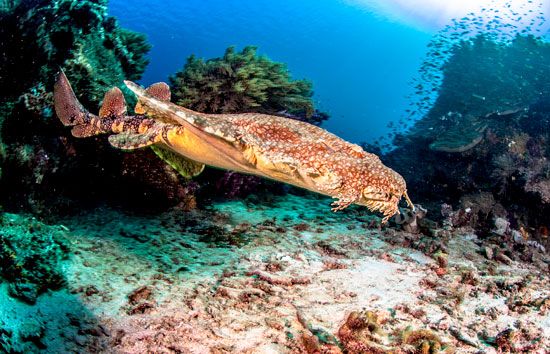
The zebra shark (Stegostoma fasciatum) is a species of carpet shark and the sole member of the family Stegostomatidae. Found in coral reef ecosystems across…
What is a zebra shark?
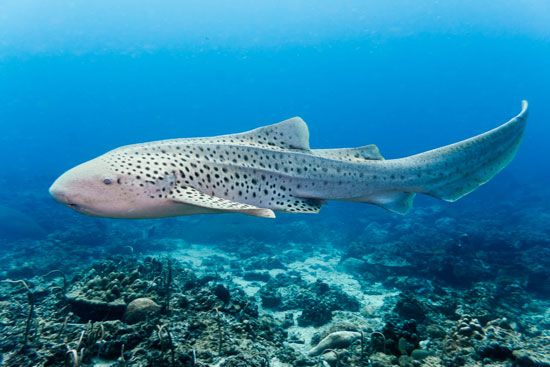
The zebra shark (Stegostoma fasciatum) is a species of carpet shark and the sole member of the family Stegostomatidae. Found in coral reef ecosystems across the Indian and western Pacific oceans, this nocturnal hunter uses its slender, flexible body to navigate narrow crevices in search of mollusks, crabs, and small fishesica.com/animal/crab), and small fishes.1
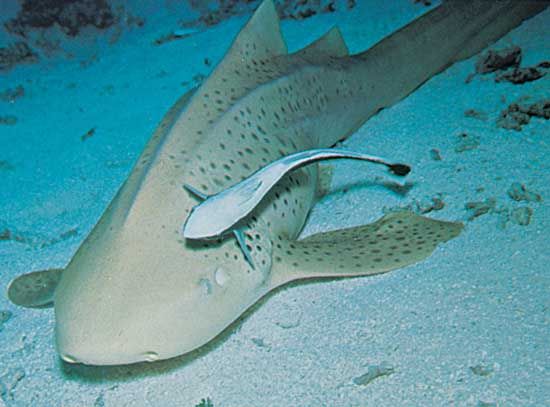
The shark’s appearance changes significantly as it matures. Juveniles display dark brown bodies with yellowish-white stripes, resembling a zebra, while adults develop a spotted pattern that leads to them being commonly called the leopard shark in Australia.12
Classified as an endangered species by the IUCN, the zebra shark faces significant threats from commercial fishing, particularly for its meat and fins. Protecting these unique marine animals is essential for maintaining the health of their reef habitats.1
Where do zebra sharks live?
Zebra sharks (Stegostoma fasciatum) inhabit coral reef ecosystems throughout the Indian and western Pacific oceans.1
They are specifically found in areas adjacent to islands on or near the continental shelf, where they spend their time hunting for food along the ocean floor and within coral structures. Researchers have identified two distinct subpopulations:1
- Indian Ocean–Southeast Asian subpopulation: This group inhabits waters across Southeast Asia, where they have faced significant population declines due to commercial fishing.1
- Eastern Indonesian-Oceania subpopulation: This group includes the waters off the eastern coast of Australia, where the species is more frequently sighted by divers and appears to be in a more stable condition.1
What do zebra sharks look like?
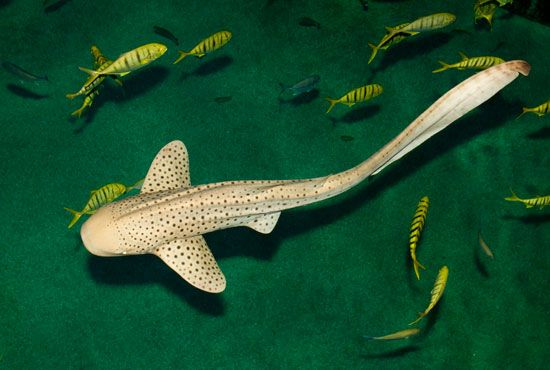
The zebra shark (Stegostoma fasciatum) possesses a large, cylindrical body with pronounced ridges, or keels, extending along its flanks toward the tail. Adults typically reach about 2.3 meters (7.5 feet) in length, though they can grow to nearly 3.7 meters (12 feet) in the wild. They feature a broad, flattened, conical head with eyes set high and marked by supraorbital ridges. Each nostril has a short, pointed barbel, and the body includes five gill slits on each side.1
Their most distinctive feature is their changing coloration:
- Juveniles: They are yellowish-white below with dark brown, vertical stripes and spots above. These stripes create saddle-like markings that resemble a zebra.
- Adults: As they reach 2 to 3 feet in length, the stripes break up into small brown spots on a yellow background. These spots become more dispersed as the shark grows, leading to the common name leopard shark in Australia.1
Additionally, the shark has an extremely long tail fin, roughly equal in length to the rest of its body.1
What do zebra sharks eat?
The zebra shark (Stegostoma fasciatum) is a nocturnal hunter that primarily feeds on mollusks. Its slender, flexible body allows it to maneuver into narrow crevices within coral reefs to locate its prey.1
In addition to mollusks, the zebra shark may occasionally consume:1
While they spend their days resting on the ocean floor, they become active at night to forage. In captivity, they are known to become active specifically when food is introduced into their environment.1
Sources
- zebra shark — Encyclopædia Britannica
- zebra shark — Merriam-Webster
Published on · 3 min read