Limpkin
The limpkin (Aramus guarauna) is a large wading bird native to the American tropics. Its range extends from the southeastern United States, Puerto Rico, and…
Where are limpkins typically found, and what is their natural habitat?
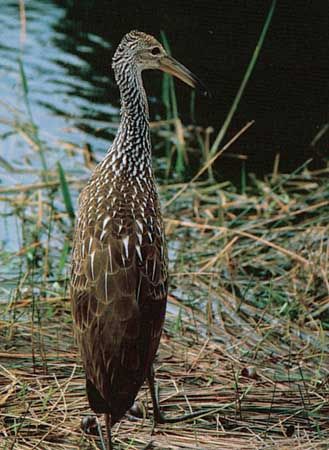
The limpkin (Aramus guarauna) is a large wading bird native to the American tropics. Its range extends from the southeastern United States, Puerto Rico, and Hispaniola, reaching as far south as central Argentina.12
Regarding their natural habitat, limpkins are typically found in environments associated with water, including the borders of wooded streams, bayous, and sloughs, as well as in open marshes. While they are primarily associated with these aquatic settings, they are also occasionally found in upland areas where they may run through brush or perch in small trees. They construct bulky nests made of leaves, twigs, and Spanish moss, which are situated in shrubs, grasses, or low trees located over or near water.1
How do limpkins communicate, and what are their distinctive vocalizations?
The limpkin is well-known for its highly distinctive vocalizations, which serve as its primary method of communication. The bird is characterized by a loud, prolonged, and wailing cry that is often heard across its swampy habitats.1
These vocalizations are among the species’ most notable traits, often described as haunting or piercing, and are frequently used to establish territory or signal to other members of the species in their environment.1
What is the taxonomic classification of the limpkin, and how is it related to other bird species?
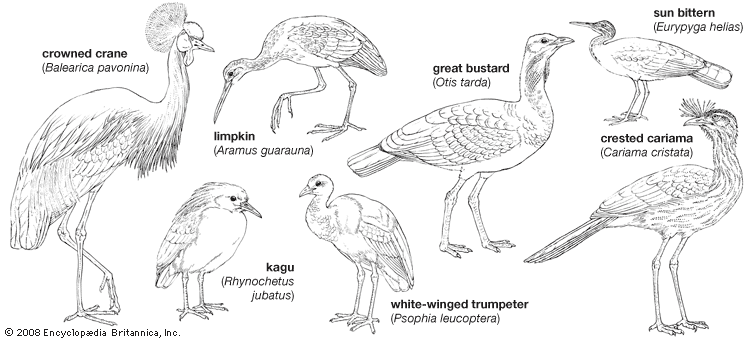
The limpkin (Aramus guarauna) is the sole member of the family Aramidae, which belongs to the order Gruiformes.13
As a member of the order Gruiformes, the limpkin shares a taxonomic classification with a diverse group of primarily marsh-dwelling birds, including cranes (family Gruidae), rails, gallinules, and coots (family Rallidae), as well as trumpeters (family Psophiidae). While the limpkin shares certain anatomical characteristics with these groups, it is distinguished by specific features, such as the absence of a caudofemoral muscle and the presence of a large, functional hallux (hind toe).3
Evolutionarily, the limpkin lineage dates back to the Oligocene Epoch, approximately 34 to 23 million years ago. Although it is a distinct species today, it is grouped within the broader, ancient order of Gruiformes, which possesses one of the most extensive fossil records of any avian order, stretching back over 80 million years.4
What is the limpkin’s diet, and how does it hunt for food?
The limpkin is an opportunistic feeder that consumes a variety of prey, including crustaceans, aquatic insects, frogs, worms, and mollusks. In the Florida Everglades, its diet consists primarily of large, greenish, freshwater snails known as Ampullaria.1
To hunt and consume these snails, the limpkin employs a specialized technique:
- Retrieval: The bird carries the snail to its nest or a preferred feeding perch.
- Securing: It holds the snail firmly in one foot.
- Extraction: The limpkin strikes the shell with several powerful blows from its bill. Once the shell is compromised, it forces its bill into the spiral opening to extract the snail.1
Sources
- Limpkin — Encyclopædia Britannica
- limpkin — Merriam-Webster
- Gruiform - Annotated classification — Encyclopædia Britannica
- Gruiform - Evolution and paleontology — Encyclopædia Britannica
- gastropod - Ecology and habitats — Encyclopædia Britannica
Published on · 2 min read