Loxonema
Loxonema is a genus of extinct gastropods, or snails, known from the fossil record. These organisms lived during the Ordovician to Early Carboniferous…
What is Loxonema?
Loxonema is a genus of extinct gastropods, or snails, known from the fossil record. These organisms lived during the Ordovician to Early Carboniferous periods, spanning approximately 488 million to 318 million years ago.1
The genus is characterized by a slender, high-spired shell featuring fine axial ornamentation. Additionally, these fossils are identified by a distinct lip located at the base of the aperture on the main whorl.1
What are gastropods?
Gastropods are the largest class within the phylum Mollusca, comprising more than 65,000 known animal species, including snails and slugs.2
Key Characteristics
- Body Structure: Snails typically possess a shell into which they can withdraw for protection, while slugs have either reduced their shells to internal fragments or lost them entirely through evolution.2
- Habitat: They are highly successful, inhabiting diverse environments including oceans, freshwater, and land.2
- Diversity: Gastropods exhibit a wide range of sizes, from species less than one millimeter in diameter to the Australian Syrinx aruanus, which can grow over two feet long. Their shell shapes are primarily based on the logarithmic spiral.3
- Classification: They are traditionally divided into prosobranchs, opisthobranchs, and pulmonates, though classification systems vary among experts.3
Biology and Reproduction
Gastropods display significant variability in their reproductive systems. Many possess a single gonad located in the visceral hump, and some species are hermaphroditic. Certain groups, such as limpets, exhibit consecutive sexuality, where individuals can change sex based on their position in a social stack or environmental factors.4
How do fossils help scientists understand ancient environments?
Fossils serve as vital indicators of ancient environments by providing clues about the ecological conditions in which organisms lived. Specialists known as paleoecologists analyze these remains to reconstruct the physical and biological constraints of past habitats, such as whether an organism inhabited seas, lakes, or bogs, and what its specific food chain or ecological niche was.67
By examining the specific requirements of fossilized species, scientists can infer past climates and geography. For example, the presence of coral fossils suggests the existence of warm, shallow water, while certain plant fossils indicate warm, swampy conditions similar to the modern Everglades. If such fossils are discovered in regions that are currently polar, it provides strong evidence that the Earth’s crust has shifted over time. Furthermore, understanding these ancient environments is practically applied in fossil fuel exploration, as oil and natural gas typically accumulate in specific, restricted environments.67
We could dive deeper into how stratigraphic correlation uses these fossils to map Earth’s history.
What characterizes the Ordovician period?
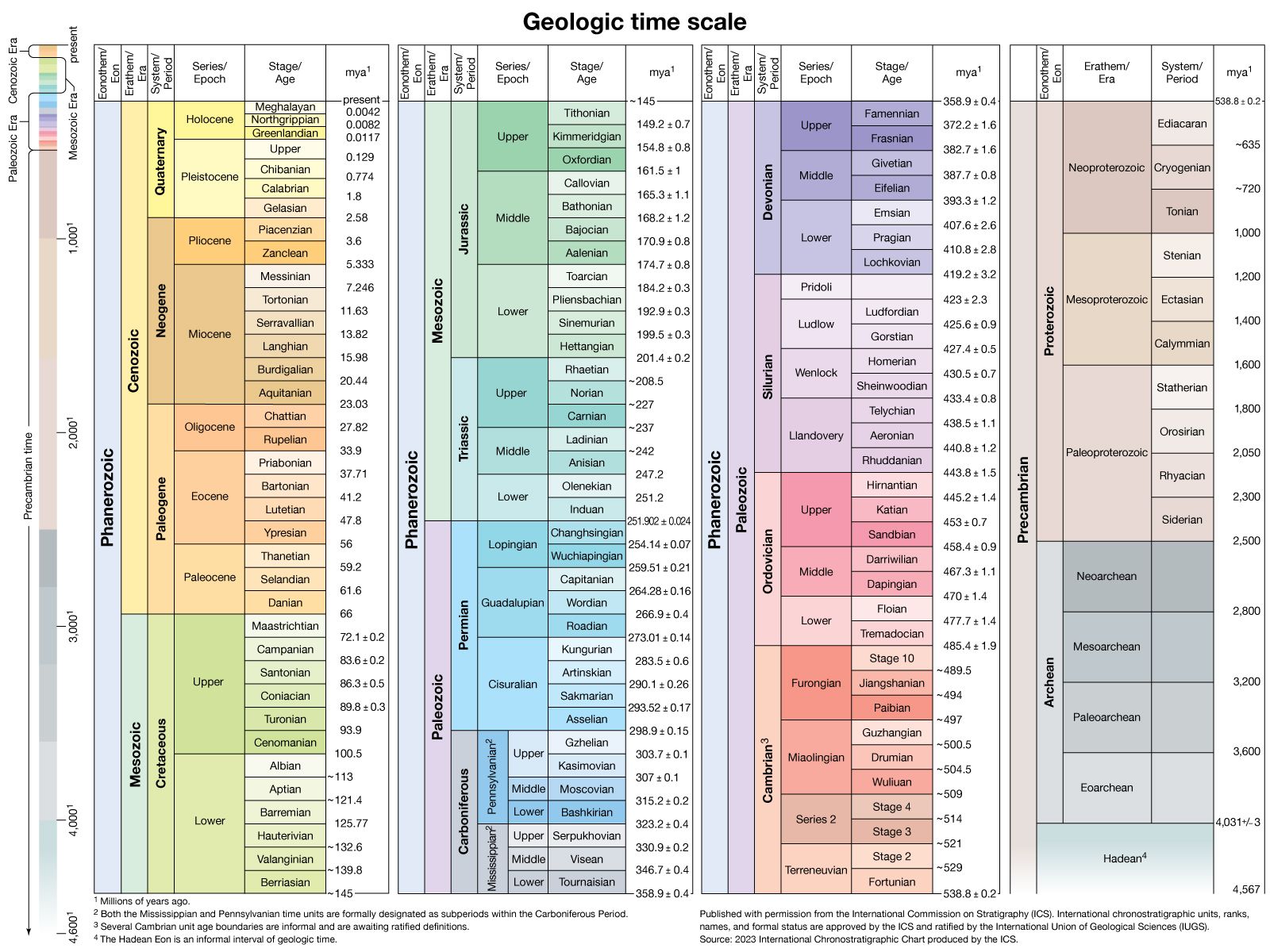
The Ordovician Period (485.4 to 443.8 million years ago) was a significant era in the Paleozoic Era characterized by major shifts in plate tectonics, climate, and biological evolution.11
Geological and Climatic Conditions
Rapid seafloor spreading at oceanic ridges caused global sea levels to rise to some of the highest levels in the Phanerozoic Eon, flooding vast portions of the continents. Atmospheric carbon dioxide levels were significantly higher than today, fostering a warm, greenhouse climate for much of the period. However, the period concluded with a brief, intense interval of glaciation over the supercontinent Gondwana, which triggered a dramatic drop in sea level.1211131415
Biological Developments
The period is noted for the “Ordovician radiation,” an intense diversification of marine life that saw the rise of almost every modern invertebrate phylum and the emergence of early fish. Common marine life included brachiopods, bryozoans, trilobites, mollusks, echinoderms, and graptolites. On land, the first plants and potentially the first terrestrial arthropods appeared.11121116
The period ended with the second-largest mass extinction in Earth’s history, which claimed approximately 85 percent of all species, largely due to climate cooling and falling sea levels.121411
Sources
- Loxonema — Encyclopædia Britannica
- gastropod — Encyclopædia Britannica
- gastropod - Evolution and paleontology — Encyclopædia Britannica
- gastropod - Size range and diversity of structure — Encyclopædia Britannica
- Animal reproductive system - Annelids and mollusks — Encyclopædia Britannica
- fossil record — Encyclopædia Britannica
- index fossil — Encyclopædia Britannica
- geology - Paleontology — Encyclopædia Britannica
- trace fossil — Merriam-Webster
- taphonomy — Merriam-Webster
- A Journey Through Time Since the Precambrian - Ordovician Period: 485.4 million to 443.4 million years ago — Encyclopædia Britannica
- Ordovician Period - Invertebrates — Encyclopædia Britannica
- Ordovician Period - Mass extinction at the end of the Ordovician — Encyclopædia Britannica
- Ordovician Period — Encyclopædia Britannica
- Ordovician Period - Paleoclimate — Encyclopædia Britannica
- Ordovician Period - Sea level — Encyclopædia Britannica
Published on · 3 min read