Mare’s-tail
Mare’s-tail refers primarily to the aquatic plant Hippuris vulgaris, a member of the plantain family. It grows from submerged rootstocks along the margins of…
What is mare’s-tail?
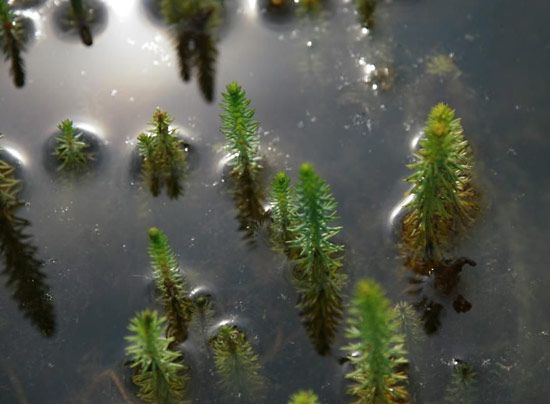
Mare’s-tail refers primarily to the aquatic plant Hippuris vulgaris, a member of the plantain family. It grows from submerged rootstocks along the margins of lakes and ponds in temperate regions worldwide. The plant is characterized by whorls of small, linear leaves arranged at intervals along its stem, which typically rises about 30 cm (12 inches) above the water.1
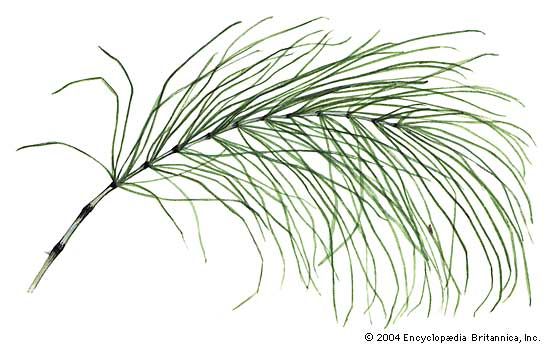
While it resembles the unrelated horsetail (Equisetum species) due to its whorled leaf structure, mare’s-tail is distinct in its reproductive biology, producing tiny, wind-pollinated bisexual flowers in the angles between its stems and leaves. In addition to its botanical definition, the term “mare’s tail” is also used to describe a type of cirrus cloud that features a long, slender, and flowing appearance.12
How do cirrus clouds form in the atmosphere?
Cirrus clouds form in the high reaches of the troposphere, typically at altitudes above 5 km (approximately 16,500 feet). At these elevations, temperatures are significantly below the freezing point, causing the clouds to be composed almost exclusively of ice crystals.4567
The formation process begins when moist air ascends into the atmosphere. As this air mass rises, it encounters lower pressure, causing it to expand and cool adiabatically. Once the air temperature drops below the dew point, the air becomes saturated, and water vapor deposits directly onto ice nuclei or tiny ice crystals.457
Because the equilibrium pressure of water vapor is lower in contact with ice than with undercooled water, these ice particles grow rapidly by incorporating surrounding water vapor. While these crystals may eventually fall, they typically evaporate before reaching the ground unless they seed lower-level clouds, potentially contributing to precipitation lower-level clouds, potentially contributing to precipitation.75
What are the main differences between aquatic plants and land-based horsetails?
While mare’s-tail (Hippuris vulgaris) and horsetails (Equisetum species) share a similar appearance due to their whorled leaves and jointed stems, they are biologically distinct plants with different evolutionary backgrounds and reproductive strategies.18
Key Differences
Feature
Mare’s-tail (
Hippuris vulgaris
)
Horsetails (
Equisetum
)
Classification
A flowering plant in the
plantain family
.
A primitive, spore-bearing
vascular plant
(class Equisetopsida).
Reproduction
Produces tiny, wind-pollinated bisexual flowers.
Reproduces via
spores
produced in terminal cones (strobili).
Habitat
Strictly aquatic; grows from submerged rootstocks in lakes and ponds.
Primarily terrestrial; found in moist or damp soils, though some species are cultivated in marshy areas.
Structure
Features whorls of linear leaves along the stem.
Features reduced, scale-like leaves and stems often reinforced with [silica]
.
Evolutionary Context
The primary distinction lies in their complexity. Horsetails are ancient, seedless vascular plants that have existed since the Devonian Period. In contrast, mare’s-tail is a flowering plant (angiosperm) that has adapted to an aquatic environment. While land plants generally evolved from aquatic ancestors, many modern aquatic plants, like mare’s-tail, represent a secondary invasion of water environments by terrestrial lineages, requiring specific physiological adaptations to survive in a medium of different density and oxygen availability.891103
Why do some plants evolve to grow in water instead of soil?
Plants do not evolve to grow in water as a replacement for soil; rather, many aquatic plants are descendants of terrestrial ancestors that underwent a secondary invasion of water environments. While all land plants ultimately trace their origins to ancient aquatic life, the transition to land required complex adaptations—such as vascular tissues, roots, and protective cuticles—to survive outside of an aqueous medium.121314
When these terrestrial lineages later returned to water, they had to develop new adaptations to thrive in a medium that is denser, more viscous, and often lower in oxygen than air. Key reasons and advantages for this lifestyle include:12
- Resource Availability: Flowing water environments provide a continuous supply of oxygen and nutrients, which are constantly replenished by currents.15
- Buoyancy: Water provides structural support, reducing the need for the rigid tissues required by land plants to stand upright against gravity.13
- Reduced Competition: By exploiting aquatic habitats, plants can avoid the intense competition for space, sunlight, and nutrients found in crowded terrestrial ecosystems.13
- Protection: The precarious nature of certain aquatic habitats, such as fast-flowing rivers, can limit the number of predators, offering a degree of protection.15
Sources
- mare’s-tail — Encyclopædia Britannica
- horsetail — Encyclopædia Britannica
- mare's tail — Merriam-Webster
- 16 Questions About Earth’s Atmosphere and Weather Answered - What are clouds made of? — Encyclopædia Britannica
- Climate - Snow and sleet — Encyclopædia Britannica
- How do clouds form? — Encyclopædia Britannica
- Cloud — Encyclopædia Britannica
- Equisetopsida — Encyclopædia Britannica
- Plant - Order Equisetales — Encyclopædia Britannica
- Equisetaceae — Merriam-Webster
- Tree - Tree structure and growth — Encyclopædia Britannica
- Inland water ecosystem - Biota of inland waters — Encyclopædia Britannica
- Biosphere - Water currents — Encyclopædia Britannica
- Biosphere - Environmental conditions — Encyclopædia Britannica
- hydrophyte — Merriam-Webster
- phylogeny - Evolution of land plants — Encyclopædia Britannica
Published on · 3 min read