M’Clure Strait
M’Clure Strait is an eastern arm of the Beaufort Sea in the Arctic Ocean, located within the Northwest Territories of Canada. Measuring approximately 170…
What is M’Clure Strait?
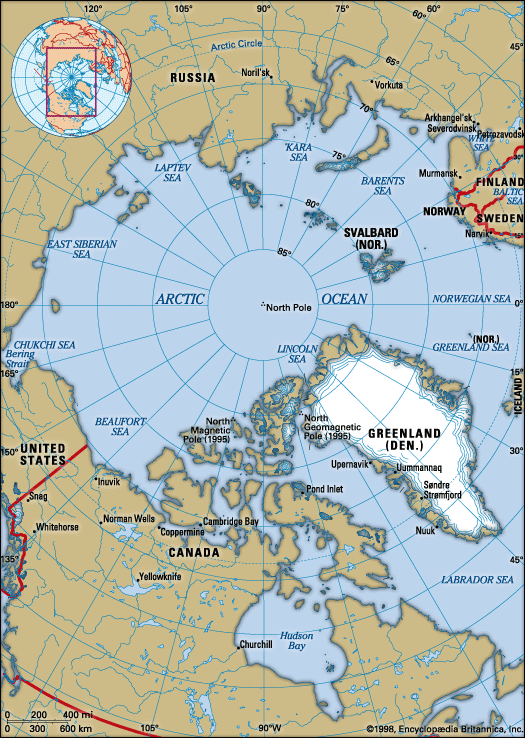
M’Clure Strait is an eastern arm of the Beaufort Sea in the Arctic Ocean, located within the Northwest Territories of Canada. Measuring approximately 170 miles (270 km) long and 60 miles (90 km) wide, the strait serves as a segment of the Northwest Passage through the Canadian Arctic Archipelago.1
Geographically, the strait lies between Melville Island and Eglinton Island to the north, and Banks Island to the south, extending westward from Viscount Melville Sound. It is named in honor of the Irish explorer Sir Robert McClure, who led expeditions in the region during the 19th-century search for the Northwest Passage.123
What is the Northwest Passage and why was it historically important?
The Northwest Passage is a historical sea route through the Arctic Archipelago of Canada, connecting the Atlantic Ocean to the Pacific Ocean.4
Historical Importance
For centuries, the passage was a primary objective for Western explorers seeking a viable commercial sea route to East Asia. Following the disruption of traditional overland trade routes in the mid-15th century, European powers—including England, France, and the Netherlands—hoped to bypass the American land barrier to reach the riches of the East.45
The quest was one of the world’s most dangerous maritime challenges, characterized by treacherous ice conditions and extreme Arctic weather. Many famous explorers, such as Henry Hudson and Sir John Franklin, met with disaster or death in their attempts to navigate the route. The passage was not successfully navigated by sea until Roald Amundsen completed his voyage between 1903 and 1906.45
Contemporary Significance
Today, the Northwest Passage is viewed as a potential shortcut for global shipping, significantly reducing travel distances between major ports like London and Tokyo compared to routes around Africa. While global warming has led to reduced sea-ice coverage and increased accessibility, the route remains complex due to environmental concerns, sovereignty disputes, and the high costs of Arctic navigation.46
Who was Sir Robert McClure and what was his role in Arctic exploration?
Sir Robert John Le Mesurier McClure (1807–1873) was an Irish naval officer who is credited with the discovery of the Northwest Passage, the elusive sea route connecting the Atlantic and Pacific oceans through the Canadian Arctic.7
Role in Arctic Exploration
In 1850, McClure took command of the HMS Investigator as part of a large-scale search for the lost Franklin expedition.7 His role in Arctic exploration is defined by the following key events:
- Discovery of the Passage: Entering from the Pacific via the Bering Strait, McClure navigated eastward north of Alaska and identified two potential entrances to the Northwest Passage around Banks Island.7
- The Expedition’s End: His ship became trapped in the ice of Mercy Bay, forcing the crew to abandon the vessel. The party was eventually rescued by another expedition near Melville Island.72
- Completion: McClure and his men returned to England in 1854. Although they completed the journey using a combination of ship travel and overland trekking, he was officially recognized as the discoverer of the passage, earning him a knighthood.728
How does sea ice affect navigation in the Canadian Arctic Archipelago?
Sea ice is the primary constraint on navigation within the Canadian Arctic Archipelago, acting as a significant physical barrier to maritime traffic. Its impact on navigation is multifaceted:41
- Physical Obstruction: Sea ice can cause severe damage to a ship’s hull and propellers. In the Northwest Passage, the presence of thick, unbroken ice during winter months renders the region largely inaccessible, while the polar ice cap frequently funnels masses of ice into critical channels, such as the Bering Strait.9101
- Operational Costs: Navigating these waters requires specialized, ice-strengthened vessels or the use of icebreakers, which significantly increases operational expenses. Furthermore, the high risk of ice-related damage often leads to elevated insurance premiums for commercial vessels.104
- Environmental Hazards: Beyond the ice cover itself, the region is plagued by giant icebergs that drift through shipping lanes, as well as smaller, harder-to-detect fragments known as “growlers” and “bergy bits” that are capable of sinking ships.1011
- Visibility and Cleanup: Open channels within the ice can lead to poor local visibility, and the presence of ice severely complicates emergency response and oil spill cleanup operations, making environmental protection a major concern.19
While global warming has led to a decline in summer sea-ice coverage and increased seasonal accessibility, the region remains a complex and hazardous environment for navigation.1012
Sources
- M’Clure Strait — Encyclopædia Britannica
- Arctic - 19th-century attempts at the passage — Encyclopædia Britannica
- M'Clure Strait — Merriam-Webster
- Northwest Passage — Encyclopædia Britannica
- European exploration - The northern passages — Encyclopædia Britannica
- Alaska - Climate of Alaska — Encyclopædia Britannica
- Sir Robert John Le Mesurier McClure — Encyclopædia Britannica
- Arctic - Traverses of the passage in the 20th century — Encyclopædia Britannica
- sea ice - The emerging impacts of recent changes to sea ice — Encyclopædia Britannica
- Arctic - Water transport — Encyclopædia Britannica
- Arctic - Climate of the Arctic — Encyclopædia Britannica
- Bering Sea and Strait - Navigation — Encyclopædia Britannica
- iceberg - Iceberg detection, tracking, and management — Encyclopædia Britannica
- Arctic - Environmental concerns — Encyclopædia Britannica
Published on · 3 min read