Notopterid
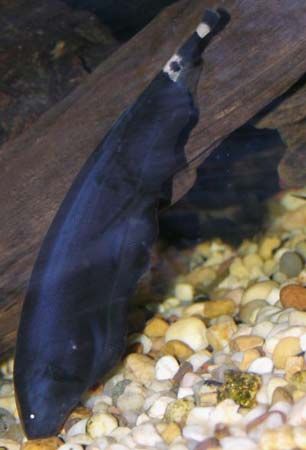
A notopterid is any of approximately eight species of air-breathing, freshwater fish that make up the family Notopteridae. These fish are found in quiet…
What is notopterid?
A notopterid is any of approximately eight species of air-breathing, freshwater fish that make up the family Notopteridae. These fish are found in quiet waters ranging from Africa to Southeast Asia.12
Key characteristics of notopterids include:
- Physical Appearance: They are long-bodied with small scales. They possess a long, narrow anal fin that extends along most of the undersurface and continues into the tail fin, while the dorsal fin is small or sometimes absent.1
- Locomotion: The undulations of their long anal fin allow them to swim both forward and backward.1
- Behavior: They are nocturnal and predacious.1
- Size and Use: The largest species, Notopterus chitala, can reach lengths of about 80 cm (32 inches). In some regions, these fish are sought after as a food source, and the species Xenomystus nigri is occasionally kept in aquariums.1
How do notopterids use their anal fins to swim backward?
The premise that notopterids use their anal fins to swim backward is inaccurate based on the provided search results. While the term “knifefish” is sometimes applied to the family Notopteridae, the specific ability to swim both forward and backward using undulations of a long anal fin is a characteristic attributed to the New World knifefishes of the order Gymnotiformes, not the notopterids.45
In the case of Gymnotiformes, these fish have evolved to move through quiet waters by rippling their long anal fins, which extend along the underside of their bodies. This specialized fin movement allows for precise, slow-motion navigation in either direction.45
What makes notopterids unique compared to other freshwater fish?
Notopterids, commonly known as featherbacks or knifefishes, possess several unique anatomical and physiological adaptations that distinguish them from other freshwater fish:
- Propulsion and Body Structure: Unlike many fish that swim using their entire body and caudal fin, notopterids maintain a rigid body while swimming. They utilize a long, narrow anal fin that runs along their undersurface for propulsion. This rigid-bodied swimming is thought to be correlated with their specialized swim bladder anatomy.18
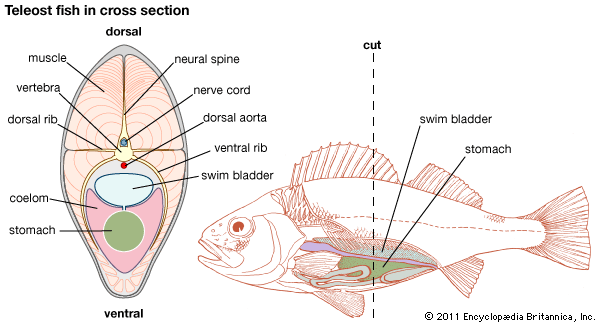
- Swim Bladder Anatomy: The swim bladder in notopterids is highly developed and extends posteriorly beyond the abdominal cavity, running along the vertebral column9. Furthermore, they possess paired extensions that connect the swim bladder to the auditory region of the skull, which likely enhances their hearing. In the genus Papyrocranus, these diverticula even penetrate the skull.38
- Air-Breathing Capability: Notopterids are air-breathing fish, an adaptation that allows them to survive in environments where the water may be deoxygenated.18
- Acoustic Communication: Some species, such as Xenomystus, are known to produce sounds for warnings and courtship, and the structure of the swim bladder in other notopterids suggests this is a common trait within the family.8
Which species of notopterids are commonly kept in home aquariums?
While there are approximately eight species of notopterids found across Africa and Southeast Asia, they are not widely kept in home aquariums due to their size, predatory nature, and nocturnal habits.
Among the family, the species most commonly encountered in the aquarium trade is the African knifefish, Xenomystus nigri. This species is favored by some enthusiasts for its unique appearance and behavior, though it requires specialized care appropriate for a nocturnal predator. Other larger species, such as Notopterus chitala, are generally unsuitable for standard home aquariums as they can reach lengths of up to 80 cm (32 inches).1
Sources
- notopterid — Encyclopædia Britannica
- notopterid — Merriam-Webster
- heteropteran - Annotated classification — Encyclopædia Britannica
- knifefish — Encyclopædia Britannica
- backswimmer — Encyclopædia Britannica
- ostariophysan - Swimming — Encyclopædia Britannica
- tetraodontiform - Locomotion — Encyclopædia Britannica
- osteoglossomorph - Annotated classification — Encyclopædia Britannica
- osteoglossomorph - Form and function — Encyclopædia Britannica
- osteoglossomorph - Behaviour and ecology — Encyclopædia Britannica
Published on · 3 min read