Mooneye
The mooneye is a North American freshwater fish belonging to the family Hiodontidae. These fish are characterized by their herring-like appearance, which…
What is mooneye?
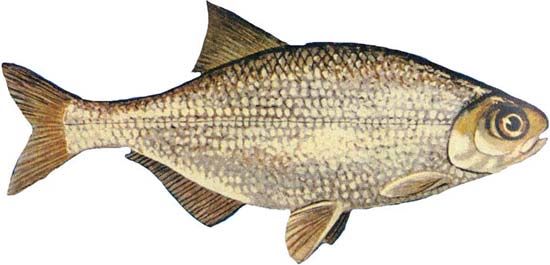
The mooneye is a North American freshwater fish belonging to the family Hiodontidae. These fish are characterized by their herring-like appearance, which includes large eyes, sharp teeth, and deeply forked tail fins. While they are considered a spirited catch for anglers, they are not typically valued as a food source.1
Within the family Hiodontidae, there are a few notable species:
- Mooneye (Hiodon tergisus): A bright, silvery fish that can reach lengths of approximately 42.5 centimeters (17 inches).1
- Goldeye (H. alosoides): A blue-backed, silvery species that grows to about 25 centimeters.12
- Southern mooneye (H. selenops): A silvery fish reaching about 30 centimeters in length.1
Taxonomically, the family Hiodontidae is classified under the order Hiodontiformes and is considered one of the most primitive living groups within the superorder Osteoglossomorpha.3
What are the main differences between mooneyes and goldeyes?
The mooneye and the goldeye are both members of the family Hiodontidae, but they exhibit distinct physical characteristics and sizes. While the term “mooneye” is sometimes used to refer to the entire family, the specific species Hiodon tergisus (the mooneye) and Hiodon alosoides (the goldeye) differ in the following ways:
- Appearance: The mooneye is described as a bright, silvery fish. In contrast, the goldeye is distinguished by its blue-backed, silvery coloration.1
- Size: The mooneye (H. tergisus) is generally larger, reaching lengths of approximately 42.5 centimeters (17 inches). The goldeye is smaller, typically growing to about 25 centimeters.1
Both fish share a herring-like appearance, featuring large eyes, sharp teeth, and deeply forked tail fins, and both are found in North American freshwater environments.1
What does it mean for a fish to be considered primitive?
In the study of bony fishes, the term “primitive” is used to describe groups that retain ancestral anatomical features or represent earlier stages of evolutionary development compared to more specialized or “advanced” lineages.56
A fish is often considered primitive based on several key characteristics:
- Skeletal Structure: Primitive groups often exhibit a more rudimentary caudal (tail) skeleton. For example, the superorder Osteoglossomorpha is widely considered the most primitive group of bony fishes due to this feature and the lack of certain intermuscular bones.5
- Evolutionary History: Fishes that belong to lineages that diverged early from the main evolutionary tree are often labeled primitive. These groups may show anatomical traits that have been modified or lost in later, more efficient swimmers.6
- Functional Efficiency: Advanced fishes, such as teleosts, evolved over millions of years to possess more efficient feeding mechanisms, improved gill ventilation, and superior swimming capabilities—such as the homocercal tail fin. In contrast, primitive fishes often possess asymmetrical tails (like the heterocercal tail) or other body plans that are less efficient for modern swimming demands.6
- Anatomical Traits: Certain unique or “retained” traits, such as the use of the tongue as an opposing surface for teeth when biting food, are characteristic of primitive groups like the osteoglossomorphs.52
It is important to note that “primitive” does not mean these fish are unsuccessful; many primitive species have survived for hundreds of millions of years by adapting to specific or restricted environments.6
What other types of fish belong to the Osteoglossomorpha group?
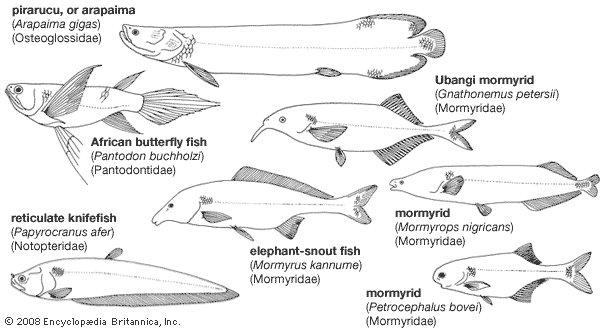
The superorder Osteoglossomorpha is a diverse group of primitive bony fishes divided into two main orders: Osteoglossiformes and Hiodontiformes.11
Order Osteoglossiformes
These are primarily tropical freshwater fishes found in Africa, Asia, South America, Australia, and the Pacific islands. They include several distinct families:11
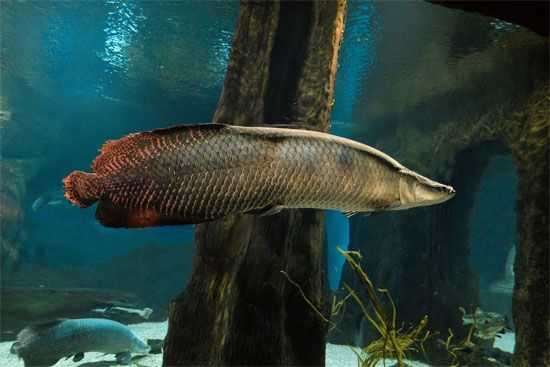
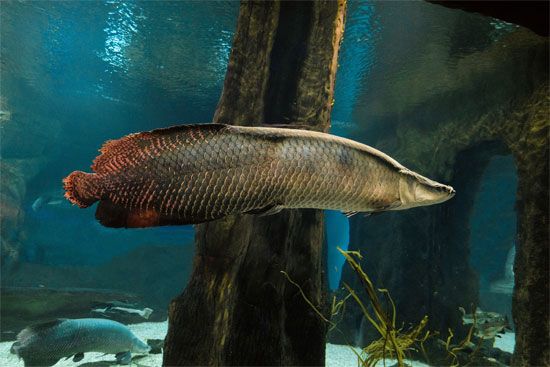
- Osteoglossidae: Known as bonytongues and arapaimas, this family includes the pirarucu (Arapaima), the arowana (Scleropages), and the African butterfly fish (Pantodon).52
- Mormyridae: Commonly called mormyrs or elephant-snout fishes, these are confined to Africa and are known for possessing electrical organs.52
- Gymnarchidae: Represented by a single species, Gymnarchus niloticus, which also possesses electrical organs and lacks an anal fin.2
- Notopteridae: Known as knifefishes or featherbacks, these are found in Africa, Southeast Asia, and India.52
Order Hiodontiformes
This order is limited to North America and is considered the most primitive group of living osteoglossomorphs. It consists of a single family, Hiodontidae, which includes only two species:511
Sources
- mooneye — Encyclopædia Britannica
- osteoglossomorph - Annotated classification — Encyclopædia Britannica
- goldeye — Encyclopædia Britannica
- mooneye — Merriam-Webster
- osteoglossomorph — Encyclopædia Britannica
- fish - Sarcopterygii: fleshy-finned fishes — Encyclopædia Britannica
- clupeiform - Critical appraisal — Encyclopædia Britannica
- fish - Actinopterygii: ray-finned fishes — Encyclopædia Britannica
- fish - Agnatha: early jawless fishes — Encyclopædia Britannica
- atheriniform - Paleontology — Encyclopædia Britannica
- osteoglossomorph - General features — Encyclopædia Britannica
Published on · 3 min read