Nummulite
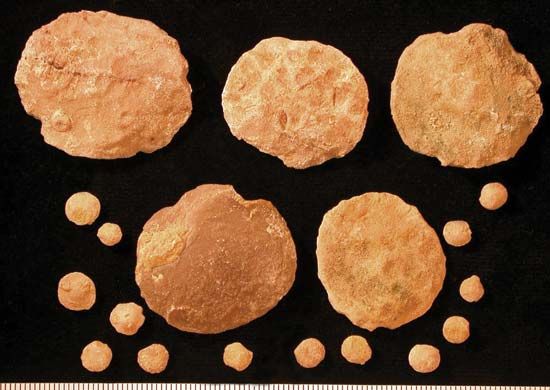
A nummulite is any of the thousands of extinct species of large, lens-shaped foraminifers—single-celled marine organisms—that thrived during the Paleogene…
What is nummulite?
A nummulite is any of the thousands of extinct species of large, lens-shaped foraminifers—single-celled marine organisms—that thrived during the Paleogene and Neogene periods.12
These organisms were particularly abundant during the Eocene Epoch, inhabiting the bottoms of shallow-water tropical marine environments. They possessed complex, labyrinthine interiors and relied on symbiotic algae for nourishment. Some species, such as those in the genus Nummulites, grew up to 150 mm in diameter.13
Because they occurred in such massive numbers, their fossilized remains often form entire rock layers, known as nummulite limestone. Notably, this limestone was used to build the pyramids of Egypt. The name itself is derived from the Latin nummulus, meaning “coin,” in reference to their distinct, coin-like shape.1435
How do foraminiferans help scientists date rock layers?
Foraminiferans are essential tools in geology because they serve as index fossils, which are organisms used to define boundaries in the geologic time scale and correlate rock strata across different regions.67
Their utility in dating and correlating rock layers stems from several key characteristics:
- Rapid Evolution and Wide Distribution: Many foraminiferan species evolved quickly and dispersed widely, allowing scientists to identify specific time intervals based on the presence of particular taxa.89
- Abundance: Because they inhabit marine environments globally and exist in massive numbers, their fossilized tests (shells) are frequently found in sedimentary rock, such as limestone and chalk.69
- Zonal Biostratigraphy: Micropaleontologists have established “zones” based on the regional distribution of these organisms. By identifying these zones, researchers can correlate sediments from high northern to high southern latitudes.8
- Integration with Other Methods: While foraminiferans provide the framework for biochronology—the dating of strata based on fossil succession—this data is often integrated with radioisotopic dating and magnetostratigraphy to create a high-resolution, consistent geologic time scale.82
What are some other examples of single-celled marine organisms?
Beyond foraminiferans, the marine environment hosts a diverse array of single-celled organisms that play critical roles in global ecosystems. Notable examples include:
- Diatoms: These microscopic algae are characterized by their intricate, pillbox-like shells (frustules) made of silica. They are highly prolific and serve as a primary food source for many marine animals.1112
- Dinoflagellates: These organisms possess two dissimilar flagella and exhibit characteristics of both plants and animals. While many are photosynthetic, others are predatory or parasitic. Some species are responsible for bioluminescence and can form harmful “red tides” when they reproduce rapidly.13
- Coccolithophores: These minute, planktonic organisms are known for secreting complex plates of calcium carbonate called coccoliths. Upon death, these plates settle on the ocean floor, contributing significantly to the formation of marine sediments.1415
- Radiolarians: These marine protozoans are typically spherical and feature beautiful, complex skeletons made of silica. Their skeletal remains accumulate on the ocean floor to form “radiolarian ooze,” which can eventually transform into sedimentary rocks like chert and flint.1617
How were nummulite fossils used in the construction of the Egyptian pyramids?
Nummulite fossils were not used as tools or active components in the construction of the Egyptian pyramids; rather, they are a natural, abundant constituent of the limestone used to build them.
During the middle of the Eocene Epoch, a major marine transgression—a rise in sea level—occurred across what is now Egypt. This event created extensive limestone deposits containing massive numbers of nummulites, which are large, lens-shaped foraminifers. Because this rock was readily available and durable, it was quarried to provide the stone blocks used in the construction of the pyramids. Consequently, the fossils are embedded within the very fabric of the structures, serving as a geological record of the environment from which the building material was extracted.121
Sources
- nummulite — Encyclopædia Britannica
- Tertiary Period - Foraminiferans — Encyclopædia Britannica
- Nummulitidae — Merriam-Webster
- nummulite — Merriam-Webster
- nummulitic limestone — Merriam-Webster
- foraminiferan — Encyclopædia Britannica
- geochronology - Accumulational processes — Encyclopædia Britannica
- index fossil — Encyclopædia Britannica
- Tertiary Period - Correlation of Tertiary strata — Encyclopædia Britannica
- Triassic Period - Correlation of Triassic strata — Encyclopædia Britannica
- Dinoflagellate — Encyclopædia Britannica
- Marine ecosystem - Benthos — Encyclopædia Britannica
- Diatom — Encyclopædia Britannica
- phytoplankton — Encyclopædia Britannica
- Coccolith — Encyclopædia Britannica
- coccolithophore — Merriam-Webster
- radiolarian — Encyclopædia Britannica
- Marine ecosystem - Marine biota — Encyclopædia Britannica
- Microbiology - Algae — Encyclopædia Britannica
- radiolarian — Merriam-Webster
- construction - Stone construction in Egypt — Encyclopædia Britannica
Published on · 3 min read