Osprey
Ospreys (Pandion haliaetus) exhibit specific nesting and breeding behaviors characterized by the following:
What is the breeding and nesting behavior of ospreys?
Ospreys (Pandion haliaetus) exhibit specific nesting and breeding behaviors characterized by the following:
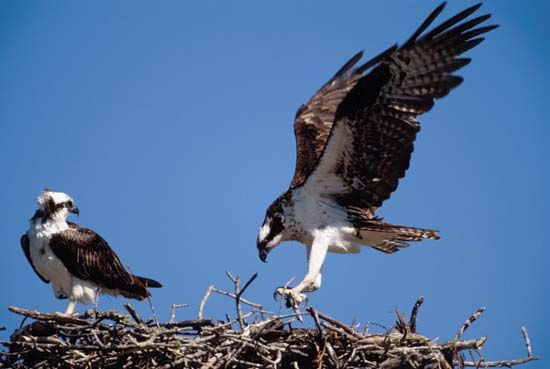
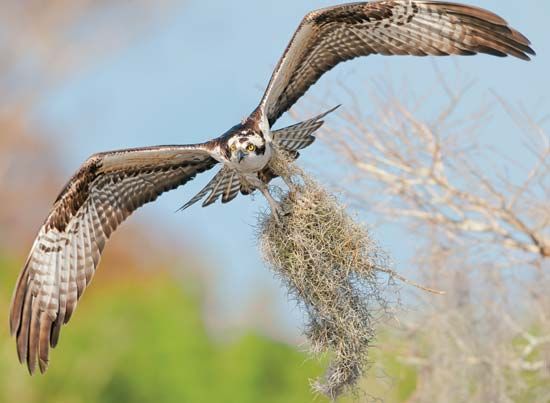
- Nesting Sites: Ospreys build bulky nests, which can reach up to 2 meters (6.6 feet) in diameter, using haphazardly arranged sticks. These structures are typically located in tall trees, on the ground on small islands, or on cliff ledges. Because the same nests are often reused by many generations of birds, they can become quite massive over time.1
- Egg-Laying and Incubation: Females typically lay two to four white eggs, which are marked with bold dark brown blotches. Both parents participate in feeding the young after they hatch.1
- Development: The downy young hatch after approximately five weeks of incubation. The young birds fledge—meaning they develop the feathers necessary for flight—in six to eight weeks.1
Ospreys are widely distributed across all continents except Antarctica and South America (where they are primarily winter visitors). While their populations faced significant declines in the mid-20th century due to the effects of DDT, they have shown successful recovery in many regions following conservation efforts.1
How do ospreys hunt and catch fish?
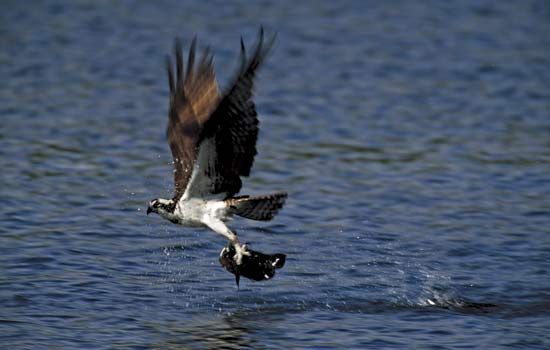
Ospreys (Pandion haliaetus) are specialized predators that hunt by flying over seacoasts and interior waterways to locate fish active near the water’s surface.16
Their hunting process involves several distinct stages:
- Detection: The bird flies over the water and hovers above its target before initiating a dive.1
- Capture: The osprey plunges feet-first into the water to seize the fish with its long, curved talons.1
- Grip: To ensure a secure hold on slippery prey, the osprey utilizes sharp, specialized structures called spicules located on the underside of its toes.1
- Consumption: Once the fish is secured, the bird carries its prey to a preferred perch to feed.1
Because ospreys do not swim, they are limited to hunting prey that remains accessible near the surface. After feeding, it is common for the bird to fly low over the water, dragging its feet as if to wash them.61
What is the taxonomic classification of ospreys and how are they related to other raptors?
The osprey (Pandion haliaetus) is the sole species within the family Pandionidae. While it is sometimes classified as a subfamily (Pandioninae) of the hawk and eagle family, Accipitridae, it is traditionally placed within the order Falconiformes, which encompasses diurnal raptors.17
Ospreys share the general characteristics of other falconiforms, such as hooked beaks and taloned feet, which are adaptations for predatory behavior. However, they possess unique anatomical features that distinguish them from their relatives, including:8
- Reversible outer toe: This allows for a more secure grip on prey.7
- Rounded talons: Unlike the grooved talons found in many other raptors.7
- Structural differences: They lack a bony eye shield and exhibit specific sternum structures that resemble those of certain kites.7
While they share an ecological niche as raptors, the osprey’s specialized feet—featuring sharp spicules for handling fish—are a result of convergent evolution, similar to the specialized traits found in other unrelated birds of prey.8
What are the unique physical characteristics of ospreys that set them apart from other birds of prey?
Ospreys (Pandion haliaetus) possess several unique physical characteristics that distinguish them from other birds of prey, primarily as adaptations for their specialized diet of fish.17
Key physical traits include:
- Specialized Feet: Unlike many other raptors, ospreys have an outer toe that is reversible, allowing them to grasp prey more effectively. The soles of their toes are covered in sharp, pointed structures called spicules, which provide a secure grip on slippery fish. Furthermore, their talons are rounded rather than grooved.971
- Anatomical Structure: Ospreys are the sole members of the family Pandionidae. Structurally, they differ from other falconiforms by the absence of a bony eye shield and by specific characteristics of the sternum that resemble those of certain kites.9
- General Appearance: They are large, long-winged birds, typically brown above and white below, with distinct white markings on the head.1
While these traits are highly specialized, they are considered products of convergent evolution, where similar functional adaptations—such as spiculed feet—have developed in other unrelated fish-eating raptors to suit their specific ecological niches.10
Sources
- Osprey — Encyclopædia Britannica
- Charadriiform - Shorebirds (suborder Charadrii) — Encyclopædia Britannica
- Animal social behavior - Social interactions involving sex — Encyclopædia Britannica
- Reproductive behaviour - Courtship — Encyclopædia Britannica
- Animal social behavior - Social interactions involving the costs and benefits of parental care — Encyclopædia Britannica
- Feeding behaviour - Food searching and diet — Encyclopædia Britannica
- Falconiform - Annotated classification — Encyclopædia Britannica
- Falconiform - Evolution and paleontology — Encyclopædia Britannica
- Falconiform - Feet and beak — Encyclopædia Britannica
- fishing eagle — Merriam-Webster
- Pelecaniform - Feeding ecology — Encyclopædia Britannica
Published on · 3 min read