Platform Reef
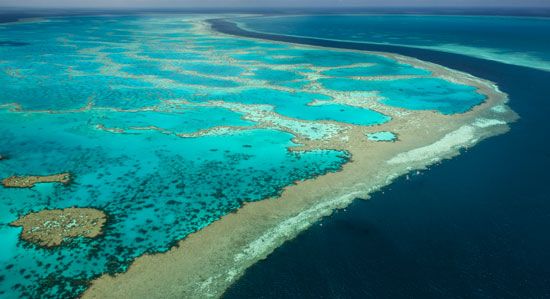
A platform reef (also known as a patch reef) is a type of coral reef typically found on continental shelves. These reefs are characterized by a primarily…
What is platform reef?
A platform reef (also known as a patch reef) is a type of coral reef typically found on continental shelves. These reefs are characterized by a primarily radial growth pattern, resulting in irregular tablelike or pinnacle features.12
The shape of a platform reef is determined by the base upon which it grows and the influence of water currents that provide nutrients. When growth forces are equal in all directions, the reef expands radially; however, if the reef develops on a sand bank, it may become elongated. Depending on environmental conditions, these reefs can evolve into various forms, such as lagoonal platform reefs or horseshoe-shaped reefs. They may exist as isolated structures or occur within the lagoons of atolls and larger reef systems.12
How do fringing reefs differ from barrier reefs?
Fringing reefs and barrier reefs are distinguished primarily by their proximity to land and the presence of a lagoon.3
- Fringing Reefs: These reefs grow directly from the shoreline of a mainland mass or a nonreef island, such as a volcanic island. They consist of flat reef areas that skirt the landmass closely.3
- Barrier Reefs: These reefs are situated several kilometers offshore. They are separated from the adjacent landmass by a deep lagoon or channel, which is often approximately 50 meters (160 feet) deep.23
According to the theory proposed by Charles Darwin, these structures often represent stages of development. As a landmass subsides or sea levels rise, a fringing reef may grow upward and outward, eventually becoming separated from the shore by an expanding body of water, thus transitioning into a barrier reef. While fringing reefs are attached to the coast, barrier reefs act as a protective perimeter, often pierced by channels that provide access to the lagoon and the land beyond.452
What causes the formation of an atoll?
The formation of an atoll is primarily explained by the subsidence theory, first proposed by Charles Darwin. This process typically involves several progressive stages:
- Fringing Reef Stage: A coral reef begins by growing around the perimeter of a volcanic island.
- Barrier Reef Stage: As the volcanic island gradually subsides or sea levels rise, the reef continues to grow upward and outward to maintain its position near the surface. This creates an intervening lagoon between the reef and the shoreline.
- Atoll Stage: Eventually, the volcanic island sinks completely below the surface, leaving behind a ring-shaped reef that encloses a central lagoon.
While subsidence is a primary driver, changes in sea level—particularly those resulting from cycles of glaciation—also play a significant role in the development of these structures. Additionally, some annular reefs may form through the subaerial erosion of uplifted reef platforms, which creates a saucer-shaped interior that becomes a lagoon upon subsequent submergence.546
What role do ocean currents play in shaping coral reefs?
Ocean currents play a vital role in shaping the physical structure and biological composition of coral reefs. Their influence is observed in several key ways:
- Geomorphology and Sedimentation: Currents, often driven by prevailing winds or tides, determine the orientation and shape of reefs. They are responsible for transporting sediment from the reef surface to the leeward side, where it is deposited to form cays (low sandy islands). When water velocity decreases abruptly, this sediment settles, and subsequent wind action can build dunes or stabilize the area through carbonate cementation.8
- Biological Dispersal: Currents act as a primary mechanism for the dispersal of marine organisms. Many reef-dwelling species, including fish and invertebrates, have a larval phase that is transported by currents over great distances. This process allows for the colonization of isolated areas and can even introduce tropical species to higher-latitude, cold-temperate reefs via major currents like the East Australian Current.910
- Nutrient and Food Supply: Constant water movement is essential for maintaining the health of the reef ecosystem. Currents help prevent the stratification of nutrients, ensuring a uniform supply of food for zooplankton, which in turn serve as a primary food source for corals. Furthermore, oceanic water flowing through reef openings brings in essential nutrients that support the productivity of atoll lagoons.11
Sources
- platform reef — Encyclopædia Britannica
- coral reef - Types of coral reefs — Encyclopædia Britannica
- barrier reef — Encyclopædia Britannica
- coral reef - Origin and development of reefs — Encyclopædia Britannica
- atoll — Encyclopædia Britannica
- lagoon - The effect of time — Encyclopædia Britannica
- coral island — Encyclopædia Britannica
- coral reef - Winds , currents, temperature, and salinity — Encyclopædia Britannica
- coral reef - Tropical water conditions — Encyclopædia Britannica
- Marine ecosystem - Distribution and dispersal — Encyclopædia Britannica
- coral reef - Corals and other reef-building organisms — Encyclopædia Britannica
- coral reef - Structure — Encyclopædia Britannica
- Marine ecosystem - Ocean currents — Encyclopædia Britannica
Published on · 3 min read