Coral Island
Coral reefs are essential to the formation and maintenance of coral islands, which are primarily composed of calcium carbonate derived from the skeletons of…
How do coral reefs contribute to the formation and maintenance of coral islands?
Coral reefs are essential to the formation and maintenance of coral islands, which are primarily composed of calcium carbonate derived from the skeletons of corals and associated marine organisms.12
Formation
Coral islands typically form through two primary processes:
- Accretion: Storms and waves break off fragments of reef rock, which mix with finer detritus to form shoals on the reef top. Currents and waves deposit this sediment, while wind may pile finer material into dunes. Rainwater dissolves the calcium carbonate, which then redeposits to cement the loose material into stable land.13
- Uplift: Crustal movements can raise a submarine reef system above sea level, creating rocky, plateaulike islands.1
Maintenance
Reefs maintain these islands by providing a continuous supply of sediment and structural protection. Vegetation colonizes the new land, contributing organic matter that aids soil development. Additionally, the cementation of deposits into beach rock and the growth of vegetation provide critical stability against erosion.13
What are the characteristic features of a coral island’s structure?
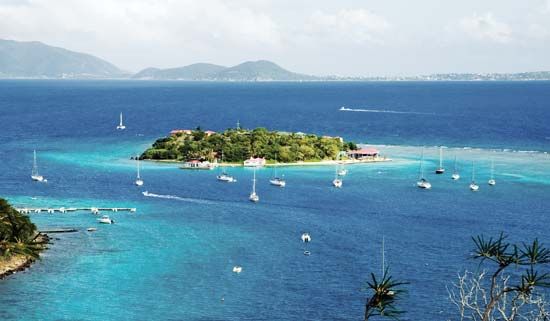
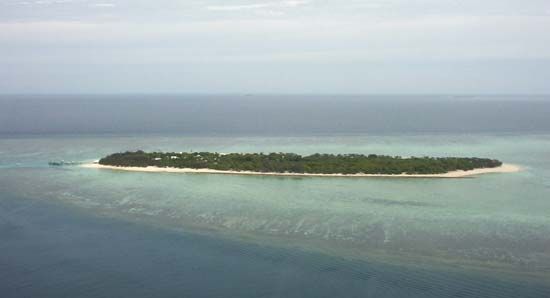
Coral islands, often referred to as cays, are characterized by their low-lying structure, typically rising only a few meters above sea level. Their physical features are defined by the following elements:16
- Composition: These islands are built from organic material, primarily calcium carbonate derived from the skeletons of corals and associated marine organisms. They are often surrounded by white coral sand beaches.1
- Topography and Shape: Cays are generally flat and can be round, oval, or irregular in outline. While they typically sit 1.5 to 3 meters (5 to 10 feet) above high-tide level, wind-blown dunes can occasionally raise the elevation higher.76
- Stability Features: The structure is often stabilized by beach rock, which forms through the cementation of sand and debris by precipitated calcium carbonate. Vegetation also plays a critical role in binding the soil and adding stability.671
- Geological Context: Geologically, a coral island is a small component of a larger coral reef system. In the case of islands formed by uplift, the structure may appear as a rocky, plateaulike feature with cliffs and surfaces sculpted by solution weathering, sometimes retaining the circular shape of an atoll.1
How do coral islands differ from volcanic islands in terms of their geology?
Coral islands and volcanic islands differ fundamentally in their origins, composition, and geological processes.
Coral Islands
- Origin: These islands are formed by organic processes, specifically through accretion (the accumulation of reef debris) or uplift (crustal movements raising a reef system above sea level).1
- Composition: They are built from calcium carbonate derived from the skeletons of corals and other marine organisms. They are typically low-lying, often rising only a few meters above sea level.1
- Geological Context: They are an integral part of a living or recent coral reef system and are generally found in tropical regions.1
Volcanic Islands
- Origin: These islands are formed by volcanism, where molten rock is discharged onto the surface. This often occurs at subduction zones where tectonic plates converge, or over hot spots within a plate.910
- Composition: They are built from the extrusion of basaltic and andesitic magmas from the seafloor.910
- Geological Context: They are often associated with island arcs or chains of volcanoes that mark tectonic plate movement. Unlike coral islands, they are characterized by intense seismic and volcanic activity.91011
What are the main types of coral islands and how do they form?
Coral islands are tropical landmasses composed of organic material, primarily the skeletons of corals and other marine organisms. They are typically low-lying, often rising only a few meters above sea level, and are integrally linked to coral reef systems.1
Formation Processes
There are two primary ways these islands are formed:
- Accretion: This is the most common method for modern reef islands. Storms and waves break off pieces of reef rock, which mix with finer detritus. This material accumulates on the reef top, where it is cemented together by the precipitation of calcium carbonate. Over time, wind may form dunes, and vegetation helps stabilize the land.1
- Uplift: In this process, crustal movements raise a submarine reef system above sea level. These islands are typically rocky, featuring cliffs and surfaces shaped by solution weathering. They often retain the circular shape of an atoll, sometimes with a dry or shallow interior basin1.
Main Reef Categories
Coral islands are associated with four main types of reef structures:
- Fringing reefs: Skirt the edge of a non-reef landmass, such as a volcanic island.1
- Barrier reefs: Lie offshore, separated from a landmass by a lagoon.1
- Atolls: Circular or ring-shaped reefs that enclose a lagoon but lack a central landmass. According to the subsidence theory, these often represent the final stage of reef growth around a sinking volcanic island.11314
- Patch reefs: Irregular, tablelike, or pinnacle-shaped reefs that can occur within lagoons or as isolated developments.1
Sources
- coral island — Encyclopædia Britannica
- atoll — Encyclopædia Britannica
- coral reef - Origin and development of reefs — Encyclopædia Britannica
- coral reef - Corals and other reef-building organisms — Encyclopædia Britannica
- coral reef - Winds , currents, temperature, and salinity — Encyclopædia Britannica
- coral reef - Structure — Encyclopædia Britannica
- coral reef - Types of coral reefs — Encyclopædia Britannica
- cay — Encyclopædia Britannica
- volcano - Submarine volcanoes — Encyclopædia Britannica
- island arc — Encyclopædia Britannica
- volcanism — Encyclopædia Britannica
- volcano - Volcanism and tectonic activity — Encyclopædia Britannica
- atoll — Merriam-Webster
- atoll — Merriam-Webster
- lagoon - The effect of time — Encyclopædia Britannica
- atolls — Merriam-Webster
Published on · 4 min read