Prinia
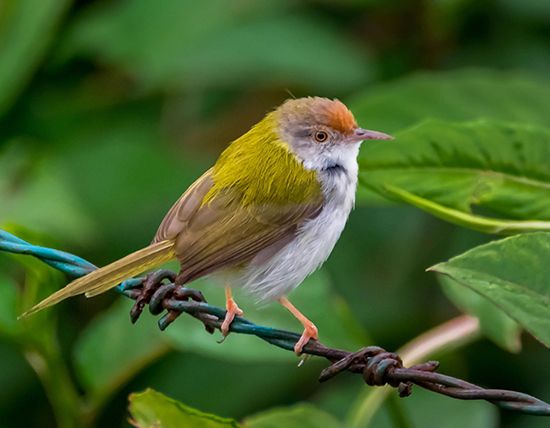
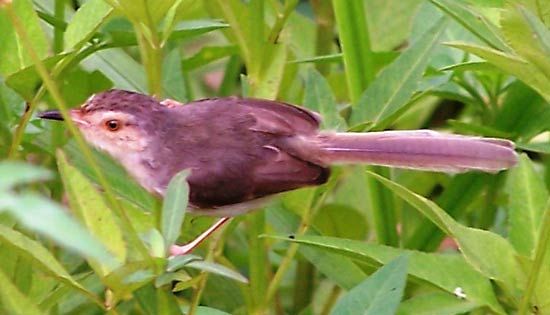
A prinia is a small bird belonging to the genus Prinia, which is part of the Old World warbler family, known as Sylviidae.
What is Prinia?
A prinia is a small bird belonging to the genus Prinia, which is part of the Old World warbler family, known as Sylviidae.1
Often referred to as wren-warblers or longtail warblers, these birds are characterized by their long, graduated tails that are frequently held in an upright, wren-like position. Measuring between 10 and 15 centimeters (4 to 6 inches) in length, prinias are typically more distinctly marked than many other members of their family. They are notable for constructing intricate, purse-shaped nests that are suspended from twigs or attached to tall grasses, often by sewing the nest directly to the surrounding foliage.1
These birds are found in various regions, including much of sub-Saharan Africa and across Asia from Bangladesh to Indochina, where they inhabit garden shrubbery and rank vegetation. Well-known species include the tawny-flanked prinia, the black-chested prinia of southern Africa, and the ashy prinia, which is among the most common birds in India.1
How do prinias construct their unique purselike nests?
Prinias are renowned for their intricate, beautifully woven, purselike nests. These structures are typically suspended from twigs or securely attached to tall grass stalks to provide stability and protection for their young.1
A defining feature of their nest-building behavior is the use of a sewing technique: the birds often stitch the nest directly to the surrounding foliage, effectively anchoring it to the plant life in their habitat. This specialized construction method allows them to create secure, sheltered environments within the rank growth and garden shrubbery they inhabit.1
What are the main differences between Old World warblers and other bird families?
Old World warblers, belonging to the family Sylviidae, are distinguished from other bird families—such as the New World wood warblers (Parulidae)—by several key anatomical and biological characteristics.
Anatomical Differences
- Wing Structure: A primary distinction is that Old World warblers possess 10 primary feathers in each wing, whereas New World wood warblers have only nine.23
- Physical Appearance: Old World warblers are generally drab in color, with plumage dominated by shades of green, olive, brown, buff, and gray. In contrast, New World wood warblers are often more brightly colored.43
- General Morphology: Members of the Sylviidae family are small, active birds (9 to 26 cm) with slender bills adapted for gleaning insects from foliage. They typically feature medium, rounded wings and weak legs and feet.423
Behavioral and Ecological Distinctions
- Nesting Habits: While both groups share similar feeding and nesting habits, Old World warblers are noted for diverse nest designs, ranging from simple cups to elaborate, domed structures. Some species, such as the tailorbirds, exhibit unique behaviors like sewing leaves together to create purse-shaped nests.4
- Evolutionary Context: Passerines, the order to which these birds belong, are characterized by high behavioral plasticity and complex nest-building, which allowed them to move into diverse ecological zones. Unlike their predecessors, which were often restricted to cavity-nesting, the flexible nesting behaviors of passerines like the Sylviidae facilitated their evolutionary success.5
It is important to note that while New World wood warblers share a name and superficial resemblance to Old World warblers, they are actually more closely related to tanagers.4
How does the long tail of a prinia help it survive in its habitat?
The long, graduated tail of a prinia is a defining characteristic that aids in its survival and movement within its habitat. Like other birds, a prinia’s tail works in conjunction with its wings to provide essential balance and maneuverability during flight, helping the bird navigate through the rank growth and garden shrubbery where it typically resides.167
While the specific evolutionary advantages of the prinia’s tail are not detailed in isolation, bird tails generally serve as critical tools for steering and maintaining stability in the air. In many species, long tails are also associated with rapid, direct flight, allowing birds to move efficiently through their environments. Furthermore, in the broader context of avian biology, such features can play a role in social signaling or mate attraction, as seen in other species where elaborate tail structures are favored through natural selection.7869
Sources
- Prinia — Encyclopædia Britannica
- Warbler — Encyclopædia Britannica
- Sylviidae — Encyclopædia Britannica
- Passeriform - Evolution and paleontology — Encyclopædia Britannica
- Passeriform - Annotated classification — Encyclopædia Britannica
- primate - General structure — Encyclopædia Britannica
- Why Do Animals Have Tails? — Encyclopædia Britannica
- Psittaciform - General features — Encyclopædia Britannica
- Passeriform - Size range and structural diversity — Encyclopædia Britannica
- Runaway selection hypothesis — Encyclopædia Britannica
- Tail — Encyclopædia Britannica
- Bird - Flight — Encyclopædia Britannica
Published on · 3 min read