Rhinoceros
Rhinoceros populations face significant existential threats, primarily driven by human activity. While historical declines were largely caused by sport…
What are the primary threats to rhinoceros populations and conservation efforts?
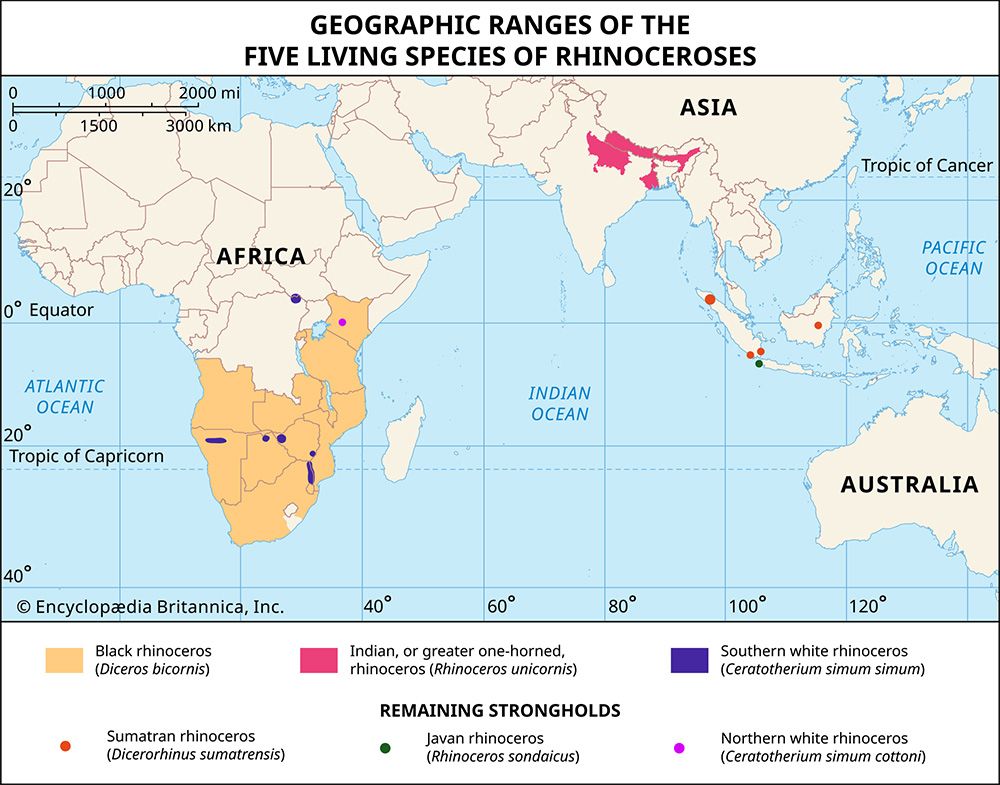
Rhinoceros populations face significant existential threats, primarily driven by human activity. While historical declines were largely caused by sport hunting and the conversion of natural habitats into agricultural land, the most critical modern threat is poaching.12
Primary Threats
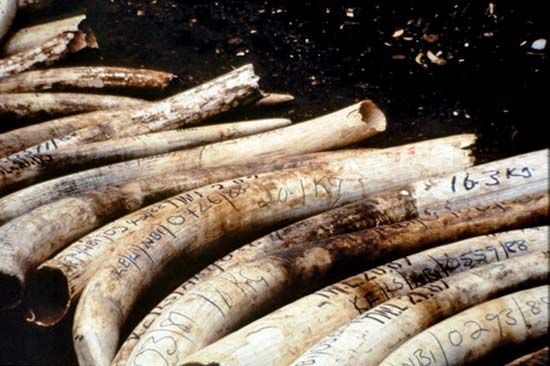
- Poaching for Horns: Rhinoceroses are illegally killed for their horns, which are in high demand for use in traditional medicines and as decorative items like dagger handles. This illegal trade is a major driver of biodiversity loss and has pushed several species to the brink of extinction.123
- Habitat Loss: The expansion of human settlements and the conversion of land for agriculture continue to restrict the geographic range of rhinoceroses, forcing them into isolated pockets within parks and reserves.12
- Enforcement Challenges: Protecting these animals is extremely costly. Wildlife officials struggle to secure vast reserves—some covering tens of thousands of square kilometers—against well-organized poaching operations. The financial burden of these security measures often exceeds the budgets of many governments.14
Conservation efforts, including international agreements like the Convention on International Trade in Endangered Species, aim to curb the trade of wildlife products, but the future of many populations remains precarious.13
How do rhinoceroses differ in size and appearance across species?
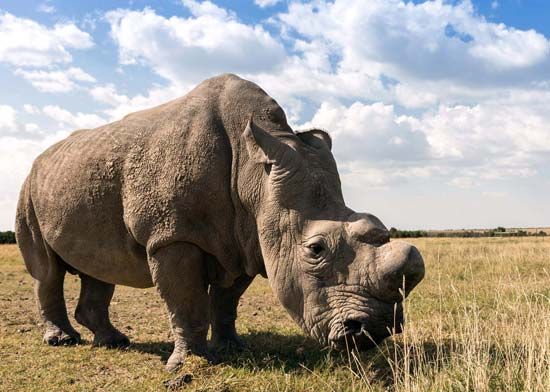
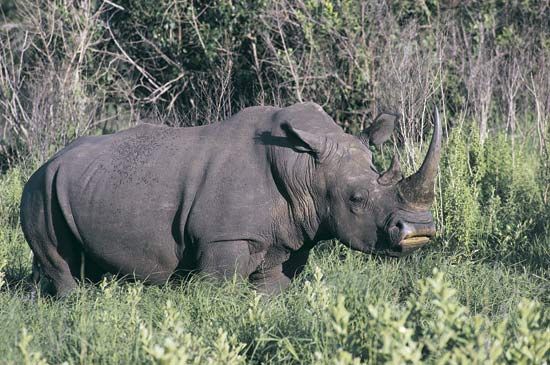
Rhinoceroses are among the largest living land mammals, though their size and appearance vary significantly across the five extant species. All species share thick, gray-to-brown skin that often forms platelike folds, particularly around the shoulders and thighs, and they possess one or two horns composed of keratin.4
Size and Physical Characteristics
Species
Size (Approx. Height/Length)
Key Distinguishing Features
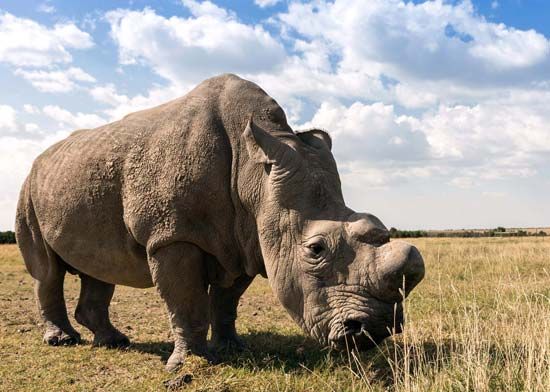
White Rhinoceros
Up to 2m high, 4m long
Largest species; broad, square muzzle for grazing.
Indian Rhinoceros
2m high, 3.5m long
Large, single horn; distinct skin folds and tubercles.
Black Rhinoceros
Varies; smaller than white
Prehensile (pointed) lip for browsing.
Javan Rhinoceros
Smaller than Indian
Lesser one-horned; smaller stature.
Sumatran Rhinoceros
1–1.5m high
Smallest species; possesses two horns.
Notable Differences
- Horns and Teeth: African species (white and black) lack the long, razor-sharp lower incisors found in Asian species and instead use their horns for fighting. In contrast, Asian species (Indian, Javan, and Sumatran) utilize these tusklike teeth to inflict lethal wounds during territorial disputes.46
- Hair and Skin: While most modern rhinoceroses are nearly hairless, the Sumatran rhinoceros is an exception, retaining more hair than its relatives. The Indian rhinoceros is specifically noted for the prominent tubercles and unique arrangement of skin folds on its body.456
- Dietary Adaptations: Physical differences often reflect feeding habits; for example, the white rhinoceros has a broad, square muzzle adapted for grazing on short grasses, whereas the black rhinoceros has a pointed, prehensile lip suited for browsing on shrubs and trees.5
What are some unique behavioral characteristics of rhinoceroses?
Rhinoceroses exhibit several unique behavioral characteristics that distinguish them from other large mammals. While most species are solitary, the white rhinoceros is an exception, living in groups of up to 10 animals. Because they are generally solitary, individuals often mark their home territories with piles of dung and urine, and they maintain well-worn trails throughout their range.5
Communication and Sensory Adaptations
Rhinoceroses possess poor eyesight but rely on acute senses of hearing and smell. To communicate, they utilize infrasonic frequencies—sounds below the threshold of human hearing—which allow them to maintain contact in dense vegetation. They also use a variety of vocalizations, including snorting, squealing, bellowing, and whistling.57
Social and Reproductive Behavior
- Courtship: Because they are largely solitary, rhinoceroses engage in elaborate courtship rituals. This often involves a chase followed by low-intensity fighting, after which the male rests his head on the female’s rump before mating.4
- Parental Care: Rhinoceroses give birth to precocial young that can stand shortly after birth—a black rhinoceros calf has been observed standing within 25 minutes. While white rhinoceros calves typically walk ahead of their mothers, black rhinoceros calves often have a “lying-out” period where they rest in thick cover. Offspring may remain with their mothers for two and a half years or longer.8
Aggression and Body Care
- Fighting: Fights are typically characterized by charges and vocal threats. While African species fight using their horns, Asian species utilize their razor-sharp lower incisors, or tusks, to inflict lethal wounds.59
- Wallowing: All rhinoceros species practice wallowing in mud, which helps regulate body temperature and serves as a form of self-grooming. They often spend hours in pools during hot weather and may rub against tree trunks or stumps after a wallow.10
What is the rhinoceros’s diet and how does it affect their habitat?
Rhinoceroses are primarily herbivores that function as either grazers or browsers, depending on the species and its physical adaptations. Their dietary habits significantly influence their local ecosystems and habitat structure.6512
Dietary Specializations
- Grazers: The white rhinoceros is a highly specialized grazer with a broad, square muzzle designed for feeding on short grasses. The Indian rhinoceros is also primarily a grazer, inhabiting tall grasslands, though it may shift to browsing during the winter months.5412
- Browsers: Species such as the black rhinoceros, Javan rhinoceros, and Sumatran rhinoceros are browsers. They possess a pointed, prehensile upper lip used to pluck leaves, twigs, and succulent plants from shrubs and trees. These species may actively break down vegetation to access otherwise unreachable foliage.45
Impact on Habitat
Rhinoceroses play a vital role in shaping their environments through their feeding and waste-disposal behaviors:
- Seed Dispersal: By ingesting fruits and plants, rhinoceroses act as essential agents of seed dispersal. Their dung serves as a nutrient-rich medium that supports the germination of various plant species.12
- Vegetation Colonization: The dung piles, or middens, created by Indian rhinoceroses provide specific sites where shade-intolerant trees can colonize open areas, effectively altering the composition of the local flora.12
Sources
- conservation - Protecting species — Encyclopædia Britannica
- poaching — Encyclopædia Britannica
- black rhinoceros — Encyclopædia Britannica
- perissodactyl - Rhinoceroses — Encyclopædia Britannica
- rhinoceros — Encyclopædia Britannica
- Indian rhinoceros — Encyclopædia Britannica
- perissodactyl - Courtship and mating — Encyclopædia Britannica
- perissodactyl - Expression and communication — Encyclopædia Britannica
- perissodactyl - Fighting — Encyclopædia Britannica
- perissodactyl - Relations between parent and offspring — Encyclopædia Britannica
- perissodactyl - Rolling and wallowing — Encyclopædia Britannica
- perissodactyl - Feeding — Encyclopædia Britannica
- artiodactyl - Food habits — Encyclopædia Britannica
Published on · 5 min read