River Aire
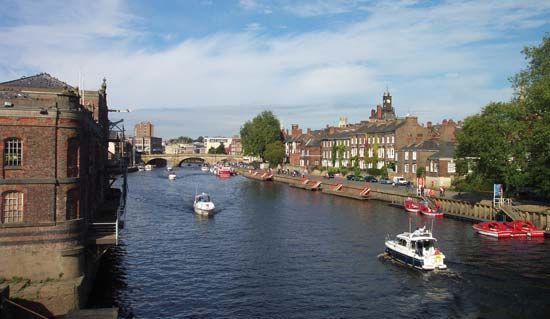
The River Aire is a 70-mile (113-kilometer) river located in northern England. It rises at Malham Tarn in North Yorkshire and flows southeastward through…
What is River Aire?
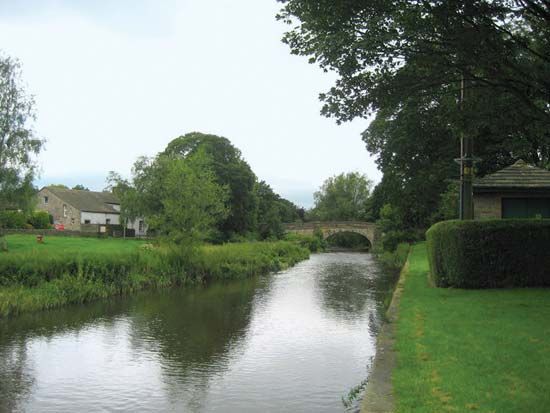
The River Aire is a 70-mile (113-kilometer) river located in northern England. It rises at Malham Tarn in North Yorkshire and flows southeastward through West Yorkshire before joining the River Ouse at the border of the East Riding of Yorkshire1.12
The river’s upper course flows through a deep, scenic valley known as Airedale, which is noted for its dairy and poultry agriculture. As the river leaves the Pennines, it crosses the Yorkshire coalfield and is joined by its major tributary, the River Calder. Leeds serves as the principal city situated along its banks.1
What is the significance of the Pennines in English geography?
The Pennines are a major upland mass that serves as the geographical “backbone” or “spine” of northern England. Extending from Northumberland in the north to Derbyshire in the south, they act as a critical north-south watershed that dictates the flow of all major rivers in the region.3
Geologically, the system is composed primarily of carboniferous limestone and Millstone Grit. This structure has been shaped by glacial action and water erosion, resulting in distinctive scenery characterized by deep valleys known as dales, rounded summits, and remarkable underground caverns and watercourses.3
Beyond their physical prominence, the Pennines are economically and historically significant:
- Water Supply: Reservoirs in the Millstone Grit areas provide essential water to the industrial regions of West Yorkshire and Lancashire.3
- Economy: The region supports sheep farming, limestone quarrying, and a robust tourism industry centered on national parks like the Peak District.3
- Heritage: The area contains significant prehistoric sites and Hadrian’s Wall, a historic Roman defensive line.3
How did the Yorkshire coalfield influence the development of cities like Leeds?
The Yorkshire coalfield was a fundamental driver in the transformation of Leeds from a regional market town into a major industrial powerhouse. During the Industrial Revolution, the availability of locally mined coal provided the essential steam power required to fuel large-scale manufacturing, allowing the city to move beyond its traditional reliance on waterpower.45
This shift in energy source facilitated a significant industrial evolution:
- Diversification of Industry: While Leeds was already established as a cloth-finishing center, the development of the coalfield helped the city surpass its woolen-manufacturing roots. Engineering became a dominant sector, and for a period, the city also saw significant growth in linen and pottery production.4
- Locomotive Engineering: The combination of coal-powered industry and the expansion of the railway network after 1848 established Leeds as a premier center for locomotive engineering.4
- Economic Foundation: The coal and iron ore deposits in the locality, paired with the city’s strategic transportation links through the Pennines, solidified Leeds’s status as the industrial capital of Yorkshire.4
What are some other major rivers in Northern England?
Northern England features a complex network of rivers, many of which originate in the Pennines, the region’s primary watershed. These rivers are generally categorized by whether they flow westward toward the Irish Sea or eastward toward the North Sea.783
Westward-Flowing Rivers
Rivers flowing west from the Pennines typically have shorter courses to the Atlantic Ocean or the Irish Sea. Notable examples include:83
- River Eden: A significant river in northwestern England.83
- River Mersey: Known for its historical importance to trade and industry.83
- River Ribble: Originates in the Pennines and flows westward.3
Eastward-Flowing Rivers
Rivers flowing east are generally longer and often coalesce into wide estuaries before reaching the North Sea. Key rivers include:83
- River Tyne: Flows through Newcastle upon Tyne and has a long history of supporting coal transport.98
- River Tees: Flows independently to the North Sea.83
- River Ouse: Drains the central Pennines and flows through York before joining the River Humber/York-England) before joining the River Humber.8
- River Aire: A major tributary that drains into the Humber.83
- River Trent: A significant river that also contributes to the Humber estuary.83
Sources
- River Aire — Encyclopædia Britannica
- Aire — Merriam-Webster
- Pennines — Encyclopædia Britannica
- Leeds — Encyclopædia Britannica
- West Yorkshire — Encyclopædia Britannica
- England - Yorkshire — Encyclopædia Britannica
- River Tyne — Encyclopædia Britannica
- River Ouse — Encyclopædia Britannica
- United Kingdom - Drainage — Encyclopædia Britannica
- England - Drainage of England — Encyclopædia Britannica
Published on · 3 min read