Roan Antelope
The roan antelope (Hippotragus equinus) is a powerfully built, large African antelope characterized by its sturdy limbs, thick neck, and an upstanding mane…
What are the physical characteristics of the roan antelope?
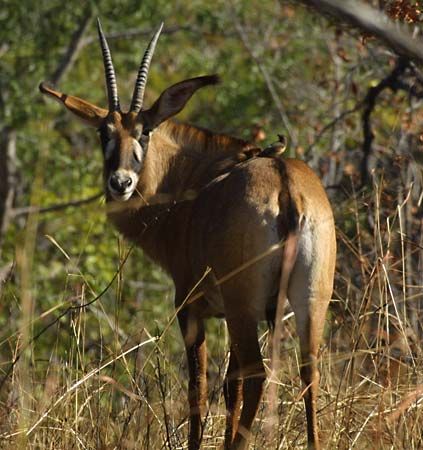
The roan antelope (Hippotragus equinus) is a powerfully built, large African antelope characterized by its sturdy limbs, thick neck, and an upstanding mane and beard. Its head is long and narrow with a wide gape and long, tasseled ears. The animal’s coat ranges from reddish gray to reddish brown, complemented by a distinctive black-and-white facial mask.1
Both sexes are similar in appearance and stand between 126 and 150 cm (50–59 inches) tall. Males are generally heavier, weighing approximately 280 kg (620 pounds) compared to 260 kg (570 pounds) for females. Both sexes possess sickle-shaped horns, though those of the male are thicker and 10–20 percent longer, measuring between 55 and 99 cm (22–39 inches).1
Known for their aggressive temperament, roan antelopes are considered formidable animals. They utilize their curved horns and a sideways stabbing technique to defend themselves, and they have even been known to kill lions that fail to overpower them quickly.1
What role do roan antelopes play in their ecosystem?
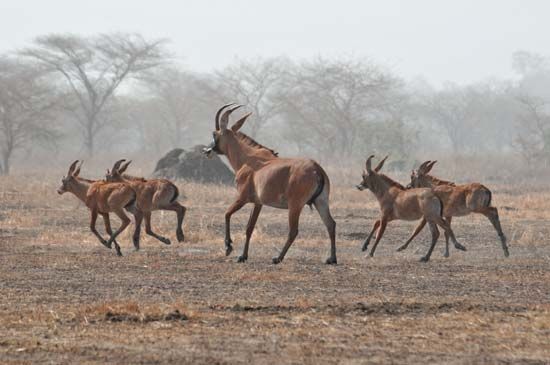
The roan antelope (Hippotragus equinus) functions primarily as a grazer within its ecosystem, specifically favoring open habitats characterized by taller, ranker perennial grasses. By consuming these specific types of vegetation, the roan antelope helps parcel out food resources among the various artiodactyls present in its environment, minimizing competition with other species that may prefer different grass heights or foliage.14
As a large, sedentary herbivore, the roan antelope is an integral part of the savanna food web. While they are formidable enough to defend themselves against predators—sometimes even killing lions that fail to overpower them quickly—they also serve as prey for other carnivores, such as leopards, which may target vulnerable juvenile subgroups. Their presence and feeding habits contribute to the complex ecological balance of the African savanna, where grazing successions and resource partitioning enable diverse species to coexist by utilizing different environmental niches.14
How does the diet of roan antelopes change throughout the year?
The provided search results do not contain specific information regarding how the diet of the roan antelope (Hippotragus equinus) changes throughout the year.
While the literature notes that the roan antelope is a grazer and browser that favors open areas with taller, ranker perennial grasses, and that many artiodactyls may shift their diet based on seasonal availability, the specific seasonal dietary transitions for the roan antelope are not detailed in the available data.
What is the gestation period for roan antelopes, and how many calves do they typically have?
The roan antelope (Hippotragus equinus) has a gestation period of approximately 9 to 9.5 months. Females typically produce a single calf at roughly 10.5-month intervals.1
After birth, the calf undergoes a 2 to 3-week hiding stage before joining the maternal herd. Within the herd, these calves often associate with other juveniles in groups known as creches. While the species is known for its formidable defensive capabilities, these juvenile subgroups can be vulnerable to predators like leopards when they are left behind during herd movements.1
Sources
- roan antelope — Encyclopædia Britannica
- antelope — Encyclopædia Britannica
- roan antelope — Merriam-Webster
- artiodactyl - Food habits — Encyclopædia Britannica
Published on · 2 min read