Oribi
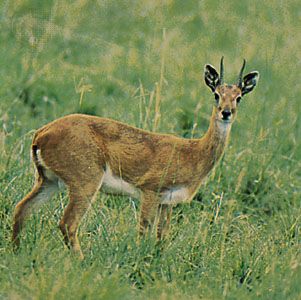
The oribi (Ourebia ourebi) is a unique dwarf antelope that functions primarily as a grazer. Its diet consists mainly of tall grass, which also provides…
What is the diet of an oribi and how does it forage for food?
The oribi (Ourebia ourebi) is a unique dwarf antelope that functions primarily as a grazer. Its diet consists mainly of tall grass, which also provides essential cover. When palatable green grass is unavailable, the oribi adapts its diet to include foliage, herbs, and forbs, making it both a grazer and a browser.1
Regarding its foraging habits, the oribi is water-independent, deriving sufficient moisture directly from its food. To supplement its diet, it frequently leaves its established territory to visit mineral licks and areas of short grass, often created by the grazing activities of larger ruminants. Additionally, during the dry season, oribis seek out postburn flushes of fresh vegetation. While they typically live in pairs or small groups, these foraging behaviors can lead multiple oribis to gather on neutral ground.1
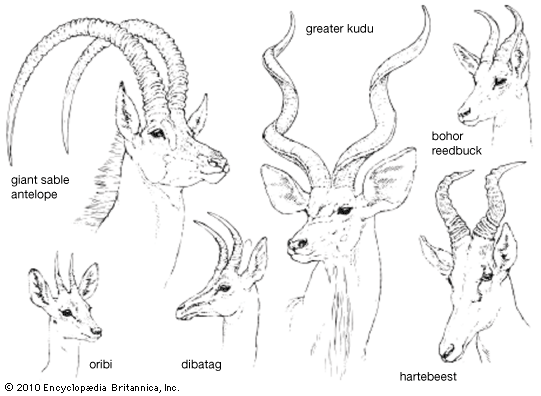
Where are oribis primarily found in Africa?
The oribi (Ourebia ourebi) is found across various regions of Africa, primarily inhabiting higher-rainfall zones where tall grass is available for cover and food. Its distribution includes:1
- Northern Savanna: The range extends from Senegal in the west to Ethiopia in the east.1
- East Africa: They are found in the coastal hinterland, extending into Tanzania.1
- South-central and Southeastern Africa: The species exists in isolated populations that reach as far south as Cape Province.1
Because the oribi relies on tall grass for both sustenance and protection, its geographic range is strictly limited to these specific savanna environments.1
What role do oribis play in their ecosystem?
The oribi plays a distinct role in the savanna ecosystem, primarily as a specialized consumer that bridges the gap between grazing and browsing. By feeding on tall grass, foliage, herbs, and forbs, the oribi helps manage vegetation growth within its territory.1
Its ecological impact is further characterized by the following behaviors:
- Vegetation Management: By consuming various plant types, oribis influence the local plant composition. During the dry season, they specifically seek out postburn flushes of vegetation, which helps them utilize areas that have been cleared by fire.1
- Interaction with Other Species: Oribis frequently visit areas of short grass created by larger ruminants. This interaction highlights their role in a complex grazing succession where different species maintain the structure of the grassland.1
- Nutrient Cycling: Through the creation of dung middens used to mark their territories, oribis contribute to localized nutrient cycling within their home ranges.1
While they are not highly social, their presence and territorial defense contribute to the overall dynamics of the African savanna, where they serve as both a consumer of primary production and a prey species for predators.1
How do oribis adapt to their habitat and what is their typical behavior?
The oribi (Ourebia ourebi) has evolved several physical and behavioral adaptations to thrive in the African savanna.
Physical and Physiological Adaptations
- Water Independence: Oribis derive sufficient moisture from their diet of grass, foliage, herbs, and forbs, allowing them to remain independent of standing water sources.1
- Speed and Agility: To evade predators, they utilize a distinctive zigzag, bounding run that reaches speeds of 40–50 km (25–30 miles) per hour.1
- Camouflage and Hiding: Their tan to reddish-brown coat provides effective cover in tall grass. Newborns remain hidden for their first month, and adults also rely on concealment to avoid detection.1
Behavioral Patterns
- Territoriality: Oribis typically live in mated pairs, defending territories of 30–100 hectares. They mark these boundaries using dung middens and tarlike secretions from their preorbital glands.1
- Social Flexibility: While usually monogamous, some populations exhibit polygamous variations, such as multiple resident females or, uniquely, cooperative territory defense by multiple males.1
- Communication: They use scent from various glands and a characteristic whistling alarm snort to communicate with family members.1
Sources
- oribi — Encyclopædia Britannica
- Savanna - Population and community development and structure — Encyclopædia Britannica
Published on · 3 min read