Sawfly
Sawflies belong to the order Hymenoptera, which includes insects that undergo complete metamorphosis. Consequently, their life cycle consists of four…
What are the different stages in a sawfly’s life cycle?
Sawflies belong to the order Hymenoptera, which includes insects that undergo complete metamorphosis. Consequently, their life cycle consists of four distinct stages:12
- Egg: The cycle begins when the adult female deposits eggs, typically into or onto a host plant.1
- Larva: Upon hatching, the insect enters the larval stage. Sawfly larvae are caterpillar-like in appearance and are distinguished from lepidopterous caterpillars by having a pair of fleshy prolegs on all body segments following the three segments that bear true legs.12
- Pupa: This is an inactive, nonfeeding stage during which the larva undergoes a dramatic transformation. Inside the pupa, larval tissues are broken down and rebuilt into adult structures, such as wings.23
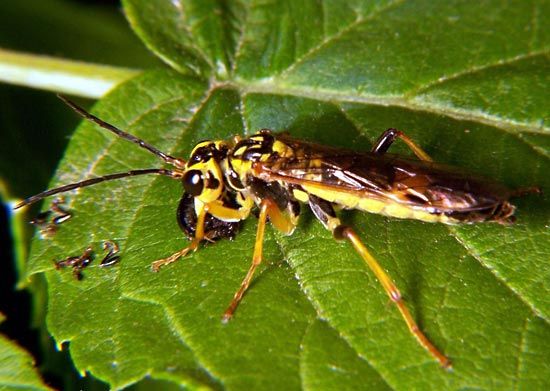
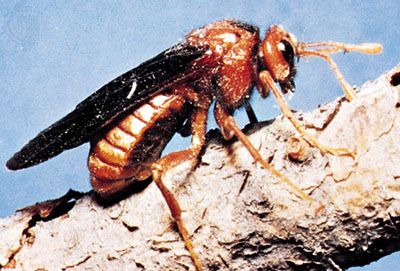
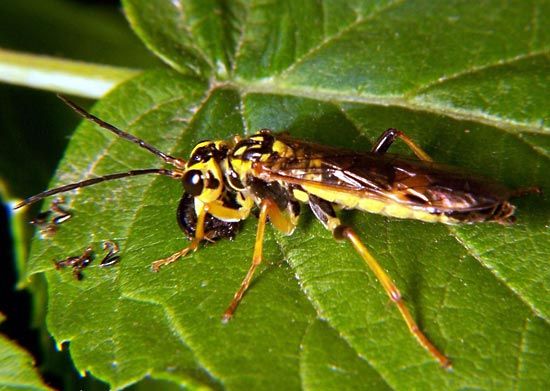
- Adult: The mature insect emerges from the pupal stage. Adult sawflies are wasplike in appearance, though they lack the constricted “waist” characteristic of many other Hymenoptera.231
Are there any natural predators or parasites that help control sawfly populations?
Sawfly populations are often managed through the use of biological control agents, particularly parasitic wasps. Because some sawfly species, such as the European spruce sawfly, can cause significant damage to forests and crops, researchers have introduced specific parasitic wasps from their native ranges to help regulate their numbers.6
While the provided information highlights that various families of parasitic wasps—such as braconids, eulophids, and pteromalids—are effective at controlling a wide range of insect pests, it specifically notes that parasitic wasps have been successfully utilized to combat sawfly outbreaks. These parasitoids typically lay their eggs on or within the host larvae, eventually killing the host as the wasp larvae develop.67
Beyond these specialized parasites, sawflies are also subject to predation by generalist insectivores, including birds, small mammals, and other predatory insects, which help keep populations in check within their natural ecosystems.8
What distinguishes sawflies from other insects in the order Hymenoptera?
Sawflies are considered the most primitive members of the order Hymenoptera and are distinguished from other members of the order—such as bees, ants, and wasps—by several key physical and biological characteristics:910
- Body Structure: Unlike most other Hymenoptera, which possess a narrow, constricted “waist” between the thorax and abdomen, sawflies have a broad midsection.91011
- Ovipositor Function: While the ovipositor in most Hymenoptera is modified for stinging or piercing, in sawflies, it is modified into a sawlike tool used to cut slits into plant leaves or stems for egg deposition.11
- Larval Appearance: Sawfly larvae are caterpillar-like and can be distinguished from lepidopterous caterpillars by their leg structure; they possess a pair of fleshy prolegs on all body segments following the three segments that bear true legs.10
- Dietary Habits: With the exception of the rare parasitic wood wasp family Orussidae, all sawflies are phytophagous (plant-eating), whereas other Hymenoptera exhibit a wide range of feeding habits, including carnivorous and omnivorous diets.91
How did sawflies get their name, and what are their characteristic features?
Sawflies derive their name from the unique, sawlike ovipositor possessed by the females of the species. This specialized organ is used to cut slits into the leaves or stems of plants, allowing the female to deposit her eggs securely within the plant tissue.9112
As members of the suborder Symphyta, sawflies are considered the most primitive group within the order Hymenoptera. Their characteristic features include:
- Body Structure: Unlike most other Hymenoptera, such as bees and wasps, sawflies lack a constricted “waist” between the thorax and abdomen, possessing a broad midsection instead.9141
- Larval Appearance: Their larvae are caterpillar-like and can be distinguished from those of Lepidoptera (butterflies and moths) by their leg structure. Sawfly larvae possess a pair of fleshy prolegs on every abdominal segment, whereas lepidopterous caterpillars have prolegs only on specific segments.1415
- Diet: With the exception of the rare parasitic wood wasp family Orussidae, all sawflies are phytophagous, meaning they feed on plants. Many species are considered significant pests to timber, food crops, and ornamental plants.914
Sources
- sawfly — Encyclopædia Britannica
- Metamorphosis — Encyclopædia Britannica
- Diptera - Adult — Encyclopædia Britannica
- pupa — Encyclopædia Britannica
- Lepidoptera - Pupa , or chrysalis — Encyclopædia Britannica
- Coleoptera - Beetles as prey — Encyclopædia Britannica
- braconid wasp — Encyclopædia Britannica
- Hymenoptera - Economic importance — Encyclopædia Britannica
- Symphyta — Encyclopædia Britannica
- Hymenoptera — Encyclopædia Britannica
- list of ants, bees, and wasps — Encyclopædia Britannica
- Hymenoptera - External structure — Encyclopædia Britannica
- List of insects - ants , bees , and wasps (order Hymenoptera ) — Encyclopædia Britannica
- sawfly — Merriam-Webster
- caterpillar — Encyclopædia Britannica
Published on · 3 min read