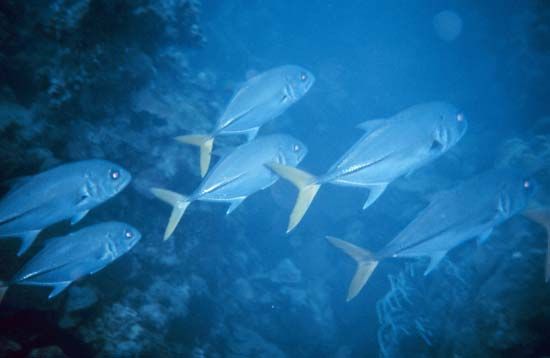
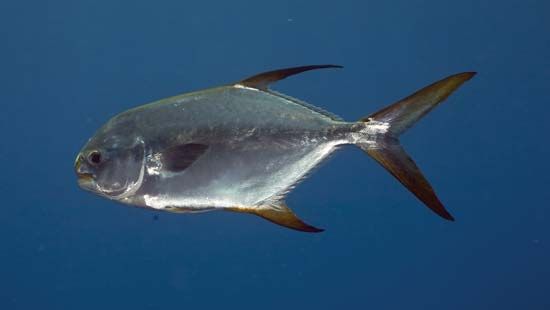
Scad
A scad is a type of carangid fish, particularly those belonging to the genus Decapterus. These fish are known for their slender, streamlined bodies and are…
What is scad?
A scad is a type of carangid fish, particularly those belonging to the genus Decapterus. These fish are known for their slender, streamlined bodies and are often found in schools in marine environments.1
What are carangid fishes?
Carangid Fishes
A carangid is any fish belonging to the family Carangidae, an order of over 200 species of swift, predatory marine fishes found primarily in warm and tropical regions worldwide. While they vary significantly in shape—ranging from elongated and streamlined to deep-bodied and thin—they share several common physical characteristics.2
Key Features
- Fins: They typically possess two dorsal fins, with the first sometimes reduced to small spines. The pectoral fins are often slim and sickle-shaped, and the tail is strong, either forked or crescent-shaped.2
- Body Structure: Many species feature a very slender tail base and a lateral line often covered with large, hard, keeled scales known as scutes.23
- Diversity: The family includes well-known forms such as jacks, pompanos, moonfish, pilot fish, and runners.2
While many carangids are valued for food or sport, some species, such as the greater amberjack, can occasionally cause ciguatera poisoning.2
What is the difference between scad and mackerel?
While scad are sometimes described as “mackerel-shaped” due to their streamlined bodies, they are distinct from true mackerel, which belong to the family Scombridae.
The primary differences include:
- Family Classification: Scad belong to the family Carangidae, which also includes jacks and pompanos. Mackerel belong to the family Scombridae, a group that also includes tunas.
- Physical Characteristics: Scad are characterized by deeply forked tails and often feature a lateral line covered with hard, keeled scales called scutes. While some scad, such as the mackerel scad (Decapterus macarellus), share a superficial resemblance to mackerel in their slender, elongated form, they are taxonomically separate.
- Coloration: Scad are typically bluish or blue-gray on their upper bodies and silvery below, whereas mackerel are often recognized by the distinct dark, wavy, or vertical stripes along their backs.
How do scientists classify different types of fish?
Scientists classify fish by examining their evolutionary history, or phylogeny, to ensure that taxonomic systems reflect the relationships between species. This modern approach has moved away from the arbitrary categorizations of the past, focusing instead on the species—the basic unit of evolution—as a population of interbreeding individuals that share a common gene pool.6
Ichthyologists rely on several key methods to establish these classifications:
- Comparative Anatomy: A primary tool is the study of the skeleton. Bones are relatively easy to observe in both living and fossilized specimens, allowing scientists to compare extant species with their ancestors.7
- External Features: Researchers analyze dimensions such as head and body length, as well as counts of characters like teeth, scales, and fin rays.7
- Modern Data: Recent advancements have incorporated data from genetics, physiology, comparative behavior, and functional anatomy to refine our understanding of fish relationships.78
Historically, classification was based on the Linnaean system, which uses a hierarchical structure (kingdom, phylum, class, order, family, genus, and species) and binomial nomenclature to name organisms. While this system remains the standard for naming, modern taxonomy now explicitly aims to recreate the evolutionary history of these animals.69
Sources
- scad — Merriam-Webster
- carangid — Encyclopædia Britannica
- jack — Encyclopædia Britannica
- scad — Encyclopædia Britannica
- mackerel scad — Merriam-Webster
- fish - Distinguishing taxonomic features — Encyclopædia Britannica
- bony fish — Encyclopædia Britannica
- clupeiform - Critical appraisal — Encyclopædia Britannica
- muscle - Jawed fishes — Encyclopædia Britannica
- Zoology - Taxonomy or systematics — Encyclopædia Britannica
- taxonomy - The Linnaean system — Encyclopædia Britannica
Published on · 2 min read