Severn River
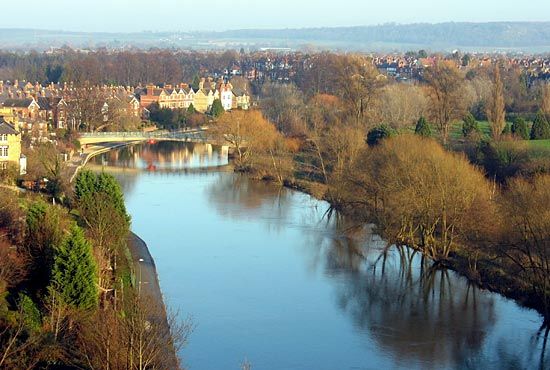
The River Severn is the longest river in Britain, stretching approximately 180 miles (290 km) from its source to its tidal waters, with an additional 40…
What is Severn River?
The River Severn is the longest river in Britain, stretching approximately 180 miles (290 km) from its source to its tidal waters, with an additional 40 miles (64 km) comprising its estuary.1
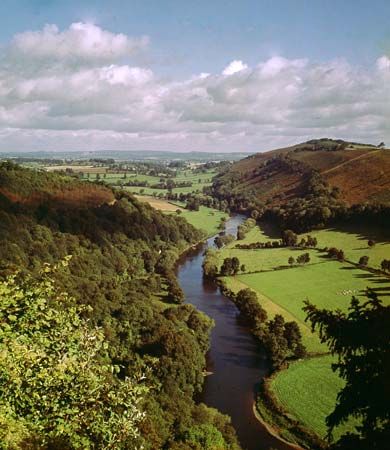
Rising near the River Wye on the slopes of Plynlimon in Wales, the river follows a semicircular path southward toward the Bristol Channel and the Atlantic Ocean. Its course was significantly altered during the Pleistocene Epoch when glacial ice blocked its original path, forcing the river to carve a new route through the gorge at Ironbridge, which later became vital to the early iron industry.1
Today, the river is crossed by notable infrastructure, including the Severn Bridge and the Prince of Wales Bridge, and is famous for the tidal bore that occurs in its estuary.1
What is a tidal bore?
A tidal bore is a powerful natural phenomenon occurring in certain rivers and estuaries where a large tidal range meets a narrow channel. During exceptionally high spring tides, the incoming tide is forced into a confined space, creating a distinct “wall of water” or a series of waves that rush upstream.2
Key characteristics of a tidal bore include:
- Movement: The bore travels upstream at two to three times the speed of a normal tidal current.2
- Flow Reversal: As the bore passes, the water’s direction changes abruptly from an outward flow toward the sea to a rapid upstream surge.2
- Structure: It typically features a well-defined front, often with breaking waves, followed by a main body of water that rises significantly higher than the water level in front of it.2
- Occurrence: Bores occur during spring tides but never during neap tides.2
Famous examples include the Qiantang River in China, the mascaret on the Seine River, and the Severn in England.2
How did the Ice Age change the river’s path?
During the Pleistocene Epoch, the River Severn originally flowed eastward to join the River Dee. However, this path was obstructed by advancing glacial ice, which blocked the river’s flow.1
As a result of this blockage, the river’s waters were forced to find a new escape route to the southeast at Ironbridge. This new course, which carved a deep gorge, was maintained even after the ice retreated following deglaciation. The resulting swift current through the gorge at Ironbridge later became a significant factor in the development of the early iron industry in the region.1
What is the history of the Ironbridge Gorge?
The Ironbridge Gorge, located in Shropshire, England, is a site of immense historical significance, widely recognized as the birthplace of the Industrial Revolution.56
Industrial Origins
In the early 18th century, the area became a major manufacturing hub after Abraham Darby demonstrated in 1709 that pig iron could be smelted using coke rather than expensive charcoal. The gorge provided an ideal environment for this industry, offering abundant supplies of coal, limestone, and waterpower, while the River Severn served as a vital artery for transporting raw materials and finished goods.576
The Ironbridge
The gorge is named after the world’s first cast-iron bridge, which spans the river. Completed in 1779 by Abraham Darby III, the structure was designed to solve the difficulties of crossing the river, which was often too shallow in summer and dangerously fast in winter. The bridge, constructed from 1,700 iron parts using woodworking techniques, became an emblem of industrial innovation.85
Legacy and Preservation
Following its completion, the bridge survived a major flood in 1795, cementing its status as a landmark of engineering. Due to structural stress and geological shifts, it was closed to vehicular traffic in 1934. Today, it remains a pedestrian crossing and a British national monument.5 In 1986, the bridge and the surrounding gorge were designated a UNESCO World Heritage site to preserve its unique industrial heritage.56
Sources
- River Severn — Encyclopædia Britannica
- tidal bore — Encyclopædia Britannica
- tidal bore — Merriam-Webster
- river - Non-fluvial invasion and deposition — Encyclopædia Britannica
- Ironbridge: Top Questions — Encyclopædia Britannica
- Ironbridge — Encyclopædia Britannica
- Shropshire — Encyclopædia Britannica
- Silurian Period - Economic significance of Silurian deposits — Encyclopædia Britannica
Published on · 3 min read