Snake-necked Turtle
Snake-necked turtles are classified within the following hierarchy:
What is the scientific classification of snake-necked turtles?
Snake-necked turtles are classified within the following hierarchy:
- Order: Testudines (turtles)
- Suborder: Pleurodira (side-necked turtles)
- Family: Chelidae
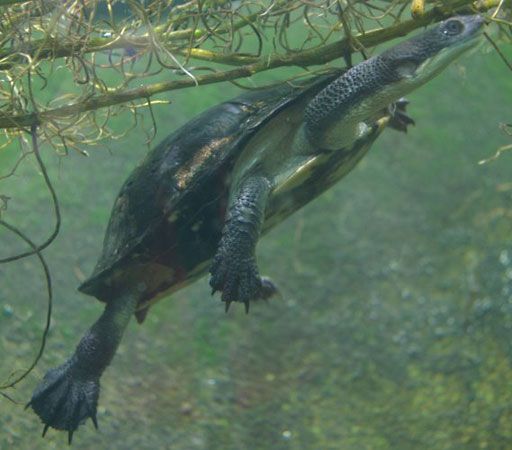
These turtles belong to the genera Chelodina and Macrochelodina. As members of the suborder Pleurodira, they are distinguished by their ability to fold their necks horizontally against their bodies, a trait that separates them from the vertical-neck-folding turtles of the suborder Cryptodira.12
What is the diet of snake-necked turtles, and how do they catch their prey?
Snake-necked turtles are carnivores that primarily feed on fish.1
To capture their prey, these turtles employ a specialized strike mechanism. While stalking, they keep their long necks folded against their bodies. Once the prey is within range, the turtle lunges its head and neck forward while simultaneously opening its mouth and throat. This action creates a vacuum that sucks both the water and the prey into the mouth. The turtle then snaps its jaws shut and may open its mouth slightly to expel the water while retaining the prey.1
How long can a snake-necked turtle’s neck extend?
Snake-necked turtles possess the longest necks of any turtle group in the world. Their necks are remarkably long, ranging from nearly as long as their shell to slightly longer than the shell itself. Because of this extreme length, the neck cannot be retracted completely beneath the margin of the shell.1
How do snake-necked turtles reproduce and care for their young?
Snake-necked turtles are egg-laying reptiles that, like most turtles, provide no parental care to their offspring once the eggs are deposited.51
Reproductive Process
The reproductive cycle begins with internal fertilization, where the male uses a penis to deposit sperm into the female’s cloaca. Females then select a site to excavate a nest chamber, typically using their hind limbs to dig. Once the eggs are laid and the chamber is closed, the female departs, leaving the eggs and eventual hatchlings to survive on their own.61
Unique Development
A notable exception in this group is the northern snake-necked turtle (Macrochelodina rugosa), which lays its eggs in nest chambers located beneath the water. These embryos undergo diapause, a period of dormancy where development stops immediately after the eggs are deposited. Development only resumes when the nesting chamber dries out during the dry season, and the turtles hatch 9 to 10 months later, just as the rainy season begins.57
Sources
- snake-necked turtle — Encyclopædia Britannica
- turtle - Classification — Encyclopædia Britannica
- annelid - Annotated classification — Encyclopædia Britannica
- bivalve - Critical appraisal — Encyclopædia Britannica
- turtle - Egg development and hatching — Encyclopædia Britannica
- reptile - Courtship and fertilization — Encyclopædia Britannica
- reptile - Embryonic development and parental care — Encyclopædia Britannica
- snake - Egg formation and laying — Encyclopædia Britannica
Published on · 2 min read