Snakehead
A snakehead is any of several species of freshwater fish belonging to the family Channidae, native to Africa and Asia. These fish are characterized by their…
What is snakehead?
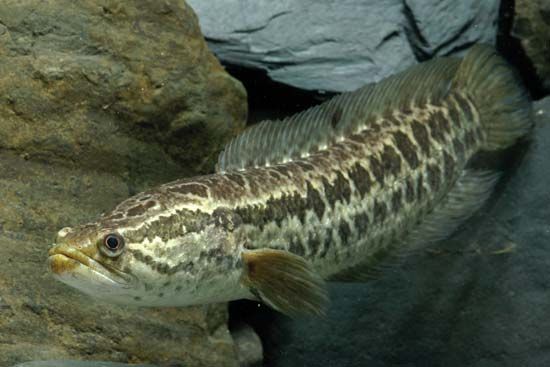
A snakehead is any of several species of freshwater fish belonging to the family Channidae, native to Africa and Asia. These fish are characterized by their long, cylindrical bodies, large mouths, and long, single dorsal and anal fins, typically ranging from 10 to 90 cm (4 to 36 inches) in length.1
Snakeheads are notable for their ability to breathe atmospheric air using vascular cavities near their gills, which allows them to survive for extended periods out of water. They are carnivorous apex predators in many freshwater ecosystems.12
While they are consumed as food in some regions, they have become a significant environmental concern in other parts of the world. Because they can travel over land and survive outside of water, they are difficult to contain when introduced to non-native environments, where they often cause ecological disruption.12
What makes an animal an invasive species?
An invasive species is any nonnative organism that significantly modifies or disrupts the ecosystems it colonizes. While many species migrate naturally, invasive species are frequently introduced to new habitats through human activities, such as global commerce, the pet trade, or international shipping.34
A species becomes invasive when it possesses a competitive advantage over indigenous organisms, allowing it to establish breeding populations and thrive, particularly in environments that lack natural predators to keep its numbers in check. These species often cause ecological harm by:3
- Outcompeting native species: They may monopolize food, living space, or other essential resources.3
- Predation: Invasive predators can be so efficient that they decimate native prey populations, sometimes leading to localized extinction.3
- Disease transmission: They can act as vectors for parasites and pathogens that native species are not equipped to resist.3
- Habitat alteration: Some species, such as invasive plants, can form dense monocultures that crowd out native vegetation or degrade land quality.35
Ultimately, these invasions reduce biodiversity and can cause significant economic damage to human communities that rely on local biological resources.3
How do scientists track the spread of non-native fish?
The provided search results focus on commercial fish-finding technologies used to locate stocks for harvesting, rather than methods specifically used by scientists to track the spread of non-native or invasive fish populations.
While modern industrial tools like sonar, echo sounders, and satellite surveys are essential for monitoring fish movement and environmental conditions in commercial contexts, the specific scientific protocols for tracking the geographic expansion of non-native species—such as environmental DNA (eDNA) sampling, tagging programs, or citizen science reporting—are not addressed in the provided information.
What are some other examples of apex predators in freshwater ecosystems?
In freshwater ecosystems, apex predators occupy the highest position in the food chain, meaning they have no natural predators of their own. These animals play a critical role in maintaining ecosystem balance by controlling the populations of other species, a process that can trigger trophic cascades that influence everything from plant growth to water quality.78
Examples of apex predators in freshwater environments include:
- Game fish: Many species of large predatory fish serve as top carnivores in lakes and rivers. Notable examples include various species of bass (Micropterus) and yellow perch.8
- Groupers and Jacks: In certain aquatic environments, these fish are recognized as apex predators because they lack natural enemies, though their populations are often vulnerable to overfishing.9
- Brown bears: While often associated with terrestrial habitats, brown bears are also considered apex predators that interact with and influence freshwater ecosystems.9
The presence of these predators is essential for the health of their habitats. When they are removed—often due to human activities like overfishing or persecution—it can lead to mesopredator release, where medium-sized predator populations explode, causing further disruption to the food web.8
Sources
- snakehead — Encyclopædia Britannica
- 9 Fish Named After Other Animals — Encyclopædia Britannica
- invasive species — Encyclopædia Britannica
- invasive species - Solutions — Encyclopædia Britannica
- invasive species - A global problem — Encyclopædia Britannica
- commercial fishing - Fish finding — Encyclopædia Britannica
- apex predator — Encyclopædia Britannica
- trophic cascade — Encyclopædia Britannica
- apex predator — Merriam-Webster
Published on · 3 min read