Spiny-finned Fish
Spiny-finned fish, members of the superorder Acanthopterygii, have developed diverse anatomical adaptations to thrive in varied aquatic environments. Their…
How have spiny-finned fish adapted to their aquatic environments?
Spiny-finned fish, members of the superorder Acanthopterygii, have developed diverse anatomical adaptations to thrive in varied aquatic environments. Their defining characteristic—fins supported by stiff, spiny rays—provides structural support and defense.12
Adaptations vary significantly by habitat:
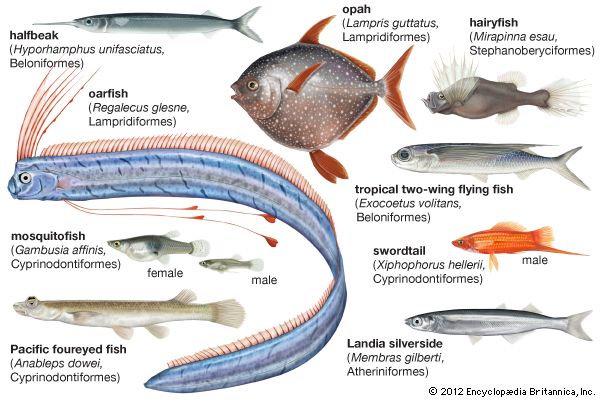
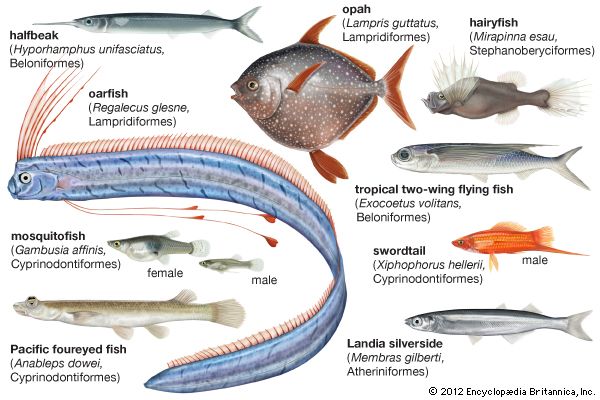
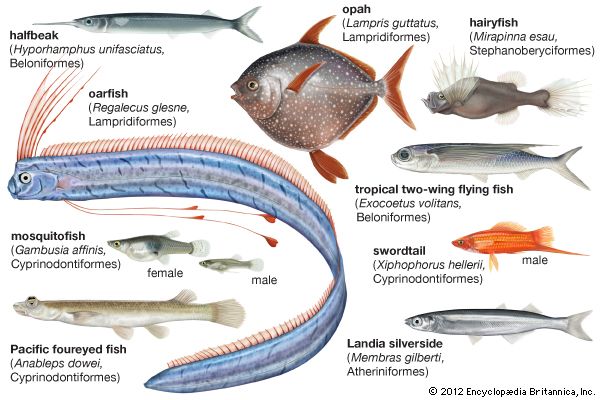
- Surface and Shallow Waters: Many atheriniforms occupy the air-water interface. A remarkable example is the four-eyed fish (Anableps), which possesses eyes divided into upper and lower sections, allowing it to see simultaneously above and below the water surface.3
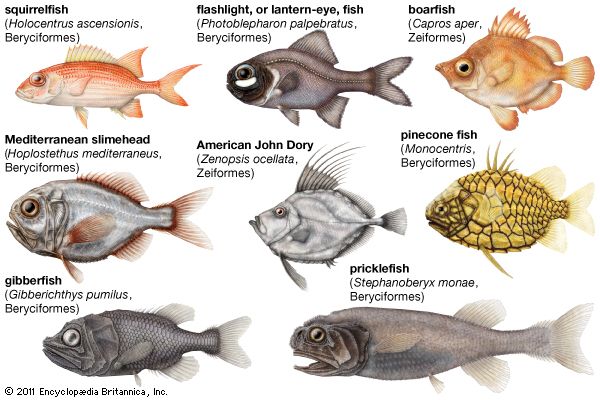
- Deep-Sea Environments: In deep-sea lineages, such as certain beryciforms and lampridiforms, evolutionary pressures have led to the reduction or loss of fin spines, decreased ossification of the skeleton, and the reduction or loss of the swim bladder, which helps these fish manage the intense hydrostatic pressure of the deep ocean.34
- Locomotion and Feeding: Many species have evolved highly protrusible jaws to capture prey efficiently, with different groups, such as the “strange-jawed” lampridiforms, developing unique mechanical methods for jaw protrusion. Additionally, features like ctenoid (serrated) scales and specialized cranial structures, such as the subocular shelf, are common adaptations among these groups.35
What are the main characteristics that define spiny-finned fish?
Spiny-finned fish belong to the superorder Acanthopterygii, a diverse group of marine and freshwater species defined primarily by the structure of their fins.17
Defining Characteristics
The primary characteristic of these fish is the presence of spiny rays in their fins, particularly in the anterior portion of the dorsal fin, as well as in the anal and ventral fins. Unlike soft rays, these spines are:184
In addition to these fin structures, many members of the Acanthopterygii are characterized by specific anatomical features, such as the absence of a duct to the air bladder, the lack of a mesocoracoid bone, and a pectoral arch that is suspended from the skull. Furthermore, their ventral fins are typically attached to the clavicular arch, and the gill opening is positioned in front of the pectoral fin.9
It is important to distinguish these from “spiny sharks” (class Acanthodii), which are an extinct group of early jawed vertebrates and are not members of the Acanthopterygii.10
What is the evolutionary history of spiny-finned fish?
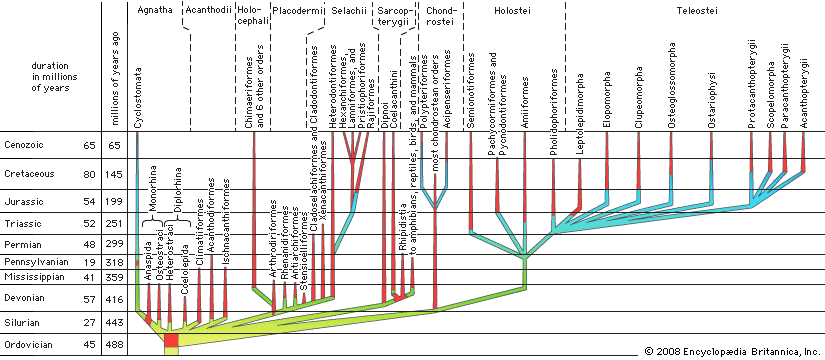
The evolutionary history of spiny-finned fish, or the superorder Acanthopterygii, is a complex narrative of radiation within the class Actinopterygii (ray-finned fishes). While the term “spiny” is often associated with the extinct Acanthodii (spiny sharks) of the Silurian and Permian periods, these are not the ancestors of modern spiny-finned fish.121314
Modern spiny-finned fish are Teleostei, a group that first appeared in the fossil record approximately 200 million years ago. They evolved from extinct holostean ancestors, specifically the Pholidophoriformes. The evolutionary trajectory of teleosts involved a long-term trend toward increased swimming efficiency, characterized by the development of a homocercal tail and a more effective feeding and gill-ventilating apparatus.10
The Acanthopterygii represent the culmination of this radiation. They likely arose from early protacanthopterygian-like ancestors, sharing evolutionary trends such as the development of spiny fin rays in the dorsal and anal fins and the formation of a subocular shelf. Their success is largely attributed to the development of a mobile, protractile mouth, which allowed them to exploit diverse ecological niches. Today, they are the dominant fishes in marine shore habitats and are also widespread in freshwater environments.10
How do spiny-finned fish differ from ray-finned fish?
Spiny-finned fish and ray-finned fish are not mutually exclusive categories; rather, spiny-finned fish are a specific group within the larger class of ray-finned fishes, known as Actinopterygii.
The primary distinction lies in the structure of their fin rays:
- Ray-finned fishes (Actinopterygii): This is the largest class of fishes, encompassing a vast array of species. While many possess flexible “soft rays” made of jointed segments of bone, the class as a whole includes diverse groups with varying fin structures.1
- Spiny-finned fish (Acanthopterygii): This superorder is defined by the presence of stiff, unbranched, and solid bony spines in their fins, particularly in the anterior portion of the dorsal fin and in the anal and ventral fins.1319
While some other ray-finned groups, such as certain ostariophysans, may develop spinous elements through the fusion of soft rays, the Acanthopterygii are characterized by these specialized spines as a primary feature. Additionally, spiny-finned fish represent a highly successful evolutionary radiation, distinguished by advanced anatomical traits like a mobile, protractile mouth and a shelf of bone under the eye, which allow them to dominate many marine and freshwater habitats.41
Sources
- spiny-finned fish — Encyclopædia Britannica
- fish - Body plan — Encyclopædia Britannica
- scorpaeniform - General features — Encyclopædia Britannica
- spiny-finned — Merriam-Webster
- atheriniform - Form and function — Encyclopædia Britannica
- Biosphere - Hydrostatic pressure — Encyclopædia Britannica
- Acanthopterygii — Merriam-Webster
- spiny ray — Merriam-Webster
- ostariophysan - Fin spines and adipose fin — Encyclopædia Britannica
- spiny shark — Encyclopædia Britannica
- spiny-rayed — Merriam-Webster
- fish - Acanthodii: early jawed fishes — Encyclopædia Britannica
- fish - Actinopterygii: ray-finned fishes — Encyclopædia Britannica
- atheriniform - Annotated classification — Encyclopædia Britannica
- skeleton - General features — Encyclopædia Britannica
- chondrichthyan - Evolution — Encyclopædia Britannica
Published on · 4 min read