Spiny Shark
The term "spiny shark" refers to a group of over 150 extinct fish species traditionally classified in the class Acanthodii. Appearing during the Silurian…
What is spiny shark?
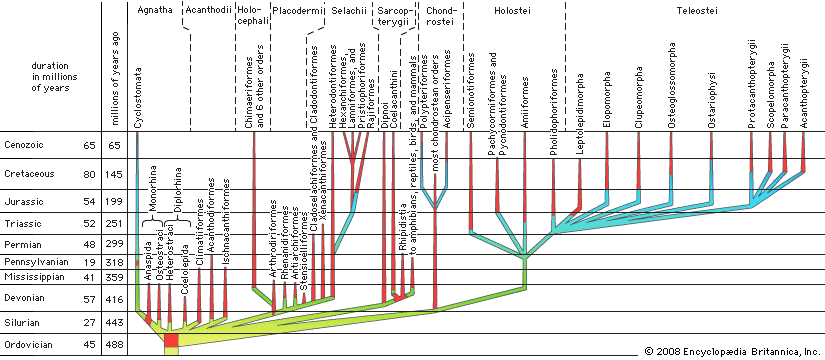
The term “spiny shark” refers to a group of over 150 extinct fish species traditionally classified in the class Acanthodii. Appearing during the Silurian Period and persisting into the Permian Period, they are considered by many paleontologists to be the earliest known jawed vertebrates.12
They are named for the characteristic spines located in front of several of their fins. While most were small—typically under 25 cm—some species, such as Gyracanthus, reached lengths of approximately 2 meters. Their evolutionary classification remains a subject of significant debate, as they exhibit a mosaic of features found in both cartilaginous fishes and bony fishes. Some researchers suggest they were early bony fishes with sharklike traits, while others argue their jaw structure indicates a closer relationship to early cartilaginous fishes.21
What are the main differences between cartilaginous and bony fishes?
The primary distinction between cartilaginous and bony fishes lies in the composition of their skeletons and specific anatomical structures.
Skeletal Composition
- Cartilaginous Fishes (Chondrichthyes): As the name implies, these fishes—which include sharks, rays, and skates—possess skeletons composed wholly or largely of cartilage. Their vertebral columns consist of cartilaginous, partly calcified centra.345
- Bony Fishes (Osteichthyes): These fishes possess skeletons that are at least partially ossified (bony). In advanced species, such as salmon and cod, the vertebrae are completely ossified.5
Anatomical and Physiological Differences
- Gill Structures: In cartilaginous fishes, each gill arch is covered by a flap of skin, and they often utilize a spiracle to assist in water intake. In contrast, bony fishes have evolved a single, movable bony covering for the entire gill chamber known as the [operculum].64
- Reproduction: All cartilaginous fishes employ internal fertilization and typically lay large, heavy-shelled eggs or give birth to live young. Bony fishes exhibit a wider range of reproductive strategies, including a higher prevalence of [hermaphroditism] compared to other vertebrate groups.7
How do scientists use fossils to study extinct animals?
Scientists use fossils as a primary source of data to reconstruct the history of life on Earth and understand the biology of extinct animals. Through the study of paleontology, researchers employ several key methods:1112
- Comparative Anatomy: By comparing the structures of fossilized remains with those of living animals, scientists can infer functional characteristics, evolutionary relationships, and adaptive changes. This helps distinguish between homologous structures—which indicate common ancestry—and analogous structures, which arise from similar environmental pressures.111314
- Environmental Reconstruction: Fossils provide clues about ancient climates and habitats. For instance, the presence of specific organisms, such as coral, can indicate the temperature and depth of ancient seas.1512
- Evolutionary Mapping: By analyzing sequences of fossils within sedimentary rock layers, scientists track morphological changes over time, documenting how groups adapted to their environments.1512
- Isotopic Analysis: Scientists use isotopic geochemistry to analyze the chemical composition of fossilized shells and bones, which can act as “geologic thermometers” to estimate ancient water temperatures.16
- Behavioral Evidence: Occasionally, fossils preserve evidence of activity, such as trace fossils (tracks or burrows) or coprolites (fossilized feces), which offer direct insights into diet and social behavior, such as pack hunting or cannibalism.1217
What were the major environmental changes during the Devonian Period?
The Devonian Period (approximately 419.2 to 359 million years ago) was characterized by significant geological and climatic shifts that fundamentally altered the Earth’s environment.
Geological and Climatic Conditions
During the Devonian, the paleocontinents of Laurentia and Baltica collided to form the supercontinent Laurussia (or Euramerica), a process marked by the Caledonian orogeny, which created extensive mountain chains. While approximately 85 percent of the globe was covered by oceans, the climate was generally warm and equitable, with limited evidence of polar ice caps. Terrestrial environments featured vast areas of nonmarine sedimentation, such as the Old Red Sandstone, alongside widespread desert conditions and carbonate reefs.181920
Marine and Atmospheric Changes
The Devonian seas experienced frequent fluctuations in sea level and episodes of widespread anoxia (oxygen depletion). These hypoxic conditions, often resulting from reduced ocean mixing or increased nutrient influx from land colonization, are linked to significant extinction events, including the Taghanic, Kellwasser, and Hangenberg events Kellwasser, and Hangenberg events.182120
Biological Colonization
The period saw the transformation of continents as plants evolved from small, moisture-dependent herbs into complex, tree-sized communities. This colonization of land by plants and the subsequent development of organic soils provided new habitats for vertebrates, leading to the emergence of the first four-legged amphibians.182022
Sources
- fish - Acanthodii: early jawed fishes — Encyclopædia Britannica
- spiny shark — Encyclopædia Britannica
- cartilaginous fish — Merriam-Webster
- Reproductive behaviour - Fishes — Encyclopædia Britannica
- Respiratory system - Fishes — Encyclopædia Britannica
- muscle - Jawed fishes — Encyclopædia Britannica
- fish - Distinguishing taxonomic features — Encyclopædia Britannica
- protacanthopterygian - Evolutionarily important taxonomic characters — Encyclopædia Britannica
- skeleton - Lower chordates and fishes — Encyclopædia Britannica
- skeleton - Principal types of skeletal elements — Encyclopædia Britannica
- paleontology — Encyclopædia Britannica
- fossil record — Encyclopædia Britannica
- geology - Isotopic geochemistry — Encyclopædia Britannica
- fossil — Encyclopædia Britannica
- dinosaur - The flesh eaters — Encyclopædia Britannica
- Comparative anatomy — Encyclopædia Britannica
- evolution - Convergent and parallel evolution — Encyclopædia Britannica
- A Journey Through Time Since the Precambrian - Devonian Period: 419.2 million to about 359 million years ago — Encyclopædia Britannica
- Devonian Period - Paleoclimate — Encyclopædia Britannica
- Devonian Period - Extinction events — Encyclopædia Britannica
- Devonian Period - Significant geologic events — Encyclopædia Britannica
- Plant - Evolution of seed plants and plant communities — Encyclopædia Britannica
Published on · 3 min read