Spitting Cobra
A spitting cobra is a type of snake belonging to the Elapidae family that can eject venom from its fangs as a defensive mechanism. Contrary to the name, they…
What is a spitting cobra?
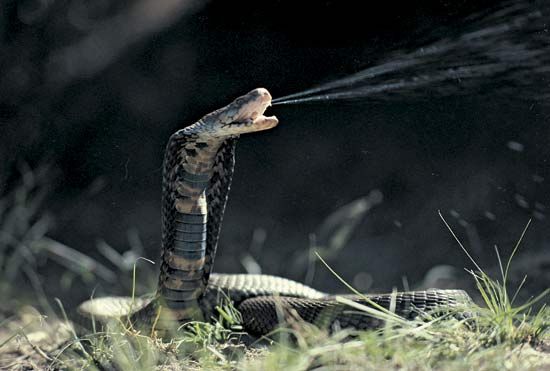
A spitting cobra is a type of snake belonging to the Elapidae family that can eject venom from its fangs as a defensive mechanism. Contrary to the name, they do not “spit”; instead, they contract muscles around their venom glands to spray the liquid toward a threat, often aiming specifically for the eyes.12
These snakes possess specialized fangs with a small, forward-facing opening that allows them to spray venom up to 3 meters (10 feet) away. While the venom typically causes no harm to unbroken skin, it can cause intense pain, damage to the cornea, and potential blindness if it contacts the eyes. In addition to this defensive spray, spitting cobras are capable of delivering venom through a bite, just like other venomous snakes.21
Found in Asia and Africa, these snakes include various species within the Naja genus and the ringhals (Hemachatus haemachatus).21
Where are spitting cobras found in the world?
Spitting cobras are found across two primary geographic regions: Africa and Asia.43
African Spitting Cobras
These species are widely distributed across the continent, inhabiting various environments ranging from savannas and semi-deserts to shrublands and grasslands.3
- Sub-Saharan Africa: Home to species such as the black-necked spitting cobra (Naja nigricollis).3
- Southern and Eastern Africa: Includes the Mozambique spitting cobra (Naja mossambica), the red spitting cobra (Naja pallida), and Ashe’s spitting cobra (Naja ashei).3
- Southern Africa: The ringhals (Hemachatus haemachatus) is found in South Africa, Eswatini, and Lesotho.3
- Other regions: Species like the Nubian spitting cobra are found in North Africa, including parts of the Nile valley, while the Mali cobra inhabits West Africa.3
Asian Spitting Cobras
These species are distributed throughout South and Southeast Asia.43
- Southeast Asia: Includes the Indochinese spitting cobra (Naja siamensis) and the equatorial spitting cobra (Naja sumatrana).3
- Indonesia and Philippines: The Javan spitting cobra (Naja sputatrix) is found in Java and nearby islands, while the Philippine cobra (Naja philippinensis) and Samar cobra (Naja samarensis) inhabit the Philippines.3
- Myanmar: The Mandalay spitting cobra (Naja mandalayensis) is native to this region.3
How does a spitting cobra defend itself?
Spitting cobras defend themselves primarily by ejecting venom toward a threat, a behavior that is a purely defensive act rather than a method of hunting.13
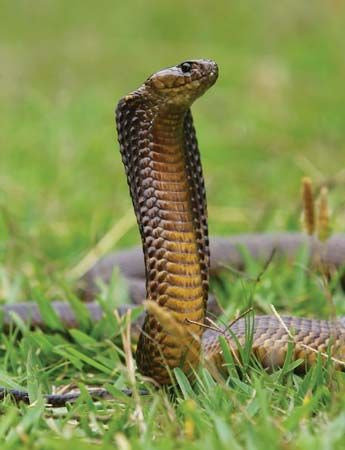
Contrary to the name, these snakes do not “spit.” Instead, they contract muscles around their venom glands to force a stream of venom through specialized fangs, which feature a small, forward-facing opening. While they often adopt a characteristic defensive posture by raising their head and the forepart of their body, they are capable of ejecting venom from any position. To increase their accuracy, some species have been observed rotating their heads from side to side to ensure the venom hits the target’s eyes.13
The venom is aimed specifically at the face, particularly the eyes, where it causes intense pain and can lead to severe corneal damage or even permanent blindness. Additionally, the ringhals (Hemachatus haemachatus) may also defend itself by feigning death, rolling onto its back with its mouth agape.13
What is in the venom that spitting cobras spit?
Spitting cobra venom is a complex mixture of toxic enzymes and various proteins designed to neutralize threats by maximizing pain.13
A key component identified in their venom is a higher proportion of the toxin phospholipase-A2. This toxin works in conjunction with other components to cause intense pain and damage to ocular membranes and the cornea when sprayed into the eyes of a target.1
Generally, snake venoms are categorized by the systems they affect, including:
- Neurotoxins: Affect the nervous system.3
- Cytotoxins: Cause direct destruction of cells and tissues.3
- Myotoxins: Damage muscle tissue.3
- Hemotoxins: Affect the blood and circulatory system.3
Because of the high concentration of pain-inducing toxins, researchers also study spitting cobra venom for its potential role in the development of new painkilling drugs.1
Sources
- reptile - Spitting — Encyclopædia Britannica
- spitting cobra — Merriam-Webster
- spitting cobra — Encyclopædia Britannica
- cobra — Encyclopædia Britannica
- Venom — Encyclopædia Britannica
Published on · 3 min read