Bandy-bandy
The term "bandy-bandy" refers to Australian snakes belonging to the cobra family, specifically within the genus Vermicella. While some sources may associate…
What is bandy-bandy?
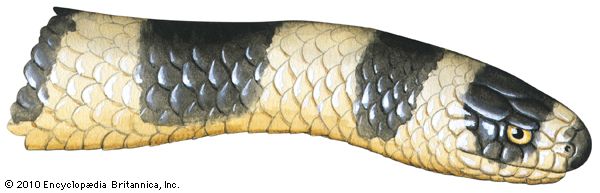
The term “bandy-bandy” refers to Australian snakes belonging to the cobra family, specifically within the genus Vermicella. While some sources may associate the name with other ringed species, the genus Vermicella is characterized by its striking black and white or yellowish bands.12
These snakes are typically 50–80 cm (20–31 inches) long and possess a slender, cylindrical body with a small head and eyes. Although they are venomous, they are considered inoffensive to humans, often possessing mouths too small to deliver a bite. When threatened, a bandy-bandy will raise several coils of its body vertically to create an unusual silhouette intended to deter predators. They are specialized predators that feed almost exclusively on blindsnakes, and females typically lay clutches of 2 to 13 eggs.12
What are other examples of elapid snakes?
The family Elapidae comprises approximately 300 species of venomous snakes characterized by short, fixed fangs at the front of the upper jaw. While they vary in habitat and behavior, they are generally slender and agile creatures found across Africa, the Americas, southern Asia, the Pacific Islands, and Australia.3
Beyond the bandy-bandy, other notable examples of elapid snakes include:
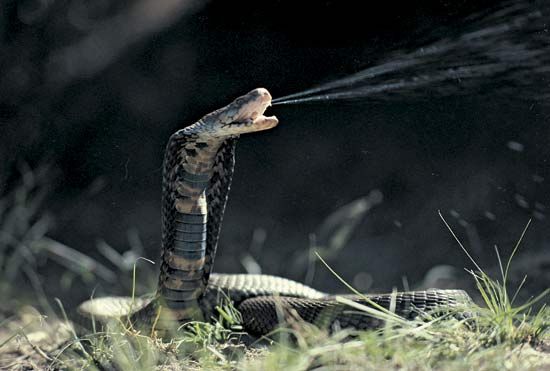
- Cobras: Famous for their defensive hood, this group includes the king cobra, the Egyptian cobra, and various spitting cobras capable of projecting venom.4
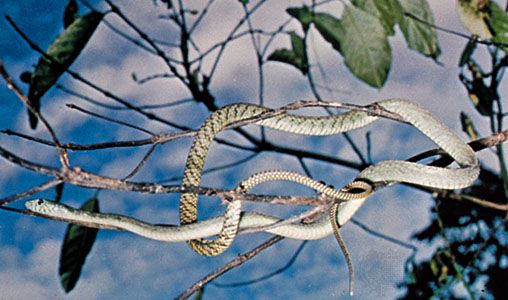
- Mambas: Highly venomous and often arboreal, these snakes are among the few members of the family that live in trees.4
- Coral snakes: Known for their distinctive, often brightly colored patterns.3
- Sea snakes: Adapted for aquatic life, these species often possess paddle-shaped tails.3
- Kraits, Taipans, Tiger snakes, and Brown snakes: These are additional examples of the diverse elapid family.3
How do blindsnakes differ from other snake species?
Blindsnakes, which belong to the infraorder Scolecophidia, differ from other snake species in several key anatomical and behavioral ways:
- Vision: They possess degenerate eyes that are often visible only as small black spots beneath opaque head scales, reflecting their specialized subterranean lifestyle.67
- Skull and Feeding: Unlike more advanced snakes that utilize “walk-feeding” with highly mobile jaw arches, blindsnakes employ a primitive “inertial-feeding” mode. Their skulls are less flexible, and they have significantly reduced dentition, sometimes lacking teeth in one jaw entirely.7
- Morphology: They are generally small, blunt-headed, and cylindrical with short tails, and their bodies are covered in smooth, shiny scales.6
- Habitat and Diet: All blindsnakes are fossorial (burrowing) and are primarily found in soil or associated with termite and ant nests. They feed almost exclusively on the eggs and larvae of these social insects and other soft-bodied arthropods.6
- Reproduction: While most snakes reproduce by laying eggs, some blindsnakes, such as the flowerpot snake, are capable of parthenogenesis, allowing them to reproduce without fertilization.6
What other unique defense mechanisms do snakes use?
Beyond the common practice of fleeing from danger, snakes employ a diverse array of unique defense mechanisms to deter predators:
- Visual Displays: Many snakes use warning coloration, such as bright red, orange, or yellow undersides, to signal that they are distasteful or dangerous. Others utilize camouflage to blend into their environment, while some harmless species engage in mimicry by adopting the color patterns of venomous snakes.9
- Body Posturing: Snakes may inflate their bodies or spread their necks—like the iconic hood of a cobra—to appear larger and more intimidating. Threat postures, such as the S-curve coil used by vipers, prepare the snake to strike if the initial display fails.10
- Acoustic Warnings: Many species hiss loudly when confronted. Rattlesnakes vibrate their tails to produce a warning sound, a behavior mimicked by other species like the fox snake, which vibrates its tail against dry leaves to create a similar noise.11
- Chemical Defense: When other measures fail, some snakes, such as garter snakes and water snakes, emit a foul-smelling musk from their cloacal glands to repel attackers.12
Sources
- bandy-bandy — Encyclopædia Britannica
- bandy-bandy — Merriam-Webster
- elapid — Encyclopædia Britannica
- cobra — Encyclopædia Britannica
- Elaps — Merriam-Webster
- blind snake — Encyclopædia Britannica
- lizard - Evolution and classification — Encyclopædia Britannica
- snake - Skull and sense organs — Encyclopædia Britannica
- reptile - Display of colour — Encyclopædia Britannica
- reptile - Body form and posturing — Encyclopædia Britannica
- reptile - Striking and biting — Encyclopædia Britannica
- reptile - Odours — Encyclopædia Britannica
- Chemoreception - Defensive odors — Encyclopædia Britannica
- reptile - Avoidance and noise — Encyclopædia Britannica
Published on · 3 min read