Subpolar Gyre
Subpolar gyres are large-scale, cyclonic ocean circulation features that form primarily due to wind-driven circulation. These gyres are situated beneath…
What causes the formation of subpolar gyres?
Subpolar gyres are large-scale, cyclonic ocean circulation features that form primarily due to wind-driven circulation. These gyres are situated beneath persistent regions of low atmospheric pressure, where wind stress on the sea surface induces a momentum exchange that drives the movement of water.1234
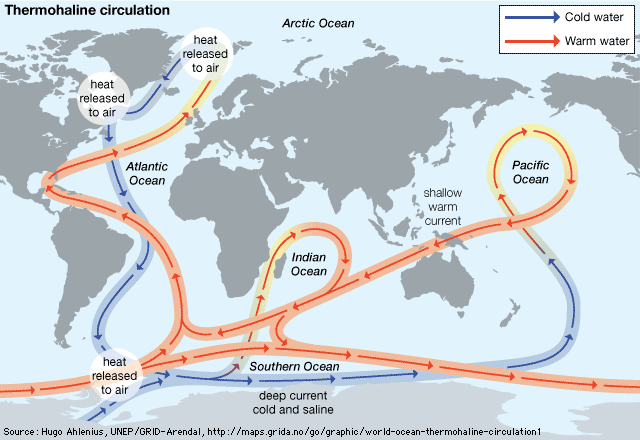
Within these cyclonic systems, Ekman transport plays a critical role by forcing surface water divergence and upwelling. While wind-driven circulation is the primary force behind these gyres, it is part of a broader system of ocean circulation that also includes thermohaline circulation, which is driven by density variations resulting from heat and water exchange between the ocean and the atmosphere.124
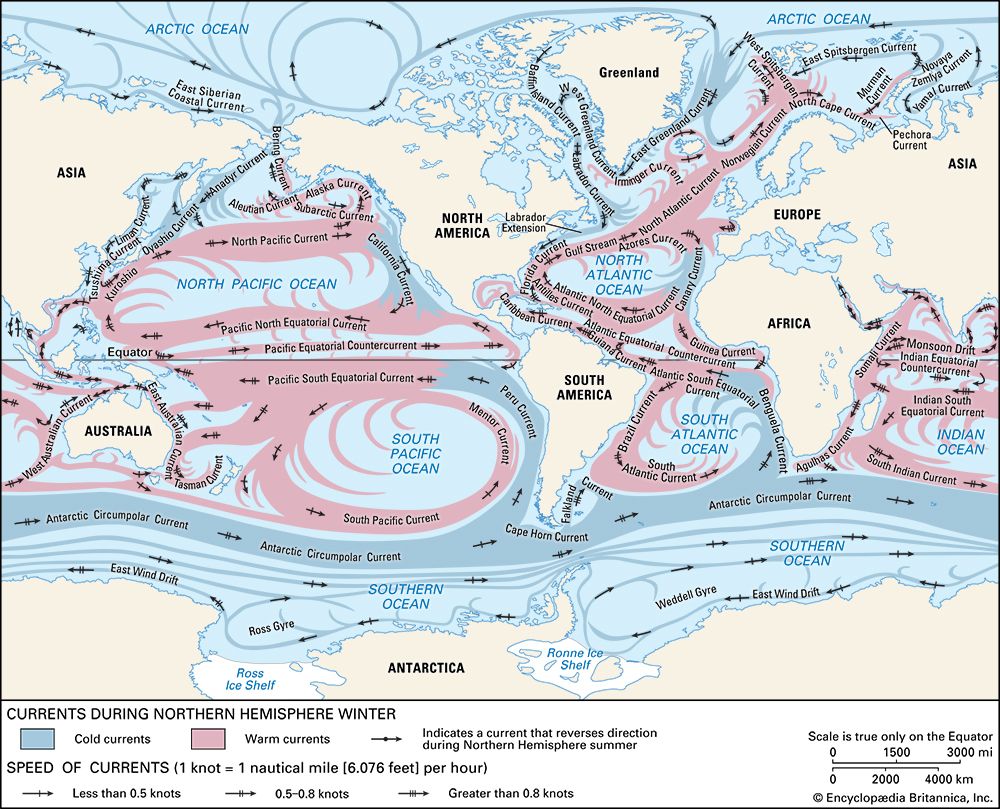
In the Northern Hemisphere, these gyres are well-defined, such as the North Atlantic and North Pacific subpolar gyres, whereas in the Southern Hemisphere, they are less distinct and typically found poleward of the Antarctic Circumpolar Current.12
How do subpolar gyres differ from other types of ocean currents?
Subpolar gyres differ from other ocean circulation systems, such as subtropical gyres, primarily in their rotational direction, atmospheric drivers, and vertical water movement.
Key Differences
- Rotational Direction: Subpolar gyres are cyclonic (counterclockwise in the Northern Hemisphere), whereas subtropical gyres are anticyclonic (clockwise in the Northern Hemisphere).124
- Atmospheric Pressure: Subpolar gyres form beneath persistent regions of low atmospheric pressure. In contrast, subtropical gyres sit beneath regions of high atmospheric pressure.14
- Vertical Movement: Due to Ekman transport, subpolar gyres force upwelling and surface water divergence. Subtropical gyres force surface water to sink, creating downwelling and subtropical convergence.14
- Geographic Positioning: Subpolar gyres are located poleward of the maximum westerlies, while subtropical gyres extend from the equatorial current system to the maximum westerlies near 50° latitude.5
- Depth Penetration: In polar regions, where water stratification is low, wind-driven circulation—including subpolar gyres—can reach all the way to the seafloor. In more stratified regions like the tropics, wind-driven currents are typically limited to the upper 1,000 meters.5
While both types are primarily wind-driven circulation features, they are distinct from thermohaline circulation, which is a more sluggish, density-driven process that encompasses the global ocean and extends to the seafloor.67
What role do subpolar gyres play in global ocean circulation?
Subpolar gyres are significant components of global ocean circulation, functioning as large-scale, cyclonic systems that influence both regional climates and the distribution of heat. By driving surface water divergence and upwelling through Ekman transport, these gyres play a vital role in the vertical movement of water within the ocean.110
Their primary contributions to the global system include:
- Heat Redistribution: In the North Atlantic, the subpolar gyre includes the Norwegian Current, which transports relatively warm water northward. The release of this heat into the atmosphere is essential for maintaining the moderate climate observed in northern Europe.110
- Interaction with Global Currents: Subpolar gyres operate alongside the more sluggish thermohaline circulation. While wind-driven gyres dominate the surface layers, they exist within a broader framework where dense, cold water sinks in polar regions—such as the North Atlantic—to drive global overturning circulation.2
- Regional Dynamics: By facilitating the movement of cold currents like the Labrador Current and the Oyashio Current, these gyres help define the boundaries between different water masses and influence nutrient distribution in high-latitude ecosystems.110
How do subpolar gyres affect climate and weather patterns in nearby regions?
Subpolar gyres significantly influence regional climate and weather patterns by regulating heat distribution and interacting with atmospheric pressure systems.
Heat Regulation and Climate
In the North Atlantic, the subpolar gyre includes the Norwegian Current, which transports relatively warm water northward. The heat released from this current into the atmosphere helps maintain a moderate climate in northern Europe, preventing the extreme cold that might otherwise be expected at such high latitudes.112
Atmospheric Interactions
Subpolar gyres are situated beneath persistent regions of low atmospheric pressure, which influences local weather dynamics. Research suggests a link between the movement of water masses through the North Atlantic subpolar gyre and the North Atlantic Oscillation (NAO). The NAO is a major climate fluctuation that affects weather patterns across North America and Europe; shifts in the gyre’s temperature and salinity may contribute to decadal changes in the NAO, potentially impacting long-term climate forecasting for these regions.1213
Regional Dynamics
By facilitating the flow of cold currents—such as the Labrador Current and the Oyashio Current—subpolar gyres help define the boundaries between distinct water masses, which in turn affects nutrient distribution and local marine ecosystems.112
Sources
- subpolar gyre — Encyclopædia Britannica
- ocean current - The subpolar gyres — Encyclopædia Britannica
- ocean current - Frictional forces — Encyclopædia Britannica
- ocean current - Two types of ocean circulation — Encyclopædia Britannica
- ocean current — Encyclopædia Britannica
- ocean current - Wind-driven circulation — Encyclopædia Britannica
- ocean current - Distribution of ocean currents — Encyclopædia Britannica
- Climate - The Kuroshio — Encyclopædia Britannica
- subtropical gyre — Encyclopædia Britannica
- Climate - The Gulf Stream — Encyclopædia Britannica
- thermohaline circulation — Encyclopædia Britannica
- Atlantic Ocean - Contemporary study — Encyclopædia Britannica
- Atlantic Ocean - The North Atlantic — Encyclopædia Britannica
- Climate - Thermohaline circulation — Encyclopædia Britannica
Published on · 3 min read