Sudeten
The Sudeten mountains are the broken remnants of an ancient massif with a complex geological history. Geologically, they are part of the Variscan orogenic…
How were the Sudeten mountains formed geologically?
The Sudeten mountains are the broken remnants of an ancient massif with a complex geological history. Geologically, they are part of the Variscan orogenic belt, a series of mountain ranges formed between 370 million and 290 million years ago due to the collision between Africa and a North American–North European continent. This process involved seafloor spreading, the subduction of oceanic crust, and significant plate collision, which resulted in crustal thickening and subsequent uplift and erosion.123
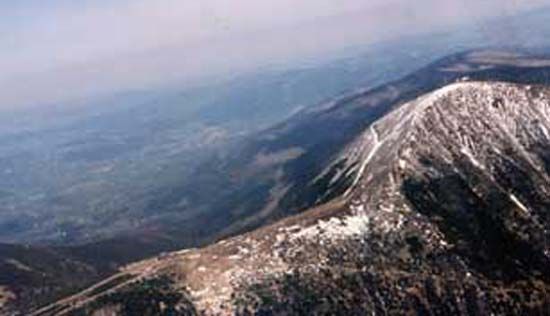
While the foundation of the region dates back to this ancient orogeny, the current rugged relief of the Sudeten is largely attributed to later earth movements that accompanied the Carpathian uplift. Today, the system exists as a series of ranges characterized by crystalline rock and flattened summits, forming the northeastern boundary of the Bohemian Massif.214
What are some popular tourist activities and attractions in the Sudeten region?
The Sudeten region offers a variety of outdoor and cultural activities, particularly within the Giant Mountains, which serve as a primary hub for the area’s developing tourist industry.26
Outdoor Recreation
- Hiking: The region features extensive trails through beech, pine, and fir forests, providing access to the diverse landscapes of the mountain system.6
- Winter Sports: The area is well-known for its ski slopes, with significant resort development in locations such as Vrchlabí, Jilemnice, Trutnov, Špindlerův Mlýn, and Janské Lázně in the Czech Republic, as well as Szklarska Poręba and Karpacz in Poland.6
- Nature Exploration: Visitors can explore protected areas, including Krkonoše National Park, which preserves glacial landscapes, Alpine vegetation, and unique boreal-Arctic species.67
Cultural and Local Attractions
- Craftsmanship: The region is famous for its traditional glass and porcelain production. Visitors can observe local glassmaking, a specialty often associated with the foothills, particularly in Jablonec nad Nisou.26
- Towns and Heritage: Beyond the natural scenery, the principal towns of Liberec and Jablonec serve as cultural centers where visitors can experience the region’s history of textile production and craftsmanship.26
What natural resources are found in the Sudeten mountains, and how have they been exploited historically?
The Sudeten mountains are known to contain a variety of mineral deposits, though the history of their exploitation is characterized by a long-term decline in small-scale mining operations. While the region is rich in geological resources, these have historically been overshadowed by other economic activities.9
Historical Exploitation and Resources
- Mineral Wealth: Although mineral deposits abound throughout the system, small-scale workings have been in decline for a significant period. This contrasts with the neighboring Ore Mountains, which have a much more extensive and documented history of intensive mining for gold, silver, lead, copper, tungsten, and uranium.92
- Quartz and Glassmaking: A notable resource utilized in the region is quartz, which has been historically essential to the development of the Bohemian glass industry. This craft is particularly prominent in the southern foothills, such as in Jablonec nad Nisou, where small-scale glassworks have long operated.69
- Timber and Forestry: The region’s extensive beech, pine, and fir forests have supported a traditional timber-working industry, which remains a key component of the local economy alongside machine production.6
Today, the economy of the Sudeten region is primarily driven by manufacturing, such as the textile industry, and a growing tourist sector, rather than large-scale mineral extraction.96
How do the Sudeten mountains compare to other European mountain ranges in terms of size and elevation?
The Sudeten mountains, which form the border between the Czech Republic and Poland, are the broken remnants of an ancient massif characterized by flattened summits. In terms of elevation, they are significantly lower than major European ranges like the Alps.2
Elevation Comparison
- Sudeten Mountains: The highest peak in the system is Sněžka, located in the Giant Mountains, which reaches an elevation of 5,256 feet (1,602 meters). Other ranges within the system, such as the Orlice Mountains, have lower peaks, with their highest point, Velká Deštná, standing at 3,658 feet (1,115 meters).21011
- The Alps: By contrast, the Alps feature much higher elevations. For example, Mont Blanc reaches 15,771 feet (4,807 meters), and several peaks in the Central Alps, such as the Matterhorn, exceed 14,000 feet. Even the highest points in the Eastern Alps, such as the Grossglockner at 12,460 feet, are substantially higher than the tallest summits in the Sudeten system.4
The Sudeten range is defined by its role as part of the Bohemian Massif, an elevated basin encircled by various mountain groups.10
Sources
- Variscan orogenic belt — Encyclopædia Britannica
- Sudeten — Encyclopædia Britannica
- Bohemian Massif — Encyclopædia Britannica
- Lusatian Mountains — Encyclopædia Britannica
- Poland - The Sudeten of Poland — Encyclopædia Britannica
- Giant Mountains — Encyclopædia Britannica
- Czech Republic - Plant and animal life — Encyclopædia Britannica
- Sudetenland — Encyclopædia Britannica
- Ore Mountains — Encyclopædia Britannica
- Alps - Physiography — Encyclopædia Britannica
- Orlice Mountains — Encyclopædia Britannica
- Czech Republic - Relief — Encyclopædia Britannica
Published on · 3 min read