Sunda Shelf
The Sunda Shelf is a significant region for natural resource extraction, particularly regarding energy reserves. Since the mid-20th century, the shelf has…
What natural resources are found on or beneath the Sunda Shelf?
The Sunda Shelf is a significant region for natural resource extraction, particularly regarding energy reserves. Since the mid-20th century, the shelf has become economically vital due to the exploitation of substantial petroleum and natural gas deposits located beneath the seafloor.1
Key areas for these submarine hydrocarbon reserves include the waters near Brunei, the coast of Malaysia, and various locations off the coast of Indonesia, such as the areas near the Natuna Islands and off the coast of Sumatra.12
While the shelf itself is primarily recognized for its oil and gas potential, the broader Southeast Asian region—which includes the islands of Borneo, Java, and Sumatra that sit upon the shelf—is also a major producer of metallic minerals, most notably tin a major producer of metallic minerals, most notably tin.13
What role did the Sunda Shelf play in human migration and settlement in Southeast Asia?
The Sunda Shelf, often referred to as “Sundaland” when exposed, played a critical role in the early human history of Southeast Asia by serving as a vast, interconnected landmass. Until approximately 7000 BCE, sea levels were roughly 150 feet (50 meters) lower than they are today, creating a network of watered plains that linked the islands of Borneo, Java, and Sumatra to the Asian mainland.145
These land bridges facilitated the movement of plants, animals, and early human populations throughout the region. This connectivity is believed to have contributed to the cultural and developmental coherence observed in the Hoabinhian culture, a hunting and gathering society that flourished between 13,000 and 4000 BCE. The stone tools from this period exhibit a remarkable similarity in design across the region, reflecting the ease of interaction enabled by the shelf’s geography.451
As sea levels rose to their present height around 6000 BCE, the landscape transformed into the current archipelago, fostering more localized evolutionary processes and cultural differentiation.1
What is the Sunda Shelf and where is it located in Asia?
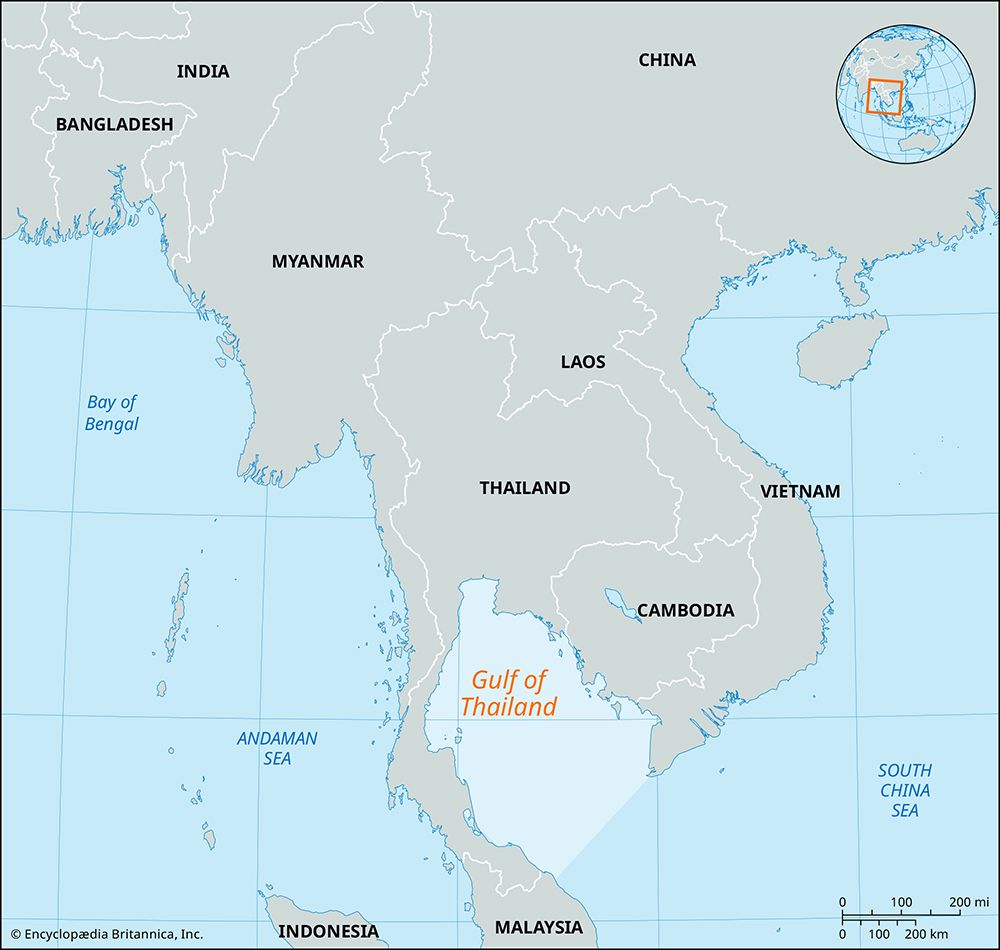
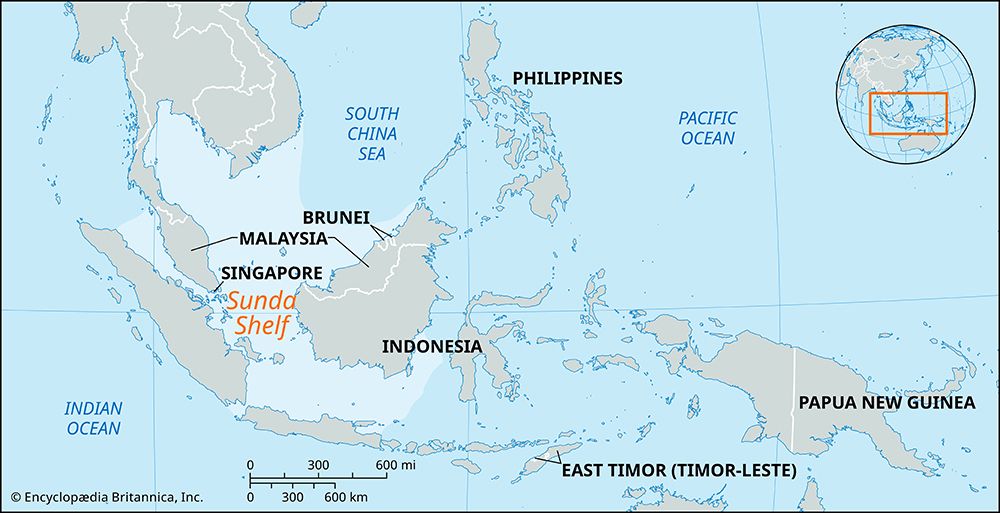
The Sunda Shelf is a stable continental platform that serves as a southward extension of mainland Southeast Asia. Covering approximately 690,000 square miles (1,800,000 square km), the shelf is largely submerged under shallow seas, including the Gulf of Thailand, the southern South China Sea, and the Java Sea, with average depths of less than 330 feet (100 meters).16
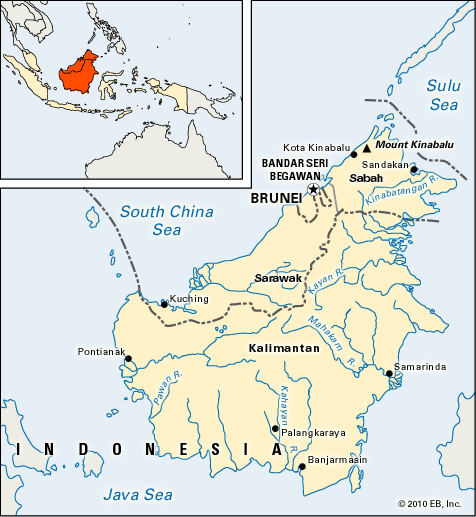
Geographically, the shelf is occupied by the Indonesian islands of Borneo, Java, and Sumatra. It is bounded to the west and south by the Java Trench—a seismically active subduction zone—and is separated from the Sahul Shelf in the southeast by the volcanic Lesser Sunda Islands.16
Historically, the entire shelf was once above sea level, acting as a land bridge that connected the islands to the Asian mainland. Today, it remains a vital region for petroleum and natural gas extraction.16
How was the Sunda Shelf formed geologically?
The Sunda Shelf is a stable continental platform that functions as a southward extension of the Asian continental mass. Geologically, it represents a complex crustal segment where the shelf meets and overrides oceanic crust to the south, resulting in the formation of the volcanic arc comprising the Greater and Lesser Sunda islands.156
The shelf is not a uniform structure; while areas like the Java Sea exhibit relatively low relief and are non-volcanic, the outer edges of the shelf—particularly along the South China and Celebes seas—feature strong relief and are among the most active volcanic zones globally. The shelf’s southern and western boundaries are defined by the Java Trench, a deep, seismically active subduction zone.51
Much of the shelf’s current submerged state is of geologically recent origin, having been formed at the close of the Pleistocene Epoch approximately 12,000 years ago. Evidence of its former exposure as a terrestrial landmass includes remnants of ancient stream networks and eroded metamorphic sections that remain above sea level as parts of Borneo, Java, and Sumatra.51
Sources
- Sunda Shelf — Encyclopædia Britannica
- Southeast Asia - Industry of Southeast Asia — Encyclopædia Britannica
- Pacific Ocean - Submarine hydrocarbons — Encyclopædia Britannica
- history of Southeast Asia - Origins — Encyclopædia Britannica
- Indonesia - Relief — Encyclopædia Britannica
- Southeast Asia - Insular Southeast Asia — Encyclopædia Britannica
Published on · 3 min read