Theodossia
The term "Theodossia" refers to two distinct subjects. It is important to distinguish between the ancient city and the scientific classification:
What is Theodossia?
The term “Theodossia” refers to two distinct subjects. It is important to distinguish between the ancient city and the scientific classification:
- Ancient City: The name is an archaic spelling of the ancient Greek colony Theodosia, located on the Crimean Peninsula. Founded in the 6th century BCE, it became a vital port for shipping wheat to Athens. Later known as Kaffa, it served as a major trade hub and is historically significant for the 1347 siege where biological warfare was allegedly employed by catapulting plague-ridden corpses over its walls. The site is now the modern city of Feodosiya, Ukraine.1
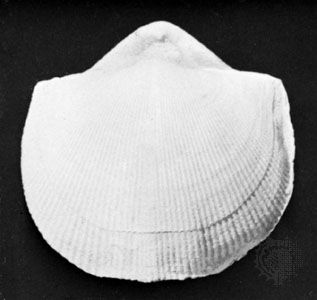
- Paleontology: Theodossia is a genus of extinct brachiopods (lamp shells). These organisms lived during the Early Devonian period (approximately 408 to 360 million years ago). Because their fossils are found only within specific rock layers, they serve as valuable index fossils for geologists correlating rock units.2
What are brachiopods and how do they live?
Brachiopods, commonly known as lamp shells, are a phylum of sedentary, bottom-dwelling marine invertebrates. Their name is derived from the Greek words for “arm” and “foot,” and they are so named because their bivalve shells resemble early Roman oil lamps.34
Physical Characteristics
Brachiopods are characterized by two valves (shells) of unequal size that cover the dorsal (top) and ventral (bottom) sides of the animal. These valves are bilaterally symmetrical, meaning the left and right sides are mirror images of each other. Internally, they possess a well-developed coelom (body cavity) and a specialized feeding organ called a lophophore, which consists of ciliated filaments that direct food-bearing currents toward the mouth.345
Lifestyle and Habitat
Brachiopods live in all oceans and are typically found attached to the substrate (the sea floor or other surfaces). Their lifestyle varies by species:35
- Attachment: Many use a tough, fleshy stalk called a pedicle to anchor themselves to the sea floor. Some species are cemented directly to the substrate by their shell, while others have an atrophied pedicle and simply lie loose on the sea floor.54
- Feeding: They are filter feeders. By using complex sets of muscles to open their valves, they allow water to circulate through the mantle cavity, where the lophophore captures food particles.5
- Burrowing: Some species, such as Lingula, live in burrows in mud or sand, using a flexible, contractile pedicle to extend or retract their shell as needed.5
While they were once one of the most abundant forms of life on Earth, their numbers have significantly declined since they first appeared in the Cambrian Period.34
How do scientists use index fossils to date rock layers?
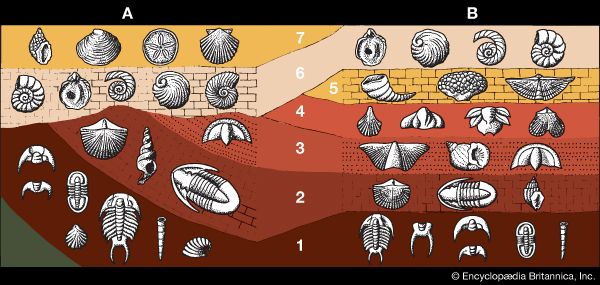
Scientists use index fossils to date rock layers by applying the law of faunal succession, which observes that fossilized plants and animals appear in the rock record in a predictable, orderly sequence over time.1112
To be an effective index fossil, a species must possess specific characteristics that allow geologists to correlate strata across different geographic locations:
- Short temporal range: The species existed for a relatively brief period, meaning its presence identifies a specific interval of geologic time.1312
- Wide distribution: The organism was cosmopolitan, allowing researchers to match rock layers found in distant parts of the world.1312
- Abundance and distinctiveness: The fossils are common enough to be easily found and possess unique physical features that prevent misidentification.1312
By identifying these fossils within sedimentary layers, geologists can determine the relative age of the rock. This method serves as a fundamental tool in stratigraphy, and the relative sequences established by these fossils have been consistently confirmed by modern radiometric dating techniques.1112
What was the Devonian period like for marine life?
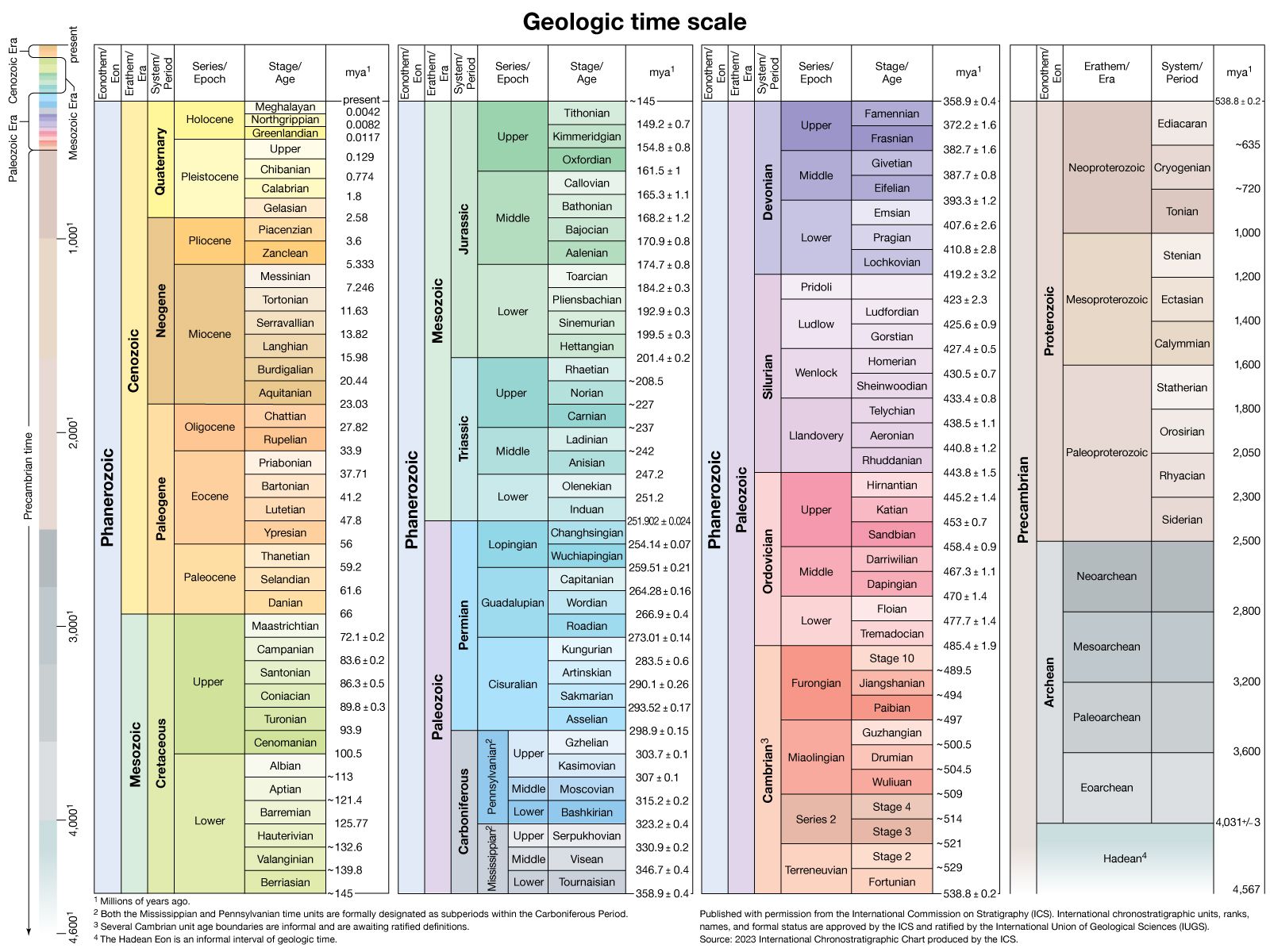
The Devonian Period (approximately 419.2 to 358.9 million years ago) is famously known as the “Age of Fishes” due to the immense diversity and abundance of fish species that inhabited the world’s oceans, which covered about 85 percent of the globe.1415
Marine Life Diversity
Marine environments were teeming with life, much of which continued from the Ordovician Period. Key inhabitants included:16
- Invertebrates: Brachiopods were highly diverse, with spire-bearing spiriferoids being particularly common. Corals and stromatoporoids were essential for building extensive reef systems.16
- New Arrivals: The period saw the emergence of ammonites from nautiloid ancestors, as well as the first appearance of Scaphopoda (tusk shells).16
- Arthropods: Trilobites remained significant, though they faced decline toward the end of the period, while giant eurypterids (sea scorpions) thrived in certain environments.16
Environmental Challenges
Despite this richness, marine communities suffered from a series of mass extinction events, such as the Kellwasser and Hangenberg events. These were often linked to periods of anoxia (low oxygen levels) in the seas, potentially caused by global temperature fluctuations or nutrient runoff from the colonization of land by plants. These extinctions eliminated 70 to 80 percent of all animal species, though they were followed by cycles of recovery and diversification as surviving organisms adapted to new niches.171415
Sources
- Feodosiya — Encyclopædia Britannica
- Theodossia — Encyclopædia Britannica
- lamp shells — Encyclopædia Britannica
- branchiopod - Evolution and paleontology — Encyclopædia Britannica
- branchiopod - Distinguishing taxonomic features — Encyclopædia Britannica
- branchiopod - Reproduction and life cycles — Encyclopædia Britannica
- branchiopod - External features — Encyclopædia Britannica
- lamp shells - Form and function — Encyclopædia Britannica
- branchiopod - Distribution and abundance — Encyclopædia Britannica
- Brachiopoda — Merriam-Webster
- index fossil — Encyclopædia Britannica
- law of faunal succession — Encyclopædia Britannica
- dating - Principles and techniques — Encyclopædia Britannica
- A Journey Through Time Since the Precambrian - Devonian Period: 419.2 million to about 359 million years ago — Encyclopædia Britannica
- Devonian extinctions — Encyclopædia Britannica
- Devonian Period - Invertebrates — Encyclopædia Britannica
- Devonian Period — Encyclopædia Britannica
Published on · 4 min read