Timber Rattlesnake
The timber rattlesnake (Crotalus horridus) is a venomous snake belonging to the family Viperidae, native to the eastern United States. These forest-dwelling…
What is a timber rattlesnake?
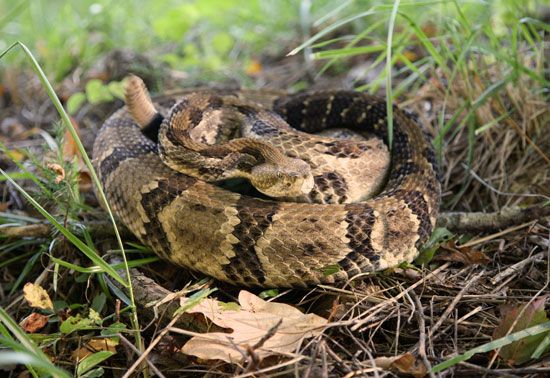
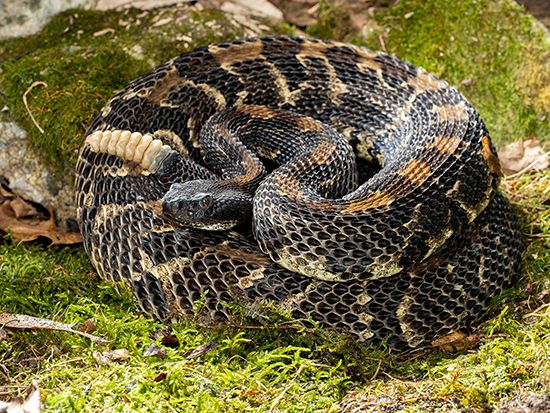
The timber rattlesnake (Crotalus horridus) is a venomous snake belonging to the family Viperidae, native to the eastern United States. These forest-dwelling reptiles typically inhabit upland woods and low mountain ridges, ranging from New Hampshire to northern Florida and westward into Texas.1
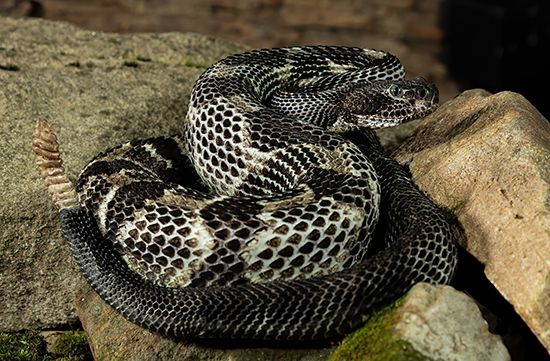
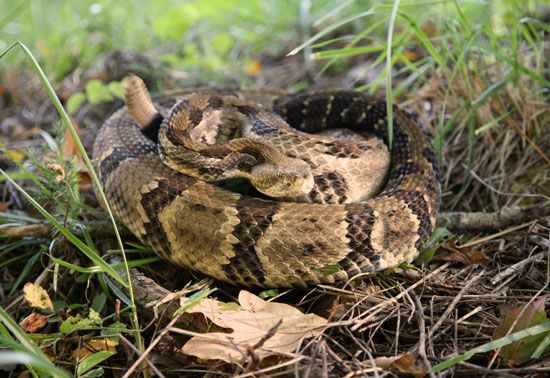
Physically, they are stout-bodied with a broadly triangular head and a rattle at the end of their tail. They are ambush predators that use infrared radiation detection to hunt small mammals and birds. While they possess potent venom, they are generally not aggressive and typically provide a warning rattle before striking.1
Historically, the timber rattlesnake holds significance as a national symbol in the U.S., famously featured on the Gadsden flag with the motto “Don’t tread on me”. Although currently classified as a species of least concern by the IUCN, many local populations face declines due to habitat loss, hunting, and human persecution.1
Where do timber rattlesnakes live?
Timber rattlesnakes (Crotalus horridus) are primarily found in the eastern United States, where they inhabit upland woods and low mountain ridges.1
Their geographic range is extensive:
- Northern and Eastern limits: The range extends from New Hampshire along the Appalachian Mountains down to northern Florida.1
- Western limits: The range stretches from southeastern Minnesota to southeastern Texas.1
These snakes are considered forest-dwelling creatures. During the spring and fall, they are often found basking on south-facing rocky slopes, and they frequently gather in rock crevices on mountain slopes to hibernate during the winter. While they were once observed in southern Ontario, they have not been recorded there since 1941. Within their range, they are often found foraging in fields, pastures, farms, and along old stone fences.1
What do timber rattlesnakes eat?
The timber rattlesnake (Crotalus horridus) is an ambush predator that primarily feeds on small mammals and ground birds.2
To secure its prey, the snake employs a combination of specialized sensory adaptations and hunting behaviors:
- Ambush Strategy: The snake often positions itself with its head resting on its coils or on logs that serve as runways for small mammals, waiting for prey to pass by.2
- Sensory Detection: It uses its forked tongue to perceive scents in the environment. During the heat of summer, when it hunts at night, it utilizes a pair of pit organs—sensory receptors located on the sides of its head—to detect the infrared radiation emitted by the body heat of its victims.2
- Foraging Areas: These snakes are known to forage in fields, pastures, and farms, as well as along old stone fences, where they are likely to encounter their prey.2
As a member of the family Viperidae, the timber rattlesnake is equipped with venom glands and tubular fangs, which allow it to immobilize its prey efficiently.24
How does a timber rattlesnake use its rattle?
A timber rattlesnake uses its rattle primarily as a warning device to ward off large mammals. The rattle consists of loosely connected, hollow segments of hardened, keratinized skin. When the snake feels threatened, it rapidly vibrates the tip of its tail, causing these segments to strike against one another and produce a distinct buzzing sound.378
While this behavior is an effective defensive adaptation for deterring animals like buffalo, cattle, or horses, it is often counterproductive when the snake encounters humans. By creating this sound, the snake inadvertently draws attention to its location, which frequently leads to its capture or death rather than its escape.7
It is important to note that rattlesnakes are not inherently aggressive and generally do not attack unless they are provoked or handled. The rattle serves as a signal to keep potential threats at a distance, reflecting the snake’s preference for avoidance over confrontation.38
Sources
- timber rattlesnake — Merriam-Webster
- timber rattlesnake — Encyclopædia Britannica
- rattlesnake — Encyclopædia Britannica
- black-tailed rattlesnake — Encyclopædia Britannica
- snake - Specializations for securing food — Encyclopædia Britannica
- Black rat snake: Top Questions — Encyclopædia Britannica
- reptile - Avoidance and noise — Encyclopædia Britannica
- snake - Molt — Encyclopædia Britannica
Published on · 3 min read