Trailing Arbutus
Trailing arbutus (Epigaea repens) is a low-growing, trailing plant belonging to the heath family (Ericaceae). It is native to the sandy or boggy, acid…
What is trailing arbutus?
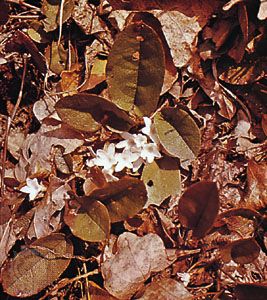
Trailing arbutus (Epigaea repens) is a low-growing, trailing plant belonging to the heath family (Ericaceae). It is native to the sandy or boggy, acid woodlands of eastern North America.12
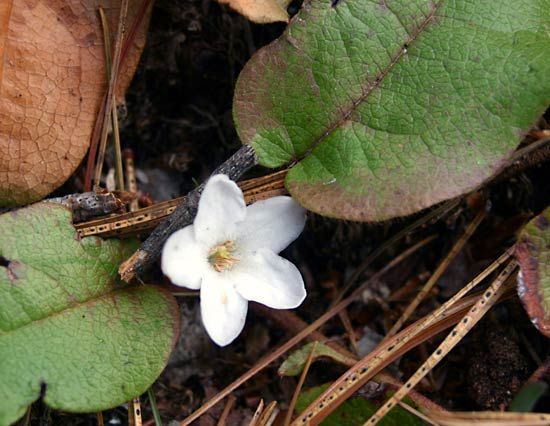
The plant is characterized by oblong, hairy evergreen leaves that measure between 2 and 6 cm (0.75 to 2.5 inches) in length. It produces highly fragrant, dense clusters of white, pink, or rosy flowers, each featuring a five-lobed corolla. Due to its delicate nature and specific habitat requirements, it is often found in shady wildflower gardens.1
It is important to note that while trailing arbutus is a member of the Ericaceae family, it belongs to the genus Epigaea, which is distinct from the genus Arbutus—a group of shrubs and trees that includes species such as the strawberry tree and the Pacific madrona2.
What other plants belong to the heath family?
The heath family (Ericaceae) is a diverse group comprising approximately 126 genera and 4,000 species of flowering plants, primarily consisting of shrubs and small trees. These plants are widely distributed globally and are frequently cultivated for their ornamental value or edible fruits.34
Notable members of the family include:
Food Crops
- Blueberries (Vaccinium species)43
- Cranberries (Vaccinium macrocarpon and V. oxycoccos)4
- Huckleberries (Gaylussacia species)4
- Lingonberries (Vaccinium vitis-idaea)4
- Bilberries (Vaccinium myrtillus)4
Ornamentals and Other Notable Plants
- Rhododendrons and Azaleas (Rhododendron species)43
- Heaths (Erica species) and Heather (Calluna vulgaris)45
- Mountain Laurel and Sheep Laurel (Kalmia species)43
- Manzanita and Bearberry (Arctostaphylos species)4
- Wintergreen (Gaultheria species)4
- Sourwood (Oxydendrum arboreum)4
- Doghobble (Leucothoe species) and Fetterbush (Pieris species)4
- Pipsissewa (Chimaphila species)4
Many of these species are adapted to acidic, poorly drained soils and are characterized by their attractive flowers and evergreen foliage.43
How do evergreen plants survive in cold climates?
Evergreen plants in cold climates survive freezing temperatures through specialized physical adaptations that protect their foliage from damage. Unlike deciduous species, which shed their leaves to avoid the risk of cellular rupture caused by freezing water, evergreens possess thick, leathery leaves often coated in waxes and resins.78
These protective layers serve as a barrier against cold temperatures, preventing the leaves from fracturing or drying out. Furthermore, the needlelike or scalelike shape of the leaves found on many conifers reduces the surface area exposed to wind and minimizes the accumulation of heavy snow, which could otherwise cause physical breakage to the tree. By retaining these durable, hardened leaves, evergreens are able to maintain their structure and protect their internal tissues from the harsh conditions of winter.87
What are some other native wildflowers of North America?
North America is home to a vast array of native wildflowers, which are flowering plants that grow without intentional human aid. While some species are considered weeds when they appear in cultivated fields, they serve as vital components of their natural ecosystems in woodlands, prairies, and mountains.10
Some notable examples of native North American wildflowers include:
- Wild Prairie Rose (Rosa arkansana): This plant is recognized as the state flower of North Dakota.11
- Sunflowers: While often cultivated as a crop for their seeds, sunflowers are native to the Great Plains and grow as wildflowers in uncultivated valleys.10
It is important to note that the classification of a plant as a “wildflower” versus a “weed” often depends on human perspective and whether the plant is growing in a desired location. Additionally, while many wildflowers in the United States are native, some species—such as certain buttercups—were introduced from other regions and have since spread across the continent.10
Sources
- trailing arbutus — Encyclopædia Britannica
- arbutus — Encyclopædia Britannica
- list of economically important members of the family Ericaceae — Encyclopædia Britannica
- Ericaceae — Encyclopædia Britannica
- Ericales — Encyclopædia Britannica
- heath — Encyclopædia Britannica
- Evergreen — Encyclopædia Britannica
- horticulture - Frost control — Encyclopædia Britannica
- Why Do Leaves Fall in Autumn? — Encyclopædia Britannica
- Wildflower — Encyclopædia Britannica
- North Dakota: Country Facts — Encyclopædia Britannica
Published on · 3 min read