Trochonema
Trochonema is a genus of extinct gastropods (snails) known from the fossil record. These organisms lived during the Ordovician Period through the Devonian…
What is Trochonema?
Trochonema is a genus of extinct gastropods (snails) known from the fossil record. These organisms lived during the Ordovician Period through the Devonian Period, a span ranging from approximately 505 to 360 million years ago.1
The shell of a Trochonema is characterized by a series of turretlike whorls, which are decorated with slight lines. Additionally, the shell features a large, conspicuous, and roughly circular aperture.1
What are gastropods?
Gastropods are members of the class Gastropoda, which is the largest group within the phylum Mollusca. This diverse class includes more than 65,000 animal species, primarily categorized as snails—which possess a shell for protection—and slugs, which have evolved to lose or significantly reduce their shells.2
Gastropods have successfully adapted to nearly every major habitat, including oceans, freshwater environments, and land. Their evolutionary history is marked by significant transitions, such as the shift from herbivorous to carnivorous diets and the development of complex reproductive strategies, including internal fertilization and various forms of parental care. While some species are used as food or for ornamental purposes, others play ecological roles as scavengers, predators, or herbivores.234
Fossil evidence of gastropods dates back to the Cambrian Period, and they have undergone extensive adaptive radiation throughout geologic history.3
What was the Ordovician Period like?
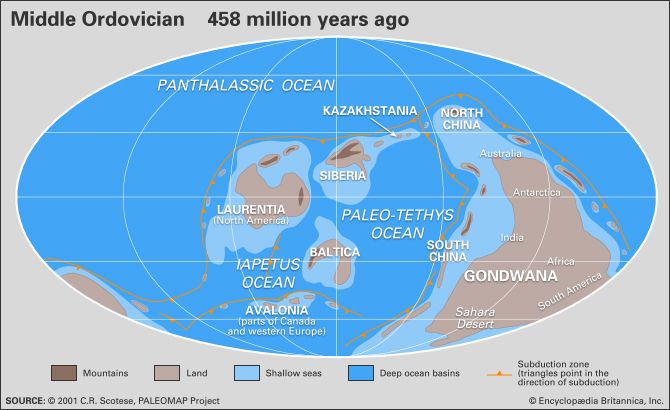
The Ordovician Period (485.4 to 443.8 million years ago) was a time of profound geological and biological transformation. Driven by rapid seafloor spreading, global sea levels rose to some of the highest in the Phanerozoic Eon, flooding continents and creating vast, shallow seas that deposited extensive sediment layers rich in fossils.56
Climate and Life
Atmospheric carbon dioxide levels were significantly higher than today, fostering warm climates globally, though a brief, intense glaciation occurred in the Southern Hemisphere near the period’s end.56
The era is defined by the “Ordovician radiation,” an intense diversification of marine life. By the end of the period, nearly every modern invertebrate phylum had appeared, alongside the emergence of fish. Common marine life included:576
- Brachiopods and bryozoans
- Trilobites and mollusks
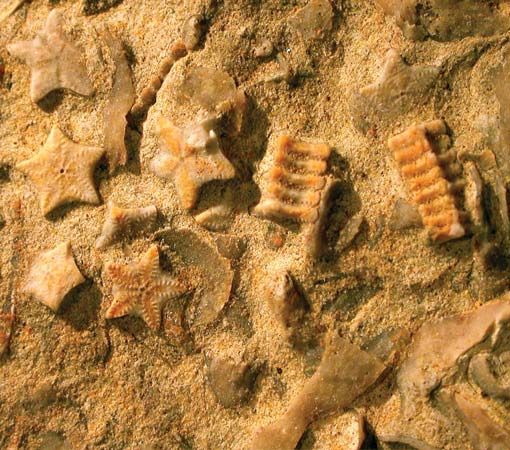
- Echinoderms (reaching a peak of 20 classes)
- Graptolites and corals
On land, the first plants appeared, potentially accompanied by the first terrestrial arthropods.5 The period concluded with the second-largest mass extinction in Earth’s history, which claimed roughly 85 percent of species, likely triggered by the late-period ice age and falling sea levels.658
How do scientists use fossils to study ancient life?
Scientists use fossils as the primary source of information to reconstruct the history of life on Earth. By studying these remains, imprints, or traces of ancient organisms, researchers can draw several critical conclusions:9
- Understanding Evolution: Paleontologists track progressive morphological changes within animal groups to describe evolutionary history, often interpreting these shifts as adaptations to specific environments.109
- Determining Geologic Age: Fossils allow geologists to assign relative ages to sedimentary strata. Index fossils—species that were geographically widespread but lived for a short geologic span—are particularly useful for stratigraphic correlation across different regions.11109
- Reconstructing Ancient Environments: Through paleoecology, scientists analyze the ecological niches of fossilized organisms to determine past climates and environmental conditions, such as water temperature or habitat type.11109
- Resource Exploration: Fossils, including microfossils, help geologists locate fossil fuels like oil, gas, and coal by identifying specific stratigraphic positions.12119
Sources
- Trochonema — Encyclopædia Britannica
- gastropod — Encyclopædia Britannica
- gastropod - Evolution and paleontology — Encyclopædia Britannica
- gastropod - Reproduction and life cycles — Encyclopædia Britannica
- A Journey Through Time Since the Precambrian - Ordovician Period: 485.4 million to 443.4 million years ago — Encyclopædia Britannica
- Ordovician Period - Invertebrates — Encyclopædia Britannica
- Silurian Period - Late Ordovician mass extinction — Encyclopædia Britannica
- Ordovician Period — Encyclopædia Britannica
- Did you know? — Merriam-Webster
- Climate change - Evidence for climate change — Encyclopædia Britannica
- dating - Fission-track dating — Encyclopædia Britannica
- geology - Paleontology — Encyclopædia Britannica
- fossil record — Encyclopædia Britannica
- dinosaur - The flesh eaters — Encyclopædia Britannica
- fossil — Encyclopædia Britannica
Published on · 2 min read