Tunicate
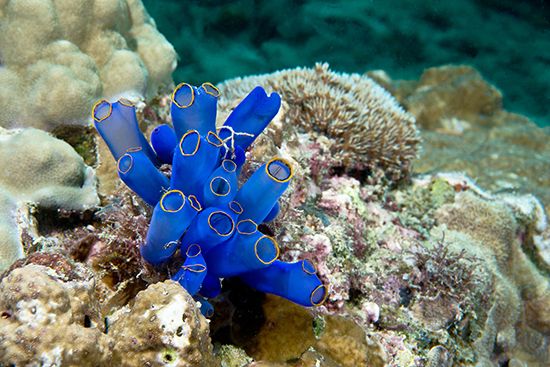
Tunicates are filter feeders that consume small particles of food suspended in the water.
How do tunicates filter feed, and what types of particles do they consume?
Tunicates are filter feeders that consume small particles of food suspended in the water.1
The feeding process relies on the movement of cilia—tiny, hairlike cellular extensions—which draw a continuous current of water into the animal’s mouth and through its pharynx. Within the pharynx, a sheet of mucus is secreted by the endostyle, a specialized glandular organ located beneath the gill slits. This mucus acts as a filter, trapping the suspended food particles as the water passes through.1
Once the food is captured, the cilia lining the pharynx transport the food-rich mucus sheet upward over the gill slits. The sheet is then rolled up and moved into the posterior section of the gut for digestion. After the food is extracted, the filtered water exits the body through the atrial opening. Additionally, some tropical tunicates may supplement their nutrition through symbiotic relationships with unicellular plants and blue-green algae4.1
How do tunicates undergo metamorphosis, and how does this process change their body structure?
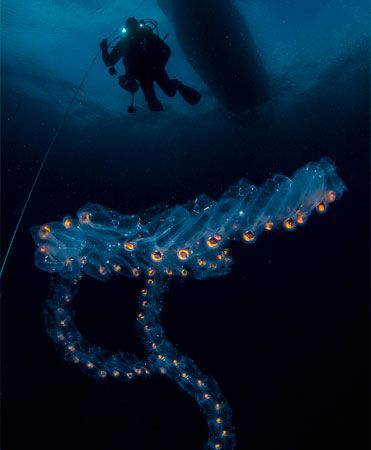
Tunicates undergo a dramatic transformation known as necrobiotic metamorphosis, a process where the specialized larval features are destroyed as the animal transitions into its adult form.5
The Larval Stage
The tunicate larva, often called a tadpole, is a motile, non-feeding stage designed primarily to locate a suitable habitat. It possesses several chordate characteristics, including a notochord, a dorsal nerve cord, and a muscular tail that comprises two-thirds of its body.67
The Metamorphosis Process
Once the larva finds a surface, it attaches using three anterior adhesive papillae. Following attachment, the following structural changes occur:6
- Resorption of Larval Organs: Within approximately one day, the tail, notochord, nerve cord, and most of the brain—including sensory organs like the eye and statocyst—are resorbed or destroyed. The tail tissue provides essential food reserves for the developing animal during this period.756
- Structural Reorganization: The area between the mouth and the point of attachment grows rapidly. This shifts the orientation of the mouth so that it faces away from the substrate, which becomes the animal’s posterior end.7
- Development of Adult Features: As larval parts disintegrate, the adult’s large pharyngeal cavity develops. The atrium typically forms from two pouches that grow inward and fuse into a single cavity, opening near the mouth on the dorsal side of the body.57
How have tunicates been used historically by humans, and are there any current commercial applications?
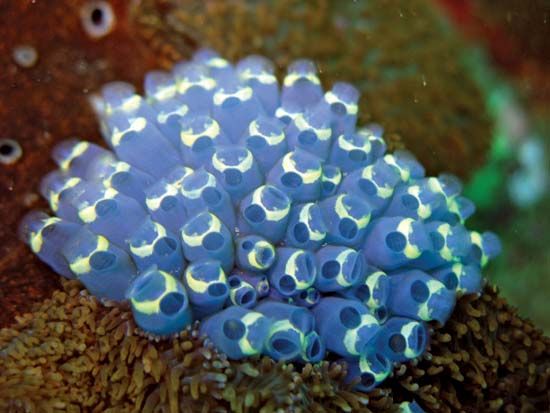
Historically, tunicates have not been a significant direct food source for humans, though they play a vital role in the food chain by supporting marine ecosystems that humans rely on.3
Beyond their ecological importance, tunicates are primarily studied for their evolutionary significance, as they provide researchers with critical clues regarding the ancestry of vertebrates. In terms of modern applications, scientists are actively investigating the unusual chemicals found within these organisms, which show potential for the development of new pharmaceutical drugs.3
While they are not currently a major commercial commodity, some species are recognized as fouling organisms because they attach to and grow on the hulls of ships, which can create maintenance challenges for maritime industries.3
What are the main characteristics that define tunicates within the chordate phylum?
Tunicates are members of the subphylum Tunicata within the phylum Chordata. They are defined as chordates primarily because they possess specific anatomical features at some point in their life cycle, most notably during their larval stage.19
Defining Chordate Characteristics
To be classified as a chordate, an organism must exhibit the following features, which are present in the tunicate tadpole larva:
- Notochord: A stiff, dorsal supporting rod. In tunicates, this is typically restricted to the tail.910
- Dorsal Nerve Cord: A hollow nerve cord positioned above the gut.910
- Pharyngeal Gill Slits: Openings from the pharynx to the exterior, used for filter feeding.911
- Post-anal Tail: A tail that extends behind and above the anus.910
- Endostyle: A mucus-secreting structure located in the pharynx.910
Unique Tunicate Features
While they share these ancestral traits, tunicates are distinguished by several unique characteristics:
- Tunic: Adults are typically encased in a tough, secreted covering called a tunic, which is unique for containing cellulose—a polysaccharide rarely found in animals.110
- Metamorphosis: Most tunicates undergo a dramatic metamorphosis where they transition from a free-swimming, chordate-like larva to a sessile (attached) adult, during which most of their chordate features are resorbed or lost.112
- Atrium: Adults possess an atrium, a large internal cavity that surrounds the gills and serves as a filter-feeding mechanism.101312
Sources
- tunicate — Encyclopædia Britannica
- Chordate - Digestion and nutrition — Encyclopædia Britannica
- tunicate - Importance — Encyclopædia Britannica
- tunicate - Associations — Encyclopædia Britannica
- tunicate - General features — Encyclopædia Britannica
- tunicate - Reproduction and life cycle — Encyclopædia Britannica
- Animal development - Metamorphosis — Encyclopædia Britannica
- tunicate - Size range and diversity of structure — Encyclopædia Britannica
- Chordate — Encyclopædia Britannica
- Chordate - Annotated classification — Encyclopædia Britannica
- cephalochordate - General features — Encyclopædia Britannica
- Chordate - General features — Encyclopædia Britannica
- Chordate - External features — Encyclopædia Britannica
- tunicate - Nervous system and organs of sensation — Encyclopædia Britannica
Published on · 4 min read