Larvacean
A larvacean is a transparent, free-swimming marine animal belonging to the class Appendicularia within the subphylum Tunicata. These organisms are…
What is larvacean?
A larvacean is a transparent, free-swimming marine animal belonging to the class Appendicularia within the subphylum Tunicata. These organisms are characterized by a tadpolelike body consisting of a trunk and a tail, which bears a striking resemblance to the larval form of a sea squirt.1
A unique feature of the larvacean is its ability to secrete a delicate, gelatinous “house” that encloses its body. By beating its tail, the animal creates a unidirectional current that pulls water through the structure, allowing it to capture microscopic food particles. Because this house is temporary, a larvacean will abandon it and secrete a new one several times throughout each day.1
What are tunicates and how are they related to vertebrates?
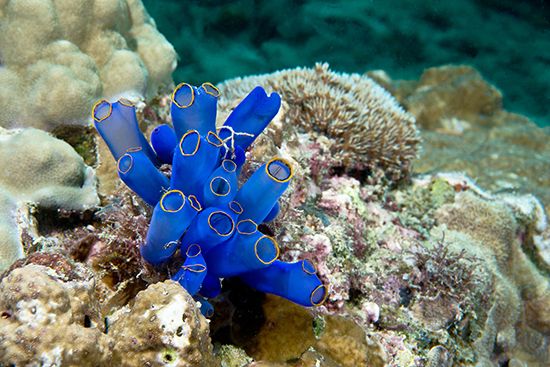
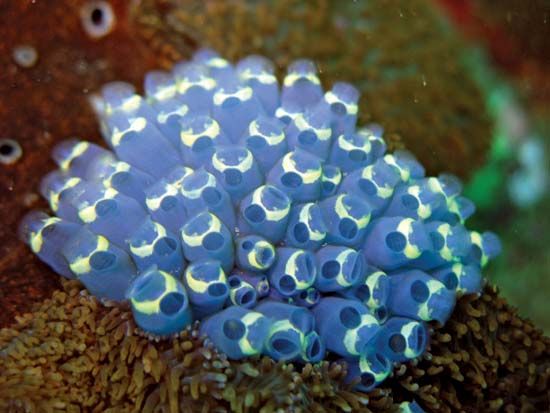
Tunicates are small marine animals belonging to the subphylum Tunicata within the phylum Chordata. They are typically found in seas worldwide, ranging from sessile, bottom-dwelling forms to free-swimming, pelagic species.45
Relationship to Vertebrates
Tunicates are significant to science because they provide essential clues regarding the ancestry of vertebrates. Their connection is primarily observed during the tadpole larval stage, which possesses key chordate features—such as a notochord, a dorsal nerve cord, and a tail—that are lost during metamorphosis into the adult form.67
Evolutionary theories regarding this relationship include:
- The Classical Theory: Suggests that a cephalochordate-like ancestor diverged into two lineages: one that became sessile (tunicates) and another that remained unattached, eventually evolving into vertebrates.8
- The Alternative Theory: Proposes that the common ancestor was tunicate-like and that both cephalochordates and vertebrates arose through modifications of the tadpole larva.8
Within the chordates, tunicates likely branched off before the common ancestor of cephalochordates and vertebrates emerged, as the latter two share specific similarities in neuroanatomy and biochemistry.8
How do larvaceans contribute to the ocean’s carbon cycle?
Larvaceans play a significant role in the ocean’s carbon cycle through their unique feeding behavior and the production of their gelatinous “houses.” As these organisms graze on phytoplankton, they effectively consume carbon that has been fixed by these primary producers.110
The contribution to the carbon cycle occurs primarily through the following process:
- House Abandonment: Larvaceans secrete a delicate, mucus-based house to filter microscopic food particles from the water. Because they abandon these structures and secrete new ones several times each day, a large volume of mucus is released into the marine environment.1
- Marine Snow Formation: These discarded, mucus-rich houses become part of marine snow—organic aggregates that include cells, mucus, and other debris. Marine snow acts as a vehicle for transporting organic carbon from the upper layers of the ocean to the deep seafloor.10
- Carbon Sequestration: By sinking rapidly, these aggregates help sequester carbon in the deep ocean, where it is effectively removed from the atmosphere for extended periods.1110
What other marine animals build protective structures like the larvacean house?
While the larvacean’s gelatinous house is a unique structure used for both protection and filter-feeding, other marine animals utilize various secretions and physical structures to protect themselves or interact with their environment.
Protective Secretions and Structures
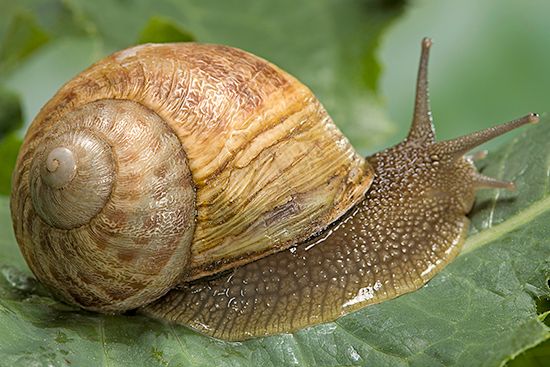
- Mollusks: Many mollusks, such as snails and bivalves, secrete complex materials to build hard shells composed of calcium carbonate, which provide robust physical defense against predators. Additionally, many gastropods secrete slippery mucus from mantle extensions to deter predators, while some species use specialized glands to create structures like the operculum—a hardened plate used to seal the shell opening.1112
- Crustaceans: Certain larval crustaceans, such as those in the genus Squilla, develop elaborate, spiny armor during their juvenile stages, which serves as a protective mechanism against predation while they drift as plankton.13
- Cnidarians: While not building a “house” in the same sense as a larvacean, many gelatinous organisms like the Portuguese man-of-war utilize specialized gas bladders to maintain buoyancy and navigate the surface, often in conjunction with stinging cells (nematocysts) for defense and prey capture.13
Unlike the larvacean, which actively constructs and abandons its mucus house multiple times a day to filter-feed, these other organisms typically produce permanent or semi-permanent structures or chemical defenses to survive in their respective niches.11412
Sources
- larvacean — Encyclopædia Britannica
- crustacean - Reproduction and life cycles — Encyclopædia Britannica
- malacostracan - Food and feeding — Encyclopædia Britannica
- tunicate — Encyclopædia Britannica
- Chordate - Evolution and paleontology — Encyclopædia Britannica
- tunicate - General features — Encyclopædia Britannica
- Chordate - Annotated classification — Encyclopædia Britannica
- tunicate - Importance — Encyclopædia Britannica
- Chordate - General features — Encyclopædia Britannica
- decarbonization - Natural carbon removal — Encyclopædia Britannica
- Marine ecosystem - Plankton — Encyclopædia Britannica
- tunicate - Food and feeding — Encyclopædia Britannica
- Integument - Mollusks — Encyclopædia Britannica
- mollusk - Features of defense — Encyclopædia Britannica
- tunicate - Size range and diversity of structure — Encyclopædia Britannica
Published on · 3 min read