Types of Spiderwebs
While all spiders produce silk, only about half of the known species build webs to capture prey. Weaving spiders utilize various silk types—some stronger…
What is Types of Spiderwebs?
While all spiders produce silk, only about half of the known species build webs to capture prey. Weaving spiders utilize various silk types—some stronger than steel by weight—to construct structures that serve as homes, nurseries, and traps.12
The four primary categories of spiderwebs include:
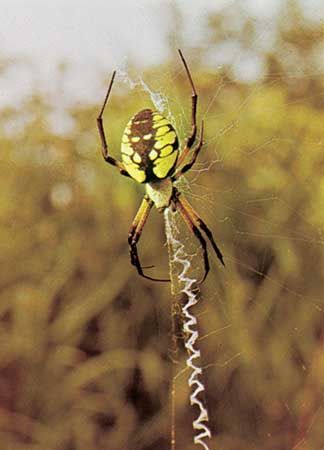
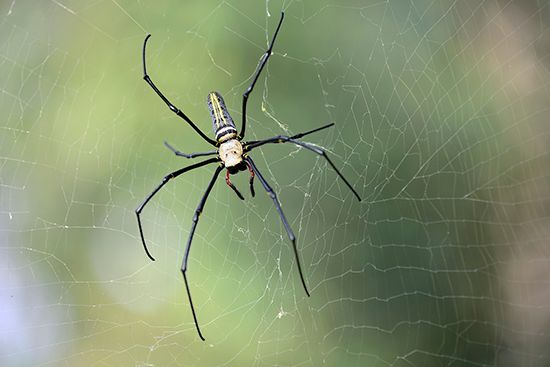
- Orb webs: Perhaps the most recognizable, these circular nets are highly efficient at covering large areas with minimal silk. They act as air filters to trap flying insects.12
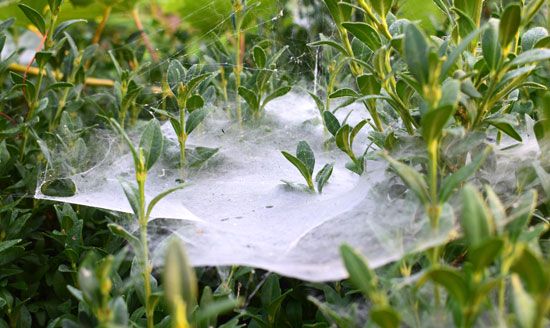
- Sheet webs: These consist of flat, dense mats of silk, often layered in vegetation with anchor threads designed to trip unsuspecting prey.12
- Tangle webs: Also known as cobwebs, these are irregular, three-dimensional structures built with sticky silk to ensnare insects.12
- Funnel webs: These provide both a retreat for the spider and a snare at the entrance of a tunnel.1
Beyond these, some species exhibit specialized behaviors, such as net-casting spiders that throw webs over prey, or social spiders that maintain large communal webs.2
How do spiders avoid getting stuck in their own webs?
The precise mechanisms that allow spiders to avoid becoming entangled in their own webs are not yet fully understood by scientists. While it is clear that spiders navigate their webs with remarkable agility, the exact biological or chemical strategies they employ to prevent sticking to their own traps remain a subject of ongoing research.5
What is known is that spiders are highly specialized for their environment. During the construction of an orb web, for example, the spider first creates a framework of non-sticky, dry silk to serve as a structural foundation. Only after this framework is established does the spider add the sticky, ensnaring silk. Furthermore, web-building spiders possess a third claw on their feet, which differs from the two-clawed structure found in many non-web-building species, potentially aiding in their movement across the silk.256
What makes spider silk stronger than steel?
Spider silk is a remarkable biological material primarily composed of proteins known as fibroin. Its extraordinary strength—often cited as being stronger than steel by weight—is a result of its unique molecular structure and the specialized way it is produced.81
The silk is synthesized within various glands in the spider’s abdomen and forced through spinnerets. As the liquid protein emerges, it undergoes a transformation into a solid thread, likely triggered by tension forces or chemical changes as it passes through the spigot. This process creates strands of uniform diameter that possess both high tensile strength and significant elasticity, allowing the material to absorb the energy of thrashing prey and withstand environmental stressors like wind without breaking.81
Spiders can produce up to seven different types of silk, each tailored for specific functions—such as draglines for structural support or sticky threads for trapping prey—by varying the protein composition and production method.81
How do spiders use vibrations to detect prey in their webs?
Spiders utilize their webs as sophisticated sensory extensions to detect and locate prey through the transmission of vibrations. When an insect becomes ensnared, it creates disturbances in the silk filaments that the spider interprets to determine the nature and location of the potential meal.1011
Spiders employ several methods to monitor these signals:
- Direct Monitoring: Many web-building spiders remain at the center of their web, known as the hub, where they sense tensions or vibrations directly through the radial spokes.12
- Signal Threads: Some species attach a specialized signal thread that runs from the hub to a nearby retreat, such as a leaf. This allows the spider to remain hidden while still detecting vibrations caused by trapped prey.12
- Vibrational Discrimination: Spiders can distinguish between different types of stimuli. For instance, they may ignore or cut away inanimate objects like pebbles, but react immediately to the specific frequency of a buzzing insect. Research indicates that house spiders can discriminate between different pitches, responding most aggressively to frequencies between 400 and 700 hertz.10
These vibrations are detected by specialized sensory organs, including trichobothria—long, fine hairs on the legs—and lyriform organs, which act as highly sensitive velocity-type ears capable of sensing mechanical stresses on the spider’s cuticle.1314
Sources
- Types of Spiderwebs — Encyclopædia Britannica
- spider - Spiderwebs — Encyclopædia Britannica
- cobweb — Merriam-Webster
- webs — Merriam-Webster
- How do spiders make circular webs? — Encyclopædia Britannica
- arachnid - Locomotion — Encyclopædia Britannica
- spider - External features — Encyclopædia Britannica
- spider - Silk — Encyclopædia Britannica
- sericulture — Encyclopædia Britannica
- sound reception - Behavioral evidence — Encyclopædia Britannica
- sound reception - Anatomical evidence — Encyclopædia Britannica
- spider - Nervous system and senses — Encyclopædia Britannica
- Animal communication - Signal production — Encyclopædia Britannica
- purseweb spider: Top Questions — Encyclopædia Britannica
Published on · 3 min read