Wall Creeper
The wall creeper (Tichodroma muraria) is a distinctive bird native to the mountainous regions spanning from southern Europe to central Asia. As the largest…
What is Wall creeper?
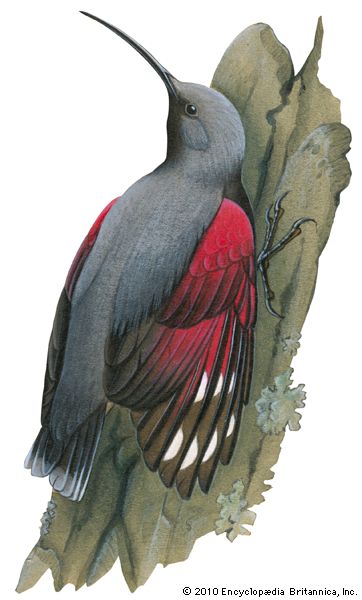
The wall creeper (Tichodroma muraria) is a distinctive bird native to the mountainous regions spanning from southern Europe to central Asia. As the largest member of the Sittidae family, it measures approximately 17 cm (6 1/2 inches) in length.1
The bird is characterized by its mostly gray plumage, broad, rounded black wings featuring central red patches, and a long, thin, downcurved bill. It is uniquely adapted for life on vertical surfaces; when searching for insects on cliffs, it ascends in a jerky motion while frequently flicking its wings. During the winter months, these birds may migrate to lower elevations, where they are occasionally observed climbing the walls of buildings in towns.12
How does the wallcreeper use its bill to find food?
The wallcreeper (Tichodroma muraria) possesses a long, thin, and downcurved bill that is specifically adapted for its insectivorous diet. While the bird searches for food on vertical cliff faces, it uses this specialized bill to probe into crevices and cracks to extract insects.12
This probing behavior is a functional characteristic of its bill type, which allows the bird to exploit narrow spaces that are inaccessible to other species. As it moves across rock surfaces in a jerky, upward motion, the wallcreeper relies on this slender, curved tool to efficiently secure its prey.21
What makes the wallcreeper’s wing coloring unique?
The wallcreeper’s wing coloring is unique due to its striking, high-contrast pattern. While the bird is primarily gray, it features broad, rounded black wings that are punctuated by vivid, central red or crimson patches.12
This coloration is particularly noticeable when the bird is in motion. As it ascends vertical cliff faces in its characteristic jerky, climbing style, it frequently flicks its wings, which causes these bright red patches to flash against the otherwise muted gray and black plumage.1
How do mountain birds adapt to living on steep cliffs?
Mountain birds have evolved specialized physiological and behavioral adaptations to thrive in high-altitude, steep-terrain environments. To navigate vertical cliff faces, species like the wallcreeper utilize a distinct, jerky climbing motion to ascend rock surfaces while searching for food in narrow crevices. Other climbing birds often rely on strong, clawed feet to cling to surfaces, sometimes bracing themselves with stiffened tail feathers for stability.14
Physiologically, birds that inhabit or traverse high mountain ranges possess highly efficient respiratory systems that allow them to extract sufficient oxygen from the thin, high-altitude air oxygen from the thin, high-altitude air. Many are also lightweight, featuring pneumatic bones that facilitate soaring. Some species, such as the bar-headed goose, can further optimize energy by reducing their metabolic rate in response to limited oxygen availability. Additionally, soaring birds utilize thermal updrafts and broad wings with slotted tips to gain elevation and navigate mountain ranges with minimal energy expenditure.5
Sources
- Wall creeper — Encyclopædia Britannica
- wall creeper — Merriam-Webster
- Passeriform - Bill — Encyclopædia Britannica
- Locomotion - Climbing birds and mammals — Encyclopædia Britannica
- How high do birds fly? — Encyclopædia Britannica
Published on · 2 min read