What’s the Difference Between Asian and African Elephants?
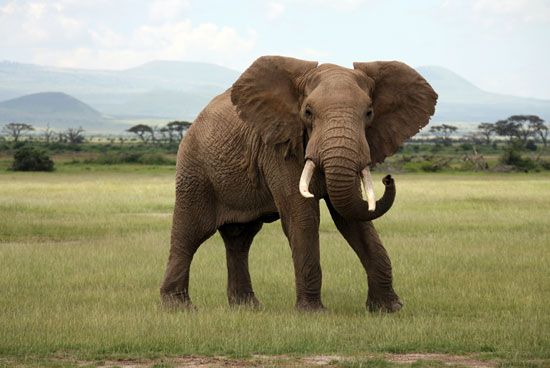
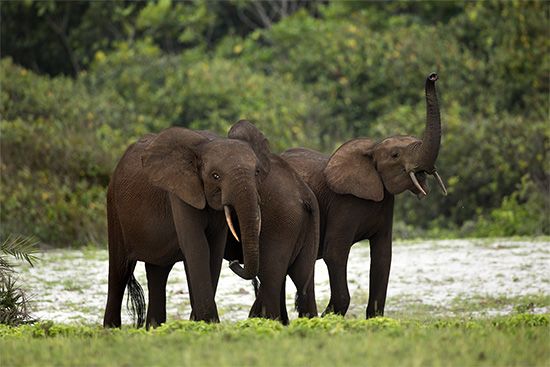
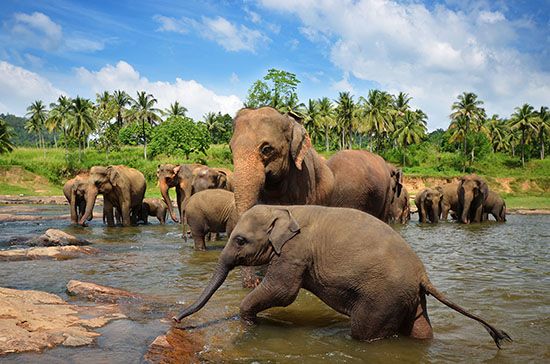
While it is common to refer to two types of elephants, scientists now recognize three distinct species: the African bush elephant, the African forest…
What’s the Difference Between Asian and African Elephants?
While it is common to refer to two types of elephants, scientists now recognize three distinct species: the African bush elephant, the African forest elephant, and the Asian elephant.12
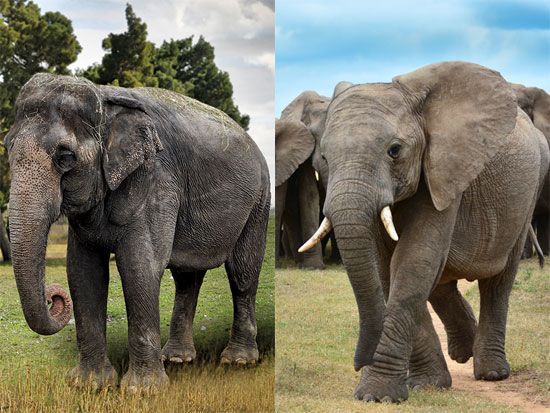
You can easily differentiate these animals by several key physical characteristics:
- Ears: African elephants have much larger ears shaped like the continent of Africa to help dissipate heat. Asian elephants have smaller, rounded ears.12
- Head Shape: African elephants have a rounded head, whereas Asian elephants possess a distinctive twin-domed head with a central divot.12
- Trunk: The tip of the trunk features flaplike projections used for grasping. Asian elephants have one projection, while African elephants have two.32
- Tusks: Both male and female African elephants can grow tusks. In contrast, only male Asian elephants can grow them, though not all do.12
Additionally, African elephants are generally larger than their Asian counterparts. While they share similar matriarchal social structures, African elephants tend to travel in larger, more rigid groups.12
What is the purpose of the ‘musth’ condition in male elephants?
The “musth” condition is a periodic state in male elephants characterized by a significant rise in testosterone levels and erratic, aggressive behavior.45
The primary purpose of this state is to establish a reproductive hierarchy. During musth, a male elephant’s physical state is typically at its peak, allowing him to outrank non-musth males and secure breeding opportunities. Because elephants are polygynous, this period of heightened aggression and dominance is essential for competing with other males to mate with females.45
During this time, elephants secrete a fluid called temporin from glands located between the eye and ear, which differs in viscosity from the fluid secreted when they are not in musth. Other elephants can detect the hormonal changes associated with musth through their keen sense of smell, using the Jacobson’s organ to analyze chemical cues from the air, urine, or feces.4
How do elephants use their trunks for communication and survival?
The elephant trunk, or proboscis, is a highly versatile organ that functions as a critical tool for both survival and communication. Anatomically, it is a fusion of the nose and upper lip, containing nearly 150,000 muscle fascicles that provide immense strength and fine motor control.6
Survival Functions
- Feeding and Hydration: Elephants use their trunks to grasp vegetation, such as grasses and fruits, and place them into their mouths. They also use the trunk to suck up as much as 10 liters of water, which is then squirted into the mouth for drinking or sprayed onto their bodies for cooling and protection against the sun and insects.768
- Sensory Perception: The trunk acts as an “olfactory periscope,” allowing elephants to swivel and sniff the air to detect danger or locate resources. Specialized whiskers on the trunk provide tactile feedback, helping the elephant understand the size, location, and fragility of objects it touches.76
- Tool Use: Elephants use their trunks to hold branches for scratching or to wield objects in threat displays.6
Communication
- Vocalization: By modifying nostril size, elephants produce a wide range of sounds, from low-frequency growls to high-pitched trumpets. They also use a pharyngeal pouch as a resonating chamber to emit infrasonic calls that can travel through the air and ground over long distances.78
- Social Interaction: Trunks are used for tactile communication, such as touching faces or intertwining trunks—a “trunk-shake” that serves as a greeting or a way to assess strength.6
What are the primary causes of the decline in wild elephant populations?
Wild elephant populations are currently facing significant threats that have led to their classification as endangered or critically endangered species by the International Union for Conservation of Nature and Natural Resources. The primary drivers of this decline include:
- Poaching: The illegal trade in ivory remains a leading cause of mortality. Poachers specifically target elephants for their tusks, a practice that has historically caused massive population crashes, such as the reduction of African elephant numbers by more than half between 1979 and 1989.9103
- Habitat Loss and Fragmentation: The conversion of natural environments into land for agriculture, mining, and logging has severely restricted the range of wild elephants. This loss of habitat forces populations into smaller, isolated areas.9103
- Human-Elephant Conflict: As natural habitats shrink, elephants increasingly encounter human settlements. Conflicts often arise when elephants consume or damage crops, leading to retaliatory actions that result in the deaths of both elephants and people.93
- Infrastructure Hazards: In some regions, Asian elephants face additional risks, such as fatal collisions with moving trains. collisions with moving trains.3
Sources
- What’s the Difference Between Asian and African Elephants? — Encyclopædia Britannica
- Asian elephant: Top Questions — Encyclopædia Britannica
- Asian elephant — Encyclopædia Britannica
- musth — Merriam-Webster
- elephant - Reproduction and life cycle — Encyclopædia Britannica
- What are elephant trunks used for? — Encyclopædia Britannica
- elephant - The trunk (proboscis) — Encyclopædia Britannica
- elephant - Sound production and water storage — Encyclopædia Britannica
- African forest elephant — Encyclopædia Britannica
- elephant - Conservation — Encyclopædia Britannica
Published on · 3 min read