Why Are Cicadas So Noisy?
The loud, characteristic buzzing of cicadas is produced exclusively by males to establish territory, attract females, and potentially deter predators.
Why are cicadas so noisy?
The loud, characteristic buzzing of cicadas is produced exclusively by males to establish territory, attract females, and potentially deter predators.12
How They Produce Sound
Cicadas possess a specialized, highly efficient sound-producing mechanism called the tymbal organ. Located on the first abdominal segment, this organ consists of a pair of circular, ridged membranes.12
- Mechanism: Large muscles attached to these membranes contract rapidly—between 120 and 480 times per second—causing the membranes to bend and produce a series of sharp clicks.12
- Amplification: Because the muscles move so quickly, the human ear perceives the sound as a continuous, high-pitched buzz. This sound is further amplified by large, internal air sacs that act as resonance chambers, matching the vibration frequency of the tymbals.12
Each of the roughly 3,000 species has a distinct song, which is often used by researchers to identify specific populations, including 13-year and 17-year periodical cicadas.12
What is the difference between annual and periodical cicadas?
The primary difference between annual and periodical cicadas lies in the length and synchronization of their life cycles.
Periodical Cicadas
- Life Cycle: These insects (genus Magicicada) have highly synchronized, long-term life cycles of either 13 years or 17 years.45
- Emergence: They emerge aboveground en masse only at the end of these specific intervals. Because they appear in such overwhelming numbers, this is believed to be an evolutionary strategy to satiate predators, ensuring enough individuals survive to mate.4
- Appearance: They are generally smaller than annual species and are characterized by red eyes and black thoraxes.4
Annual Cicadas
- Life Cycle: Despite the name, annual cicadas do not have a one-year life cycle; their development typically spans 2 to 5 years.65
- Emergence: They are called “annual” because their populations are staggered, meaning some individuals reach maturity and emerge every summer.65
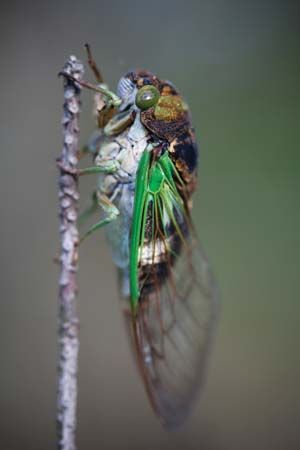
- Appearance: These species, such as the dog-day cicadas, are typically larger than periodical cicadas and are generally green in color.45
How do cicadas survive underground for so many years?
Periodical cicadas spend their long subterranean lives as active, wingless nymphs rather than in hibernation. Their survival underground is supported by several key behaviors and biological adaptations:4
- Feeding: Nymphs use strawlike mouthparts to feed on the xylem sap of tree and shrub roots. They typically reside at depths of 5 to 61 cm (2 to 24 inches), moving deeper as they age to access larger roots and shifting closer to the surface as their emergence date approaches.75
- Metabolic Efficiency: Because they feed on sap—a nutrient-poor food source—their metabolic rate is very low, which allows them to survive for over a decade without exhausting their food supply or killing the host trees.57
- Environmental Monitoring: While the exact mechanism remains unproven, scientists believe nymphs may track the passage of time by monitoring seasonal changes in the composition of the tree sap they consume, effectively using the trees’ own cycles as a molecular clock.47
- Emergence Cues: Once their 13 or 17-year cycle is complete, the nymphs wait for the soil temperature to reach approximately 64 °F (18 °C) before tunneling to the surface to molt into their adult form.4
Do other insects use sound to communicate like cicadas do?
Yes, many other insects use sound to communicate, though they often employ different mechanisms than the tymbal organ found in cicadas.13
Stridulation
The most common method of sound production among insects is stridulation, which involves rubbing two body parts together to create vibrations. This technique is widespread among several groups:9
- Crickets and Katydids: These insects possess a specialized “file” and “scraper” on their wings. By shuffling their wings together, they produce rhythmic chirps used for mating and territorial defense.10119
- Grasshoppers: Many species produce sound by rubbing their hind legs against their folded front wings, which are equipped with serrated ridges.10
- Beetles: Some beetles also utilize stridulatory mechanisms to produce sound.12
Other Sound-Producing Insects
Beyond the well-known stridulators, other insects produce sound through various means:
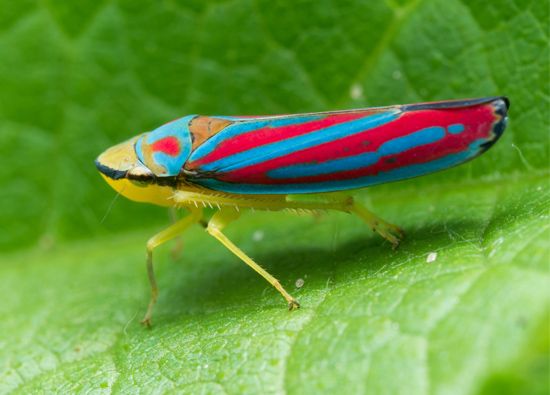
- Auchenorrhyncha: Groups such as leafhoppers, treehoppers, and planthoppers also possess tymbal organs similar to those of cicadas. While their songs are often too quiet for the human ear to detect without amplification, they use these sounds for complex social communication.3
- Aphids: A few species have been observed producing rhythmic, synchronous sounds by scraping tibial hairs against ridges on their abdomens.3
While cicadas are unique for the volume and complexity of their tymbal-based choruses, sound remains a vital tool for many insects to navigate their environments, attract mates, and establish territory.11011
Sources
- Why are cicadas so noisy? — Encyclopædia Britannica
- tymbal — Merriam-Webster
- homopteran - Sound production — Encyclopædia Britannica
- homopteran - Periodical cicada — Encyclopædia Britannica
- periodical cicada — Encyclopædia Britannica
- cicada — Encyclopædia Britannica
- Why Do Some Cicadas Appear Only Every 17 Years? — Encyclopædia Britannica
- Did you know? — Merriam-Webster
- Orthoptera - Sound production and hearing — Encyclopædia Britannica
- sound reception - Behavioral observations — Encyclopædia Britannica
- Animal communication - Signal production — Encyclopædia Britannica
- Did you know? — Merriam-Webster
Published on · 4 min read