Witteberg Series
The Witteberg series is the uppermost member of the Cape System of sedimentary rocks found in South Africa.
What is Witteberg series?
The Witteberg series is the uppermost member of the Cape System of sedimentary rocks found in South Africa.1
Composed of approximately 805 metres (2,640 feet) of sandstones and shales, the series represents a transitional period between the Late Devonian and Early Carboniferous epochs. These rocks are notable for their prominent fossil plant life, which includes various genera such as Sigillaria, Lepidodendron, Cyclostigma, and the psilophyte Dutoitia.1
What are the other members of the Cape Supergroup?
The Cape Supergroup (formerly known as the Cape System) is a major sequence of sedimentary rocks in South Africa. In addition to the Witteberg Group (formerly the Witteberg series), the supergroup consists of two other primary units:
- Table Mountain Group: The oldest and lowest member, primarily composed of resistant quartzites and sandstones that form the iconic mountains of the Cape Peninsula.
- Bokkeveld Group: The middle member, which consists largely of shales and siltstones. Unlike the other groups, the Bokkeveld is well-known for its rich marine invertebrate fossil record, including trilobites and brachiopods.
Together, these three groups represent a vast period of deposition spanning from the Ordovician to the Carboniferous periods.
How do fossils help scientists date rock layers?
Fossils are essential tools for scientists to determine the relative age of rock layers and correlate geological formations across different geographic locations. This process relies on several key principles:
The Law of Faunal Succession
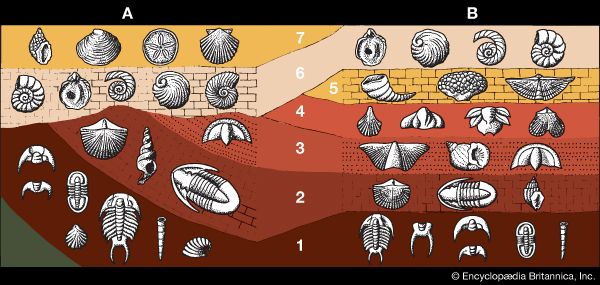
The law of faunal succession is the fundamental observation that fossilized plants and animals appear in the rock record in a predictable, non-repetitive order over time. Because different species evolved and went extinct at specific intervals, the unique assemblage of fossils found within a rock layer acts as a “time stamp,” allowing geologists to identify the specific period in which that rock was formed.23
Index Fossils
To date rocks effectively, scientists often look for index fossils. An ideal index fossil is:
- Distinctive: Easily recognizable to avoid misidentification.43
- Abundant: Found in high enough numbers to be easily discovered.43
- Widespread: Distributed across large geographic areas.43
- Short-lived: Existed for a relatively brief span of geologic time, ensuring that the rock layer containing it can be dated to a precise interval.43
By identifying these fossils, geologists can correlate separated rock outcrops, effectively piecing together the history of the Earth. While fossils provide the relative order of events, scientists often calibrate this “fossil time scale” using absolute dating techniques, such as measuring radioactive isotopes, to assign specific numerical ages to these layers.35
What is the difference between the Devonian and Carboniferous periods?
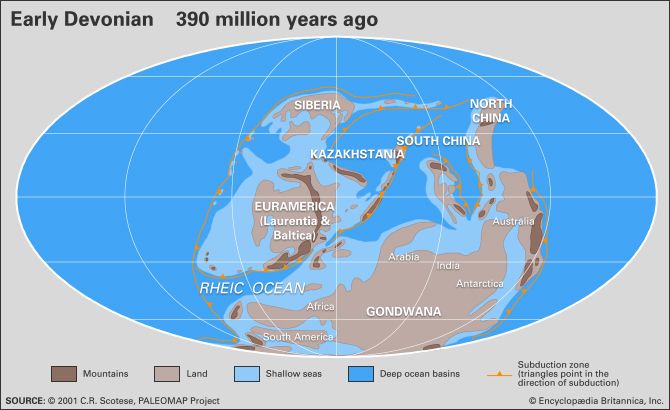
The Devonian Period (about 419.2 to 358.9 million years ago) and the Carboniferous Period (about 358.9 to 298.9 million years ago) are consecutive intervals of the Paleozoic Era, each defined by distinct biological and environmental characteristics.67
Biological Differences
- Devonian (“Age of Fishes”): This period is famous for the diversification of fish in the seas and the first appearance of ammonites and four-legged amphibians.87
- Carboniferous: Life on land expanded significantly. While amphibians continued to thrive, they were joined by a great variety of insects—some reaching massive sizes—and the first reptiles appeared in the late portion of the period. Marine life saw a decline in reef-building organisms, with sea bottoms dominated by crinoids.910
Environmental and Geological Differences
- Climate and Coal: The Devonian was generally warm and equitable with little evidence of polar ice. In contrast, the Carboniferous is named for its extensive coal-bearing strata, formed in vast swamps that flourished during the period. While the Northern Hemisphere experienced cyclical sedimentary deposits, the Southern Hemisphere underwent widespread continental glaciations.81169
- Extinctions: The Devonian was marked by a series of mass extinction events that eliminated 70 to 80 percent of animal species, often linked to low-oxygen conditions in the oceans.812
Sources
- Witteberg series — Encyclopædia Britannica
- index fossil — Encyclopædia Britannica
- law of faunal succession — Encyclopædia Britannica
- dating - Principles and techniques — Encyclopædia Britannica
- dating - Distinctions between relative-age and absolute-age measurements — Encyclopædia Britannica
- A Journey Through Time Since the Precambrian - Devonian Period: 419.2 million to about 359 million years ago — Encyclopædia Britannica
- Devonian Period - Paleoclimate — Encyclopædia Britannica
- Devonian extinctions — Encyclopædia Britannica
- Carboniferous Period - Distinctive features — Encyclopædia Britannica
- plant - Evolution of land plants from the Ordovician Period through the middle Devonian — Encyclopædia Britannica
- Carboniferous Period - Invertebrates — Encyclopædia Britannica
- Carboniferous Period — Encyclopædia Britannica
- Devonian Period — Encyclopædia Britannica
Published on · 3 min read