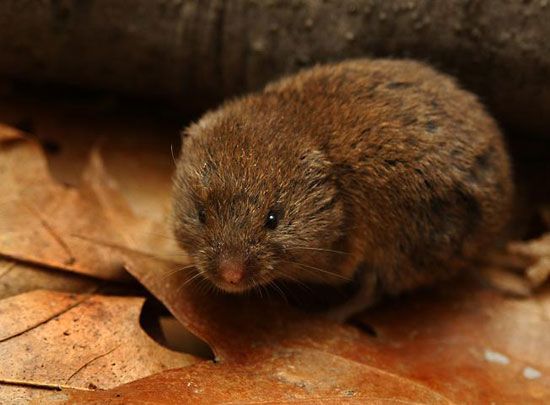
Woodland Vole
The woodland vole (Microtus pinetorum) is a small, burrowing rodent native to the eastern United States. Its diet is primarily herbivorous, consisting of…
What is the diet of woodland voles and how does it impact their ecosystem?
The woodland vole (Microtus pinetorum) is a small, burrowing rodent native to the eastern United States. Its diet is primarily herbivorous, consisting of grass stems and roots, fruit, seeds, and bark. Occasionally, these voles also consume fungi and insects.1
Regarding their impact on the ecosystem, woodland voles are specialized for a fossorial lifestyle, spending the majority of their time in elaborate burrow networks constructed just beneath thick leaf litter. By loosening soil with their heads, teeth, and forefeet to create these tunnels, they contribute to soil aeration and turnover within their forest habitats. Furthermore, because they inhabit areas such as orchards and cultivated fields, they are sometimes considered agricultural pests due to their feeding habits on plant roots and bark.12
What role do woodland voles play in seed dispersal and plant growth?
The provided search results do not contain information regarding the specific role of woodland voles in seed dispersal or their direct impact on plant growth. While the articles note that woodland voles consume seeds, roots, and stems as part of their diet and contribute to soil aeration through their burrowing activities, they do not explicitly detail the ecological consequences of these behaviors for plant propagation or growth cycles.12
How do woodland voles differ from other small rodents like mice or shrews?
Woodland voles (Microtus pinetorum) are distinct from other small rodents and insectivores like mice and shrews in their biological classification, physical adaptations, and dietary habits.
Biological Classification
Woodland voles are rodents belonging to the family Muridae and the subfamily Arvicolinae, which also includes lemmings and muskrats. In contrast, shrews belong to the family Soricidae and are classified as insectivores, a group distinct from rodents.123
Physical and Behavioral Differences
- Adaptations: Woodland voles are highly specialized for a fossorial (burrowing) lifestyle, featuring a slender, cylindrical body, strong feet, and large front claws for digging. While they resemble short-tailed shrews in body form, shrews possess a mobile, pointed snout and reddish-tipped teeth.123
- Sensory Traits: Woodland voles have very small eyes and ears hidden in dense fur, relying on prominent whiskers to navigate underground. Shrews also have small eyes, but they utilize a repertoire of squeaks and clicks for echolocation and possess scent glands that produce a foul odor.123
- Diet: Woodland voles are primarily herbivorous, feeding on grass roots, stems, seeds, bark, and occasionally fungi or insects. Shrews are voracious predators that consume invertebrates and small vertebrates, sometimes using neurotoxins to immobilize prey.13
How do woodland voles adapt to seasonal changes in their environment?
Woodland voles (Microtus pinetorum) are active year-round and do not hibernate, unlike many other small mammals that enter a state of dormancy to survive winter food shortages. Instead, they rely on specific behavioral and physical adaptations to cope with seasonal changes in their environment.215
Seasonal Adaptations
- Physical Changes: Woodland voles undergo a seasonal change in their appearance; their soft, silky fur becomes noticeably darker during the winter months compared to their summer coat.1
- Subsurface Activity: To avoid harsh surface conditions, these rodents spend the majority of their time in elaborate, subsurface burrow systems constructed just below a layer of thick leaf litter. These burrows provide a stable microclimate, protecting them from temperature extremes.21
- Nesting: They build globular nests made of dead grass and leaves, which are typically situated under logs or deep within their burrow networks, offering insulation against the cold.1
- Foraging: Because they remain active throughout the year, they continue to forage for grass roots, stems, seeds, and bark, occasionally supplementing their diet with fungi or insects found within their habitat.21
Sources
- woodland vole — Encyclopædia Britannica
- vole — Encyclopædia Britannica
- shrew — Encyclopædia Britannica
- short-tailed shrew — Encyclopædia Britannica
- Why Do Some Animals Hibernate? — Encyclopædia Britannica
- Dormancy - Reproductive cycles — Encyclopædia Britannica
Published on · 3 min read