Aleutian Basin
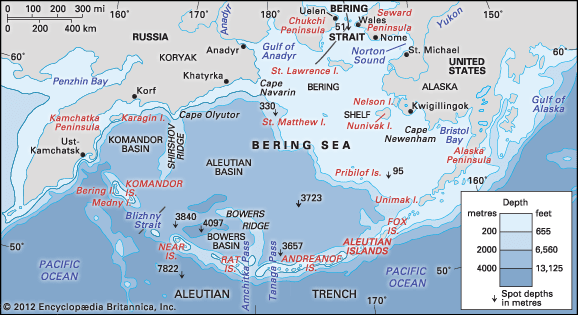
The Aleutian Basin is a submarine depression that forms the floor of the southwestern section of the Bering Sea in the Pacific Ocean.
What is Aleutian Basin?
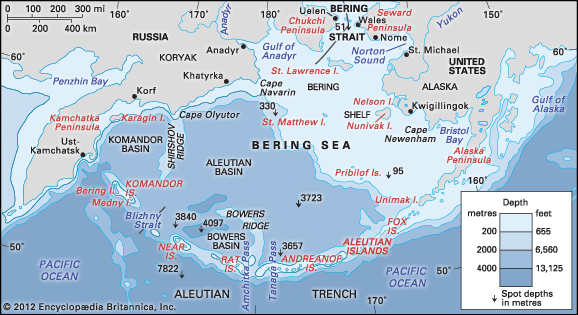
The Aleutian Basin is a submarine depression that forms the floor of the southwestern section of the Bering Sea in the Pacific Ocean.1
Spanning approximately 1,100 miles (1,800 km) north-south and 600 miles (1,000 km) east-west, the basin reaches depths exceeding 9,800 feet (3,000 meters). Its geography is defined by its surroundings: it meets Siberia and the Kamchatka Peninsula to the west, the continental shelf of North America off southwestern Alaska to the northeast, and the Aleutian Islands to the south. The basin features a thick basaltic crust and is separated from the North Pacific floor by the volcanic Aleutian Arc.1
What is the Ring of Fire and how does it relate to the Aleutian Islands?
The Ring of Fire is a massive, horseshoe-shaped belt that fringes the Pacific Ocean basin, characterized by intense seismic activity and a high concentration of volcanoes and tectonic plate boundaries. It is the world’s most seismically active region, accounting for approximately 75 percent of the Earth’s volcanoes and the majority of its strongest earthquakes.34
The Aleutian Islands are an integral part of this belt. They form an island arc—a chain of volcanic islands created at a subduction zone where one tectonic plate is forced beneath another. In this region, the subduction of an oceanic plate into the asthenosphere generates magma that rises to form the volcanic Aleutian Arc. This arc serves as a critical geological boundary, separating the Aleutian Basin from the floor of the North Pacific Ocean.456
How do volcanic arcs like the Aleutian Arc form in the ocean?
Volcanic arcs, such as the Aleutian Arc, form at convergent margins where two lithospheric plates collide. When a plate carrying dense oceanic crust meets another plate, it buckles and is forced downward into the mantle in a process known as subduction.89
As the descending slab reaches depths of approximately 100 km (60 miles), increasing heat drives off volatile components, which triggers partial melting in the overlying mantle wedge. This process generates magma that rises through the overriding plate to form a chain of volcanoes.10
When this convergence occurs between two oceanic plates, the resulting volcanic chain forms an island arc—a curved line of islands parallel to a deep-sea trench created by the subducting plate. These regions are characterized by intense seismic activity, with deep-focus earthquakes occurring along the Wadati-Benioff zone as the slab descends.8109
We could dive deeper into the differences between oceanic-oceanic convergence and oceanic-continental convergence, or explore how these processes contribute to the formation of metamorphic rocks like blueschists.
What are some unique animals that live in the Bering Sea ecosystem?
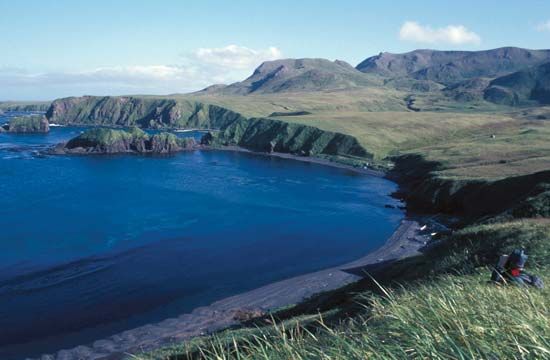
The Bering Sea ecosystem supports a diverse array of unique wildlife, particularly around its islands, which serve as critical refuges in an Arctic maritime environment.
Key animals found in this ecosystem include:
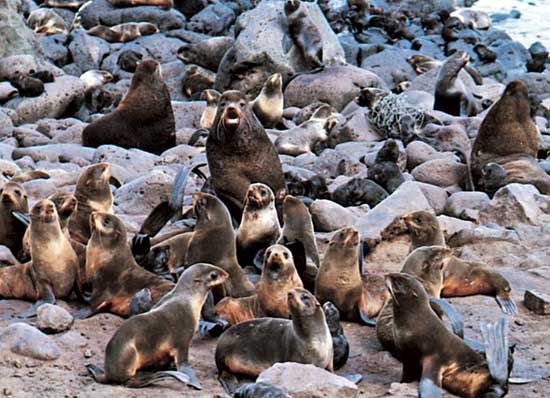
- Marine Mammals: The islands are vital breeding grounds for fur seals and sea otters. The northern regions are also inhabited by walrus and sea lions.1112
- Whales: Several species, most notably gray whales, migrate to the waters of the Bering Sea to feed during the summer months.12
- Land Mammals: Nunivak Island is home to a protected group of musk oxen.11
- Fish: The sea hosts more than 300 species of fish, including commercially significant populations of salmon, herring, cod, flounder, halibut, and pollack.12
The high biological productivity of the region is driven by the upwelling of nutrient-rich waters, which supports a complex food web starting with diatom algae and small crustaceans.1213
Sources
- Aleutian Basin — Encyclopædia Britannica
- Aleutian Islands — Encyclopædia Britannica
- plate tectonics: Top Questions — Encyclopædia Britannica
- Ring of Fire — Merriam-Webster
- Ring of Fire — Encyclopædia Britannica
- volcano - Subduction volcanoes — Encyclopædia Britannica
- volcanism — Encyclopædia Britannica
- island arc — Encyclopædia Britannica
- plate tectonics - Island arcs — Encyclopædia Britannica
- plate tectonics - Subduction zones — Encyclopædia Britannica
- Alaska - Plant and animal life — Encyclopædia Britannica
- Bering Sea and Strait - Biological and mineral resources — Encyclopædia Britannica
- Bering Sea and Strait - Hydrology — Encyclopædia Britannica
- Barents Sea — Encyclopædia Britannica
Published on · 3 min read