Gray Whale
The gray whale (Eschrichtius robustus) is a slender baleen whale known for its unique appearance, often covered in external parasites that make it look like…
What is gray whale?
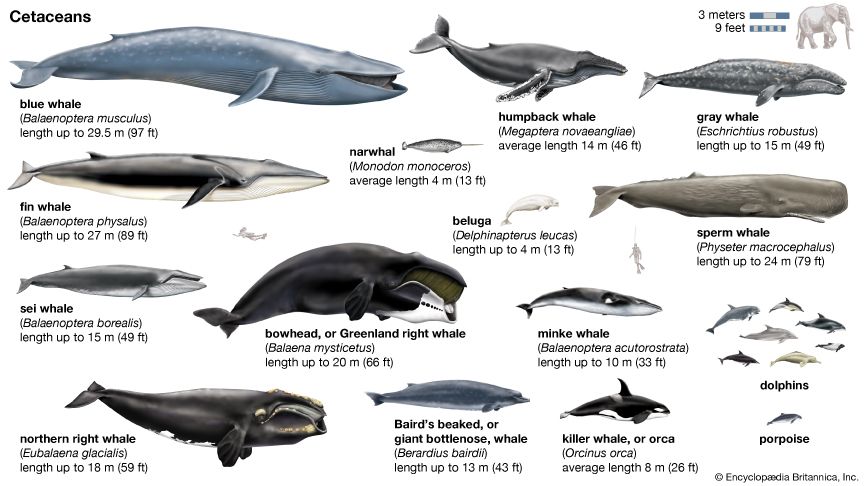
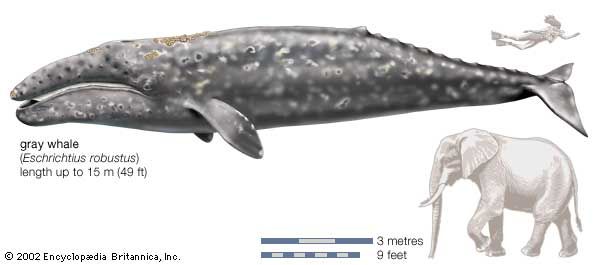
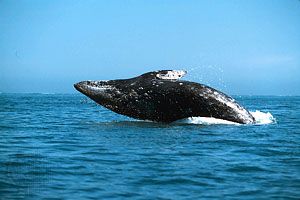
The gray whale (Eschrichtius robustus) is a slender baleen whale known for its unique appearance, often covered in external parasites that make it look like a barnacle-encrusted rock. Reaching lengths of up to 15 meters (49 feet), these cetaceans are gray or black with white mottling and possess a row of low humps on their backs instead of a dorsal fin.1
Unlike most baleen whales that filter plankton from the water column, the gray whale is a bottom-feeder that scoops up mud to strain out shrimp and other bottom-dwelling creatures. They are famous for one of the longest migrations of any mammal, with the California population traveling roughly 5,000 km between their Arctic summer feeding grounds and their winter breeding lagoons in Baja California.23
Once hunted nearly to extinction, the species has seen a significant recovery in the eastern Pacific, though the western Pacific population remains critically endangered.1
How do gray whales use baleen to feed on the ocean floor?
The gray whale (Eschrichtius robustus) employs a unique feeding strategy that distinguishes it from most other baleen whales. While many baleen species are filter feeders that skim or gulp plankton from the water column, the gray whale is primarily a bottom-feeder.43
To feed, the gray whale scoops up mouthfuls of mud and sediment from the ocean floor. This material contains various bottom-dwelling creatures, such as shrimp and other small organisms. Once the whale has taken in this mixture, it uses its baleen plates—long, comb-like structures made of keratin that hang from the roof of the mouth—to strain the sediment. By forcing the water and mud out through the bristly edges of the baleen plates, the whale effectively traps its prey inside, allowing it to swallow the food while expelling the unwanted debris.456
What are the main differences between baleen whales and toothed whales?
The primary differences between baleen whales (mysticetes) and toothed whales (odontocetes) involve their feeding anatomy, hunting strategies, and methods of vocalization.
Feeding and Anatomy
- Baleen Whales: These whales lack teeth. Instead, they possess baleen plates—comb-like structures made of keratin—that hang from the upper jaw. They are filter feeders that strain small prey like plankton, krill, and small fish from large quantities of water.94
- Toothed Whales: These whales possess simple, conical teeth used for grasping individual prey, such as squid or fish, which they swallow whole. They do not chew their food.94
Vocalization and Communication
- Baleen Whales: They use their larynx to produce low-frequency songs by recycling air. These songs can travel thousands of kilometers and often change over time.10
- Toothed Whales: They communicate and navigate using high-pitched clicks produced by passing air through nasal passages. These sounds are often used for echolocation, with the sound waves focused through a fatty organ on the forehead called the melon.10
Why do gray whales migrate such long distances every year?
Gray whales undertake one of the longest annual migrations of any mammal, traveling approximately 5,000 kilometers (about 3,000 miles) each way between their summer and winter grounds.11
This seasonal movement is primarily driven by the need to balance feeding and reproductive requirements:
- Summer Feeding: During the summer months, gray whales inhabit high-latitude waters, such as the Bering and Chukchi seas in the Arctic. These regions offer an abundant food supply, allowing the whales to build up the energy reserves necessary for their long journey and reproductive cycle.11
- Winter Breeding: In the fall, the whales migrate toward the Equator to reach warmer, protected lagoons, such as those off the coast of Baja California. These areas serve as critical environments for breeding and calving.11
Like other large whales, this migratory behavior is part of a broader life cycle that responds to environmental factors. While the specific physiological triggers for whale migration are less understood than those in birds, whales generally move to avoid unfavorable conditions, such as the food shortages and modified oceanographic conditions that occur in polar regions during the winter.2
Sources
- gray whale — Encyclopædia Britannica
- cetacean - Distribution and migration — Encyclopædia Britannica
- whale — Encyclopædia Britannica
- What do whales eat? — Encyclopædia Britannica
- baleen whale — Encyclopædia Britannica
- Filter feeding — Encyclopædia Britannica
- gray whale — Merriam-Webster
- cetacean - Feeding — Encyclopædia Britannica
- Do whales have teeth? — Encyclopædia Britannica
- whale vocalization — Encyclopædia Britannica
- Migration - Marine mammals — Encyclopædia Britannica
- Migration - Physiological stimulus of migration — Encyclopædia Britannica
Published on · 3 min read