Musk Ox
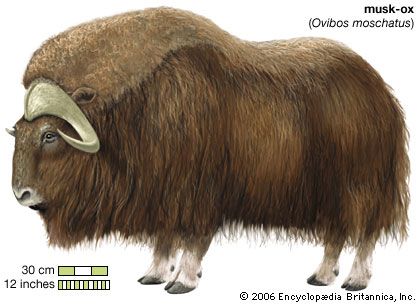
The musk ox (Ovibos moschatus) possesses several specialized adaptations that allow it to thrive in the extreme cold of the Arctic.
How have musk oxen adapted to extreme cold temperatures in the Arctic?
The musk ox (Ovibos moschatus) possesses several specialized adaptations that allow it to thrive in the extreme cold of the Arctic.
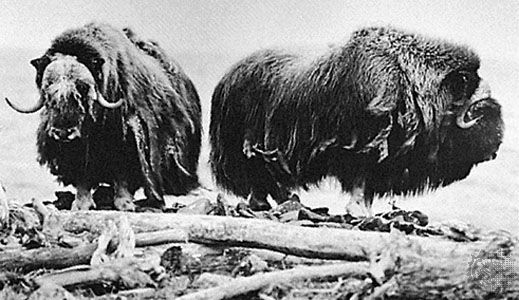
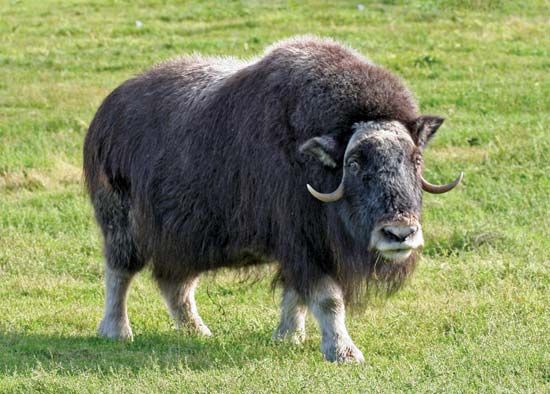
- Insulating Coat: Their primary defense against the cold is a two-layered coat. The outer layer consists of long, dark brown hair that reaches nearly to their feet, while underneath lies a dense, insulating wool known as qiviut. This undercoat is exceptionally warm and is shed during the summer months.1
- Energy Conservation: Musk oxen are highly adapted for conserving energy during harsh winter conditions. They store significant amounts of fat during the summer, which they utilize to supplement their diet when forage is scarce.1
- Reproductive Strategy: Female musk oxen utilize stored fat reserves to support lactation for calves born in late winter or early spring, before the snow has melted to reveal fresh vegetation.1
- Physical Build: Their stocky build, characterized by a large head, short neck, and short, stout legs, helps minimize heat loss in freezing environments.1
What is the diet of musk oxen, and how do they find food in their harsh habitat?
Musk oxen are herbivores that primarily feed on grasses, sedges, and willows. Because the Arctic environment offers limited resources, these animals have developed specific strategies to manage their nutritional needs throughout the year.1
During the brief Arctic summer, when vegetation is more abundant, musk oxen consume large amounts of food to build up significant fat reserves. These stored energy supplies are critical for their survival during the harsh winter months when forage is scarce and difficult to access.1
To cope with the limited availability of food in winter, musk oxen are highly adapted for energy conservation. While other herbivores may migrate out of the Arctic when forage quality declines, musk oxen remain in the region. They rely on their stored fat to supplement their meager winter diet and to support essential biological functions, such as lactation for calves born in late winter or early spring, before the snow has melted to reveal new plant growth.12
How have musk oxen been historically important to indigenous Arctic peoples?
Musk oxen have played a significant role in the lives of indigenous Arctic peoples, primarily as a valuable natural resource. Historically, these animals have been hunted for sustenance, though their unique defensive behavior—forming a protective circle against predators—unfortunately made them highly vulnerable to human hunters, leading to severe population depletion by the late 19th century.1
Beyond their use as a food source, musk oxen are prized for their qiviut, the dense, insulating wool found in their undercoat. This fiber is shed naturally during the summer months and is highly valued by Arctic craftsmen. Qiviut is exceptionally soft and warm, often compared to cashmere or guanaco, and is spun into a fine, high-quality yarn used to create traditional garments and textiles.14
What is the taxonomic classification of musk oxen, and how are they related to other bovine species?
The musk ox (Ovibos moschatus) is a shaggy-haired Arctic ruminant belonging to the family Bovidae within the order Artiodactyla.
Despite their name and a superficial physical resemblance to the ox, musk oxen are not closely related to cattle. Instead, they are classified within the bovid subfamily Caprinae, which also includes goats and sheep. Within this subfamily, they share a closer evolutionary relationship with the mountain goat, chamois, and serow than they do with other bovine species.1
Sources
- musk ox — Encyclopædia Britannica
- Tundra - Arctic mammals — Encyclopædia Britannica
- Polar ecosystem - Biological productivity — Encyclopædia Britannica
- musk ox — Merriam-Webster
- qiviut — Merriam-Webster
Published on · 3 min read