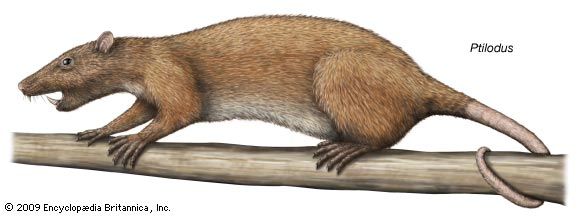
Ptilodus
Ptilodus is an extinct genus of mammals that lived during the Paleocene Epoch, approximately 65.5 to 55.8 million years ago, in what is now North America.
What is Ptilodus?
Ptilodus is an extinct genus of mammals that lived during the Paleocene Epoch, approximately 65.5 to 55.8 million years ago, in what is now North America.1
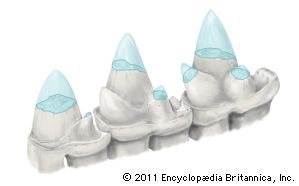
It belonged to the multituberculates, a successful group of small, rodentlike mammals that were dominant herbivores and granivores in terrestrial ecosystems for millions of years. Ptilodus possessed specialized dental features, including long, rodentlike incisors, bladelike shearing teeth marked with striations, and molars characterized by parallel rows of cusps. These features, combined with powerful chewing muscles attached to the lower jaw, allowed them to process plant material efficiently.12
While multituberculates were once the most common mammals, their exact evolutionary relationship to modern monotremes, marsupials, and placentals remains a subject of scientific debate.2
What are the main differences between multituberculates and modern rodents?
While multituberculates are often described as “rodentlike” due to their similar ecological roles as small herbivores and granivores, they are not ancestral to modern rodents or any other living mammals. Their superficial resemblance is a classic example of convergent evolution, where unrelated groups independently evolve similar traits to adapt to comparable environments.234
The primary differences include:
- Dental Structure: The defining feature of multituberculates is their unique molar construction, which features two or three longitudinal rows of cusps, sometimes totaling up to 30 cusps in advanced species. In contrast, modern rodents have a distinct dental arrangement adapted for gnawing.2
- Evolutionary Lineage: Multituberculates represent an extinct order that existed from the Jurassic Period to the early Eocene Epoch. Their exact relationship to modern monotremes, marsupials, and placentals remains a subject of scientific debate, with some researchers suggesting they branched off before the common ancestor of these groups emerged.2
- Specialized Anatomy: Multituberculates typically possessed a single pair of long lower incisors and large, bladelike shearing anterior lower premolars, which differ from the specific gnawing adaptations found in rodents.2
Why did multituberculates go extinct?
The extinction of multituberculates was part of a major episode of faunal turnover that occurred at the end of the Paleocene Epoch. During this period, many archaic groups were largely replaced by essentially modern mammalian groups, such as rodents, primates, and various ungulates.2
While the specific mechanisms of their decline are complex, this transition reflects the broader adaptive radiation of mammals during the early Eocene Epoch, as modern groups diversified and became established in terrestrial environments. Multituberculates, which had been the most common mammals for much of their history, ultimately disappeared as they were outcompeted or displaced by these emerging, more modern lineages.25
What other types of mammals lived during the Paleocene Epoch?
Following the extinction of the dinosaurs, the Paleocene Epoch (66 to 56 million years ago) was characterized by a rapid proliferation and diversification of mammals. While many of these forms were archaic or highly specialized, they laid the groundwork for modern mammalian groups.
Key groups of mammals present during this epoch included:
- Condylarths: These diverse, hoofed mammals were among the most important members of the Paleocene animal kingdom. They retained some insectivorous-carnivorous traits from their Cretaceous ancestors while evolving toward herbivorousness, and they are considered ancestral to later ungulates.
- Multituberculates: These archaic, herbivorous mammals were highly successful and common throughout the epoch, possessing teeth that functioned similarly to those of modern rodents.
- Marsupials: Opossum-like marsupials continued to thrive, particularly in regions like South America and Australia, where they developed diverse adaptive types.
- Primates: Becoming more abundant by the middle Paleocene, these early forms displayed dental anatomy intermediate between insectivores and lemurs.
- Creodonts: Appearing later in the epoch, these were primitive, catlike and doglike mammalian carnivores.
- Pantodonts: A widely distributed order of primitive, hoofed mammals that persisted from the Paleocene into the Oligocene.
- Early Modern Lineages: The late Paleocene saw the emergence of ancestral rodents and the earliest known hares, such as Eurymylus.
Sources
- Ptilodus — Encyclopædia Britannica
- multituberculate — Encyclopædia Britannica
- Multituberculata — Merriam-Webster
- mammal - Teeth — Encyclopædia Britannica
- Tertiary Period - The rise of mammals — Encyclopædia Britannica
- placental mammal — Encyclopædia Britannica
- Paleocene Epoch — Encyclopædia Britannica
- Paleocene-Eocene Thermal Maximum — Encyclopædia Britannica
- Condylarthra — Encyclopædia Britannica
- pantodont — Merriam-Webster
- Pantodonta — Merriam-Webster
- Cenozoic Era - Cenozoic life — Encyclopædia Britannica
- Condylarthra — Merriam-Webster
Published on · 3 min read